The EV transition isn't just about cars – the broader goal should be access to clean mobility for everyone
- Written by: Sita M. Syal, Assistant Professor of Mechanical Engineering, University of Michigan
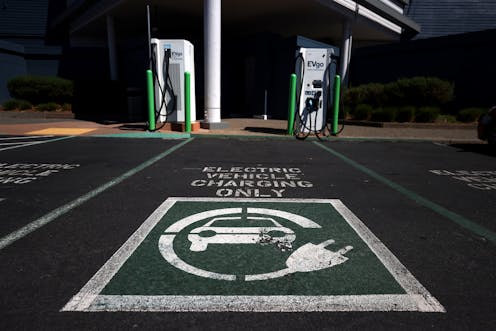
The race to decarbonize passenger cars and light-duty trucks in the U.S. is accelerating. Battery electric vehicles accounted for almost 6% of all new vehicle sales[1] in 2022, up from close to 3% in 2021, and demand is outstripping supply[2], even as manufacturers roll out new models and designs. The Biden administration is spending billions of dollars to build out EV charging networks[3] and providing incentives for purchasing new and used EVs.
This shift offers big economic and environmental benefits, but they’re not spread equitably. People who bear the most burdens in our current transportation systems often receive the fewest benefits, and are least able to change their situations.
I study the future of clean transportation and energy[4], and my research analyzes equity considerations[5] in the design of these systems. As my colleagues and I see it, an equitable transition will require thinking broadly about all transportation users and their needs – especially those who are currently being left behind.
Here are four issues that we believe should be front and center:
Banning gas-powered cars can have unintended consequences
California has banned sales of new gas-powered passenger cars and light-duty trucks[6] starting in 2035, and other states are following suit[7]. Without the right support, these bans could hurt communities that are underserved by current transportation systems.
Under California’s ban, 35% of new cars sold in-state by 2026 and 68% by 2030 must be zero-emissions models.At the end of 2022, the average price of a new battery EV was around $61,500[8], compared with an average of $49,500 for all new cars. Less-expensive models are starting to reach the market[9], but EVs remain out of financial reach for many people.
Federal tax credits[10] of up to $7,500 for new EVs or $4,000 for used ones come with manufacturer restrictions, income thresholds and vehicle price caps. For now, the policy does not offer discounts at the time of purchase, so upfront costs remain high and often prohibitive for many buyers.
These bans may affect markets for used gas-powered cars, and it’s unclear whether states will provide support for people who can’t transition immediately to EVs. Used car prices are already at unprecedented highs[11] due to inflation and global supply chain issues[12] affecting the new car market. Bans on new gas-powered cars could further boost prices in the used market, as long as those models are cheaper than EVs.
Supporting industries, such as repair shops, gas stations and auto dealerships, could also be affected. These businesses, which provide services and jobs in their communities, could be displaced in the shift to EVs, which require less maintenance[13] than gas-powered cars and have different supply chains and support systems.
The Biden administration has pledged that shifting to EVs will create high-quality jobs[14]. However, many parts of the auto industry and workforce development systems need to evolve[15] to ensure that workers benefit from this process.
The EV shift has big implications for gas stations.Gas-powered cars will keep polluting for years
Bans on sales of new gas-powered vehicles won’t affect those that are already on the road. One-third of U.S. greenhouse gas emissions[16] come from the transportation sector. Cars and light-duty trucks produce almost two-thirds of that share[17], which makes them a major driver of climate change.
They also emit air pollutants, notably fine particulates, that can cause premature deaths and illnesses, including cardiovascular disease, asthma and other respiratory ailments. Studies show that fine particle pollution disproportionately burdens communities of color[18].
Gas-powered cars can remain on the road for up to 30 years[19]. Given their harmful health effects, I believe that waiting for the U.S. auto fleet to naturally turn over to zero-emission vehicles is not acceptable.
There aren’t many mechanisms today to encourage drivers to shift away from old, dirty cars. The federal CARS program, also known as “Cash for Clunkers,” ran for a few months in 2009 and offered rebates of up to $4,500 to drivers who turned in older vehicles for more fuel-efficient new or used cars. However, this program delivered modest emission reductions relative to its cost[20]
What’s more, older vehicles often are shipped abroad for resale. According to a United Nations report, the U.S. is one of the top three global exporters of used cars[21]. In addition to increasing scrapping and recycling of older, high-emitting cars, I see a need for coordinated international regulations to ensure safe and sustainable trade of used vehicles, as the U.N. report recommended.
EV incentives don’t go to underserved drivers
Benefits to promote EV adoption often aren’t accessible to those who need them most. A 2020 study funded by the U.S. Department of Transportation found that low-income households in Atlanta were less likely to benefit from state and federal EV incentives than higher-income households, because the incentives were awarded as credits against income taxes owed[22]. This is also how current federal tax credits are structured.
In a paper currently under review[23], colleagues and I show that to date in California, EV adoption and rebate rates are lower in zip codes whose residents are majority low-income and populations of color, as well as in formerly redlined[24] neighborhoods.
In another study[25], we examined an equity mobility program in California[26] that was designed to help low-income households purchase zero-emission vehicles. We found that the program didn’t fully work as intended, because the application process was complex, imposed challenging timelines and offered applicants limited support.
California has enacted new legislation[27] that will expand this program statewide, and we look forward to seeing updates and improvements.
Rural areas face unique transportation challenges
Almost one-fifth of Americans live in rural areas[28], where they typically drive more[29] than city dwellers, have sparse access to public transit and often rely on private vehicles. Members of our research group have interviewed rural residents who don’t own cars and rely on one bus a day to get to the nearest doctor’s office or grocery store.
So far, policies intended to promote the EV transition have not focused on rural areas, although the Department of Transportation has launched an initiative focusing on these communities’ needs[30]. Rural residents are concerned about availability of charging infrastructure, economic development and EVs that fit rural residents’ needs, and in my view, they deserve targeted support.
In a car-centric society, who does the EV transition serve?
The U.S. is a car-centric society[31] where most people need access to an automobile to live their lives effectively. Many years of policies and investments[32] have produced a system that focuses on helping drivers reach their destinations as quickly as possible, rather than other objectives like clean air or reliable public transit.
By doing so, the system values the time of drivers[33] more than that of people who rely on other modes of transit. Americans with access to cars have more freedom and more choice[34] about where and how to pursue an education, work and spend time with loved ones.
Surveys show that Americans who are lower-income, Black, Hispanic or immigrants are especially likely to use public transit regularly[35]. Today, mass transit systems are in decline across the U.S.[36], thanks to pandemic ridership decreases that have worsened the effects of long-term underfunding.
In my view, the EV transition should be part of a broader shift to clean mobility that invests in public transit[37], walking and biking, as well as systems like EV charging that support private car use. New clean mobility systems should be designed so that all Americans have safe and reliable options for getting to their destinations.
References
- ^ 6% of all new vehicle sales (www.coxautoinc.com)
- ^ demand is outstripping supply (www.cnn.com)
- ^ build out EV charging networks (www.whitehouse.gov)
- ^ the future of clean transportation and energy (scholar.google.com)
- ^ analyzes equity considerations (doi.org)
- ^ new gas-powered passenger cars and light-duty trucks (ww2.arb.ca.gov)
- ^ following suit (www.governor.ny.gov)
- ^ around $61,500 (www.coxautoinc.com)
- ^ starting to reach the market (www.cars.com)
- ^ Federal tax credits (www.kbb.com)
- ^ unprecedented highs (www.npr.org)
- ^ inflation and global supply chain issues (www.jpmorgan.com)
- ^ require less maintenance (afdc.energy.gov)
- ^ will create high-quality jobs (www.whitehouse.gov)
- ^ need to evolve (localtoday.news)
- ^ One-third of U.S. greenhouse gas emissions (www.transportation.gov)
- ^ almost two-thirds of that share (www.epa.gov)
- ^ disproportionately burdens communities of color (dx.doi.org)
- ^ up to 30 years (dx.doi.org)
- ^ modest emission reductions relative to its cost (dx.doi.org)
- ^ one of the top three global exporters of used cars (wedocs.unep.org)
- ^ credits against income taxes owed (rosap.ntl.bts.gov)
- ^ paper currently under review (emberlab.engin.umich.edu)
- ^ redlined (www.nytimes.com)
- ^ In another study (emberlab.engin.umich.edu)
- ^ equity mobility program in California (ww2.arb.ca.gov)
- ^ new legislation (ww2.arb.ca.gov)
- ^ live in rural areas (www.hrsa.gov)
- ^ drive more (nhts.ornl.gov)
- ^ focusing on these communities’ needs (www.transportation.gov)
- ^ car-centric society (uwapress.uw.edu)
- ^ policies and investments (www.bloomberg.com)
- ^ values the time of drivers (smartgrowthamerica.org)
- ^ more freedom and more choice (doi.org)
- ^ especially likely to use public transit regularly (www.pewresearch.org)
- ^ in decline across the U.S. (www.governing.com)
- ^ public transit (www.bloomberg.com)