Losing a calf to wolves in Sweden hurts. But if lions take one in Uganda, a farming family's income is gone
- Written by: Alexander Richard Braczkowski, Research Fellow at the Centre for Planetary Health and Resilient Conservation Group, Griffith University
For most people, seeing the fleeting black and gold of a tiger or hearing the roar of a lion is the experience of a lifetime[1]. For millennia, we’ve admired large fierce animals, capturing them in ancient rock art[2] and successful blockbuster films[3].
But for the people living closest to them, their presence is less welcome. A gray wolf or spotted hyena may not kill a human, but they can destroy the livelihoods[4] of farmers by destroying livestock or even crops.
If we want to conserve these iconic species, we need to offset financial losses for vulnerable communities – particularly in developing countries, where people are most at risk from carnivores.
Our new research[5] explores what happens to people after wolves, lions or tigers arrive at the door of their livestock pen. The answer? In poorer parts of the world, the loss of a single calf can destroy a family’s finances, while wealthier farmers have a better chance of bouncing back.
Earth’s poorest are most at risk
The majority of Earth’s most loved and endangered carnivores, including jaguars, snow leopards, and cheetahs, live in the developing economies of the global south where conservation is chronically under-funded[6]. In these places, most of their geographic range falls outside of protected areas.
We know a great deal about the impacts[7] of these iconic animals at a societal scale. But one community is not necessarily as vulnerable as another.
To tackle the question of human vulnerability in human-wildlife conflict, we used large carnivores as a model group. This is because they can damage a family’s livelihood through livestock predation, while also being at risk of being killed[8] by livestock keepers.
We took per capita incomes for 133 countries and overlaid this data with the distribution of 18 large carnivores known to eat cattle. Then we used the cattle price database[9] run by the Food and Agricultural Organization to assess what would happen to a family’s income if one calf was killed by a carnivore.
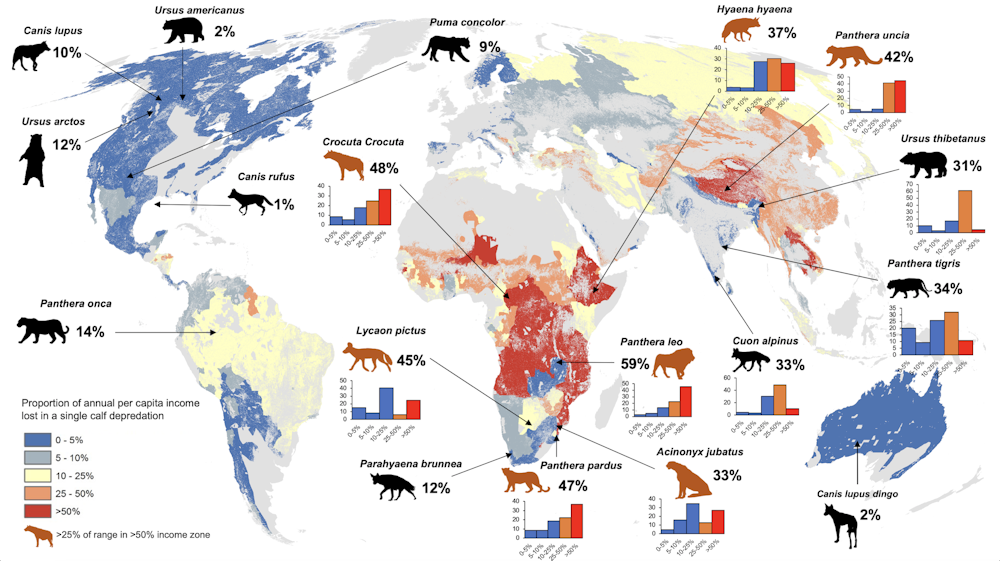
Our results are stark. Communities in developing countries were up to eight times more vulnerable than developed countries on average. We also found transition economies like China and Georgia (a country shifting from a centrally planned economy to a market-based economy) are twice as economically vulnerable.
Families living alongside predators in Uganda, Tanzania, and India often have no buffer against this kind of loss. For example, a farmer losing a calf in Utah to a pack of wolves will likely not feel the economic effect of an attack as badly as a Basongora farmer on the edge of Queen Elizabeth National Park in Uganda.
We found a single predation event in countries like Mozambique, Uganda and Tanzania would potentially wipe out a farmer’s entire income for a year. Our results also show farmers in developing economies on average produce roughly 30% less meat than those in developed ones. That means predator attacks on livestock will have even greater effects than in developed countries.
Carnivores are living on the edge
Our results also show more than half of large carnivores have at least a third of their range overlapping areas where the people live under severe economic burden. We described a severe economic burden area as where one calf loss would erase over 25% of a family’s annual income. Eight of these carnivores, including lions and cheetahs, are considered globally threatened[11].
Snow leopards, African lions, and Asiatic black bears had between 70-89% of their ranges overlapping these severe vulnerability areas. Dingoes, black bears and the red wolf, however, had just 1-2% of their range overlapping the areas of severe economic vulnerability. This is because these species mainly range in areas where per capita income is highest, such as developed economies.
Towards coexisting with carnivores
Earth’s most economically vulnerable people are key to conservation success for carnivores due to the extremely high overlap with threatened carnivore species. Unfortunately, they are also the most at risk when human needs come in conflict with wildlife. Many of us who want carnivores conserved the most live furthest away from them and their impacts.
We need to create new ways for highly vulnerable communities to receive more benefits from the wildlife that are their neighbours. Many innovative programs have worked to reduce conflict, including the creation of livestock protection enclosures[12], guardian dogs[13], and the creation of novel economic benefit[14] streams for local communities, but these programs must be built on and scaled massively if we are to succeed.
Read more: Guardian dogs, fencing, and 'fladry' protect livestock from carnivores[15]
This is particularly the case for those communities that don’t benefit from ecotourism, conservancies, or national park revenues. Localised compensation[16] is at present too small scale and underfunded to make a meaningful dent, and is often subject to abuse and moral hazard[17].
The conservation community and policymakers need to think bigger and create new sources of conservation finance.
References
- ^ experience of a lifetime (www.tandfonline.com)
- ^ ancient rock art (www.pnas.org)
- ^ successful blockbuster films (www.boxofficemojo.com)
- ^ destroy the livelihoods (www.tandfonline.com)
- ^ new research (doi.org)
- ^ chronically under-funded (www.pnas.org)
- ^ impacts (www.sciencedirect.com)
- ^ being killed (onlinelibrary.wiley.com)
- ^ cattle price database (www.fao.org)
- ^ Communications Biology (doi.org)
- ^ globally threatened (www.iucnredlist.org)
- ^ livestock protection enclosures (link.springer.com)
- ^ guardian dogs (cheetah.org)
- ^ novel economic benefit (conbio.onlinelibrary.wiley.com)
- ^ Guardian dogs, fencing, and 'fladry' protect livestock from carnivores (theconversation.com)
- ^ compensation (books.google.com.au)
- ^ abuse and moral hazard (conbio.onlinelibrary.wiley.com)