A ‘recently discovered’ whale feeding strategy has turned up in 2,000-year-old texts about fearsome sea monsters
- Written by: John McCarthy, ARC DECRA Fellow, Flinders University
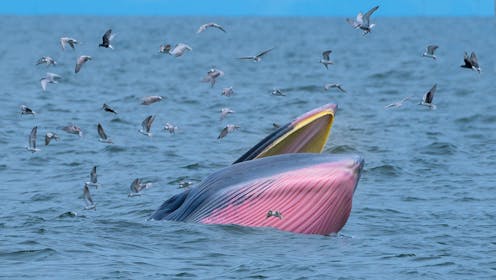
In 2011, researchers observed a previously unknown feeding strategy in whales, now called tread-water feeding or trap-feeding. It was thought to be a new technique developed by specific whale communities.
Trap-feeding is one of several whale feeding strategies first recorded in recent decades, including lunge feeding[1], lobtail feeding[2] and the dramatic bubble-net feeding[3], when whales create a fence of bubbles to herd krill or fish together.
Read more: Humpback whales have been spotted 'bubble-net feeding' for the first time in Australia (and we have it on camera)[4]
In trap-feeding, whales lie at the surface of the water with their mouths open. This allows shelter-seeking prey species such as herring and krill – which do not perceive a stationary object as a threat – to shoal into their open mouths. The whale then heaves its mouth closed, trapping hundreds of prey in a single gulp. This behaviour has been observed in the Gulf of Thailand in Bryde’s or Eden’s whales, and in Canada in humpback whales.
But it appears parallels to this behaviour were also documented in medieval literature, as we describe in a new paper published today in Marine Mammal Science[5].
The hafgufa
There are striking parallels between trap-feeding and the hunting strategy of a monstrous sea creature called the “hafgufa”, described in medieval Scandinavian manuscripts.
The mid-13th-century Old Norse text Konungs Skuggsjá[6] (the King’s Mirror) says of this creature:
‘when it goes to feed, it gives a great belch out of its throat, along with which comes a great deal of food. All sorts of nearby fish gather, both small and large, seeking there to acquire food and good sustenance. But the big fish keeps its mouth open for a time, no more or less wide than a large sound or fjord, and unknowing and unheeding, the fish rush in in their numbers. And when its belly and mouth are full, [the hafgufa] closes its mouth, thus catching and hiding inside it all the prey that had come seeking food‘ (M. Firth, Trans.).

Although this text exaggerates the creature’s size, the other details match trap-feeding surprisingly closely. Even the hafgufa’s belch may correspond to reports of rorqual whales[7] expelling a surplus slurry of water and food particles as they filter and swallow their prey.
Interestingly, the creature is not described as a fantastical monster, but as a fish, a term often used interchangeably with whales in medieval sources.
Ancient parallels
If these medieval Scandinavian texts really are describing trap-feeding, it demonstrates the technique is much older than previously thought. So, we examined other pre-modern descriptions of sea creatures looking for parallels.
Many of the texts had been adapted or translated directly from earlier texts, so it was impossible to know if the community which produced them had first-hand experience of trap-feeding. However, in some texts new accurate details had been added, suggesting an eye-witness connection.
The earliest of these, an ancient work on natural history called the Physiologus[8], was compiled in Egypt and dates back nearly two millennia.
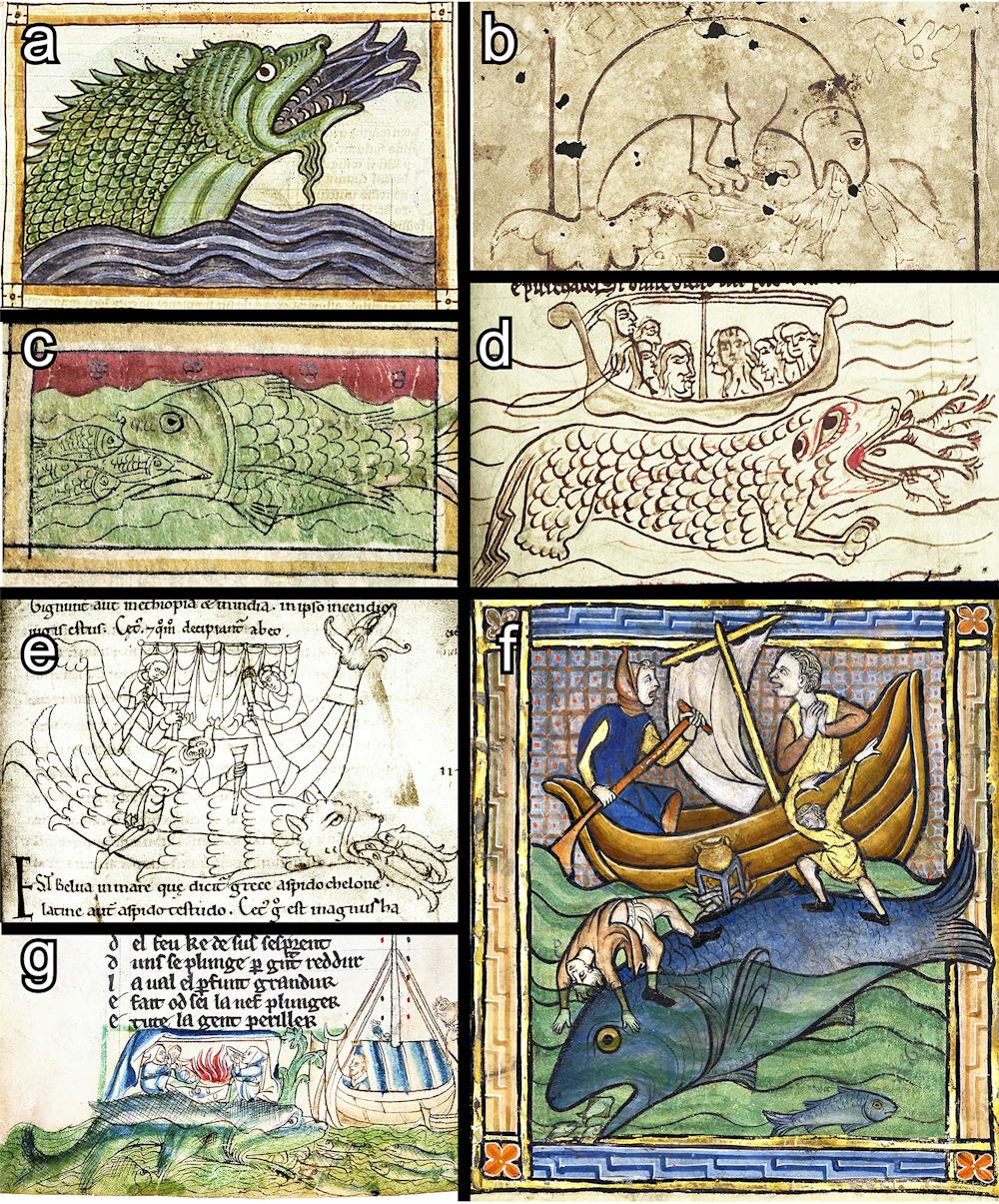 Various depictions of known or possible hafgufas/aspidochelones in 13th century medieval bestiaries from Europe.
Full details in Marine Mammal Science, 2023. (Author provided)
Various depictions of known or possible hafgufas/aspidochelones in 13th century medieval bestiaries from Europe.
Full details in Marine Mammal Science, 2023. (Author provided)
How did we not notice this before?
But if trap-feeding was first recorded 2,000 years ago, why has it not been reported in modern times until 2011?
One possible explanation is that the devastating effect of historical whaling has caused whale numbers to remain much lower than they were in medieval and ancient times. North Atlantic humpback numbers are estimated to be only a fifth of their pre-industrial whaling levels[9].
Trap-feeding may be a response to higher population density. Just this month, new research on Australian humpbacks showed that whalesongs are becoming less frequent as populations recover from whaling and competition for mating becomes more intense.
Read more: Australian humpback whales are singing less and fighting more. Should we be worried?[10]
The rise in whaling in the 17th and 18th centuries was accompanied by developments in technology and a corresponding prejudice against medieval society, which was increasingly seen as backwards, unscientific, and superstitious.
However, the most fantastical descriptions of the hafgufa are actually from 17th- and 18th-century writers, who conflated the creature with all kinds of other sea monsters, such as the kraken, resulting in a general confusion about the nature of this creature in modern times. One notable recent depiction of the hafgufa in the popular PlayStation game God of War Ragnarök[11] even depicts it as a giant jellyfish!
In conducting our research, we spoke to marine biologists who assumed it would simply be impossible to determine how long whales had been trap-feeding. So, this multidisciplinary research provides evidence from an unexpected quarter, and may highlight new avenues for researching our marine past.
It also shows that although medieval and ancient people did not have modern scientific frameworks to interpret the natural world, their observations can contain unique evidence of natural phenomena and may be more accurate than we realise.
References
- ^ lunge feeding (doi.org)
- ^ lobtail feeding (doi.org)
- ^ bubble-net feeding (doi.org)
- ^ Humpback whales have been spotted 'bubble-net feeding' for the first time in Australia (and we have it on camera) (theconversation.com)
- ^ published today in Marine Mammal Science (onlinelibrary.wiley.com)
- ^ Konungs Skuggsjá (www.gutenberg.org)
- ^ rorqual whales (www.britannica.com)
- ^ Physiologus (www.gutenberg.org)
- ^ only a fifth of their pre-industrial whaling levels (link.springer.com)
- ^ Australian humpback whales are singing less and fighting more. Should we be worried? (theconversation.com)
- ^ God of War Ragnarök (www.escapistmagazine.com)