how The Fabelmans and Babylon both use music to evoke nostalgia
- Written by: Gregory Camp, Senior Lecturer, University of Auckland
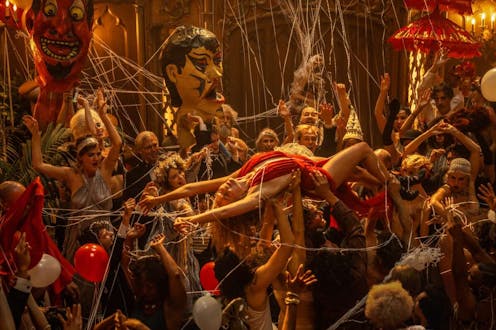
This year has seen the release of a varied collection of nostalgic films about film making. Damien Chazelle’s Babylon[1] looks at the excesses of 1920s and 30s Hollywood; Steven Spielberg’s The Fabelmans[2] explores the position of film in the director’s own childhood in the 1960s, and Sam Mendes’ Empire of Light[3] is about a cinema in 1980s England.
These cinematic looks back offer film composers a challenge: how should they musicalise the past of their medium while adhering to the expectations of contemporary audiences? Two of these films’ composers were nominated for Academy Awards for best score: Justin Hurwtiz for Babylon and John Williams for The Fabelmans. Neither won, but Hurwitz and Williams take opposing yet equally successful approaches to this challenge.
Both scores have been met with largely positive critical reception, the music being one of many points of excellence critics have found with The Fabelmans but one of the few they have found with Babylon.
Nostalgia and the score
While both films use music to evoke nostalgia for the times in which they are set, the effects are very different.
Hurwitz’s massive score for Babylon goes along with the excess of every other aspect of the film, while Williams’s modest work for The Fabelmans adds subtle emphasis to a delicate story. Hurwitz’s score plays through well over half of the three-hour Babylon, while Williams’ for The Fabelmans only takes up 20 minutes (including the end credits).
Notably, neither Hurwitz or Williams write in the currently dominating style of soundscape-based film music best exemplified by the work of Hans Zimmer, a style to which last year’s set of Oscar nominees[4] adhered more consistently.
Of the other nominated scores, Son Lux’s for Everything Everywhere All At Once is a kitchen-sink pop extravaganza and Carter Burwell’s for The Banshees of Inisherin is a finely-wrought chamber score. One might have hoped that the fact that only one nominated score this year, Volker Bertelmann’s for All Quiet on the Western Front, is in the Zimmer style presages greater variety in film scoring in the years to come. That it went on to win suggests otherwise.
Hybrid music
In Babylon, Hurwitz places tropes and topics of 1920s popular music into a 21st century context. From the 1920s, we have choirs of saxophones, muted trumpets, the syncopations of early jazz, and honky-tonk pianos. From the 2020s come cyclical melodic modules, chord-based harmonic gestures, and trance-like repetition – all recorded in clean multi-channel audio.
Read more: The nightmarish underside of the dream factory: how Babylon captures Hollywood in the 1920s[5]
Hurwitz also throws in a healthy dose of the 1960s jazz-based film scoring style of Michel Legrand, Henry Mancini, and Lalo Schifrin.
This hybrid of ‘20s, ‘60s, and “today” has frequently been used in American films and television shows about films and television. The recent Netflix series Hollywood[6] was scored (by Nathan Barr) in much the same way, although it is set in the late 1940s.
I date the popularity of this style to the innovative and influential backstage TV show 30 Rock[7], where composer Jeff Richmond took a postmodern approach to the big band styles of earlier decades to musicalise the fast-paced and absurd goings-on in the New York late night TV comedy world.
Past and emotion
Williams’s score for The Fabelmans could hardly be more different. Piano and celesta solos feature with a small orchestra playing Williams’ rich and subtly shifting chromatic harmonies.
This is the kind of music that, if not so carefully arranged with every note in the right place, could have quickly become saccharine. But Williams’s score only enters the film at a few key moments. The film’s soundscape consists primarily of music from the 1960s when the film is set (a technique of place-making more frequently used by Martin Scorsese than by Spielberg) and the piano music played by lead character Sammy Fabelman’s mother Mitzi (Michelle Williams), a character based strongly on Spielberg’s own mother Leah, who trained as a concert pianist.
As Sammy becomes a filmmaker his actions and the films he makes are accompanied by pop songs and excerpts from other film scores of the time, while the home atmosphere is largely connected to Mitzi’s own piano playing. The score is used primarily for emotionally charged moments between mother and son.
Spielberg and Williams on The Fabelmans.I read the presence of the score as Spielberg reflecting on these moments from his past – Williams scores the director’s emotional memory, while the pop songs and piano pieces are more literal nods to the years in which the film is set. All of the film’s music is about personal nostalgia shared with the audience by the director (compared to Babylon, where the nostalgia is not linked to personal memories of filmmaking and family but rather to the medium of film itself).
Read more: Winning everything everywhere all at once: 5 experts on the big moments at the Oscars 2023[8]
Williams’s most poignantly scored scene takes place during a family camping trip, where Mitzi spontaneously and lyrically dances for the family. The music provides focus to the scene, creating a sonic link between the mother as she dances and the son as he films her. The rest of the world seems to melt away as the filmmakers centre on music, light, and movement.
Hurwitz and Williams both musicalise the film-making process in both its procedural and emotional aspects. Both show excellent technical skill, Williams at the golden age end of his career and Hurwitz still at the beginning of his.
References
- ^ Babylon (www.imdb.com)
- ^ The Fabelmans (www.imdb.com)
- ^ Empire of Light (www.imdb.com)
- ^ last year’s set of Oscar nominees (theconversation.com)
- ^ The nightmarish underside of the dream factory: how Babylon captures Hollywood in the 1920s (theconversation.com)
- ^ Hollywood (www.youtube.com)
- ^ 30 Rock (www.youtube.com)
- ^ Winning everything everywhere all at once: 5 experts on the big moments at the Oscars 2023 (theconversation.com)