What Alone Australia tells us about fear, and why we need it
- Written by: Eric Brymer, Chartered Psychologist, Southern Cross University
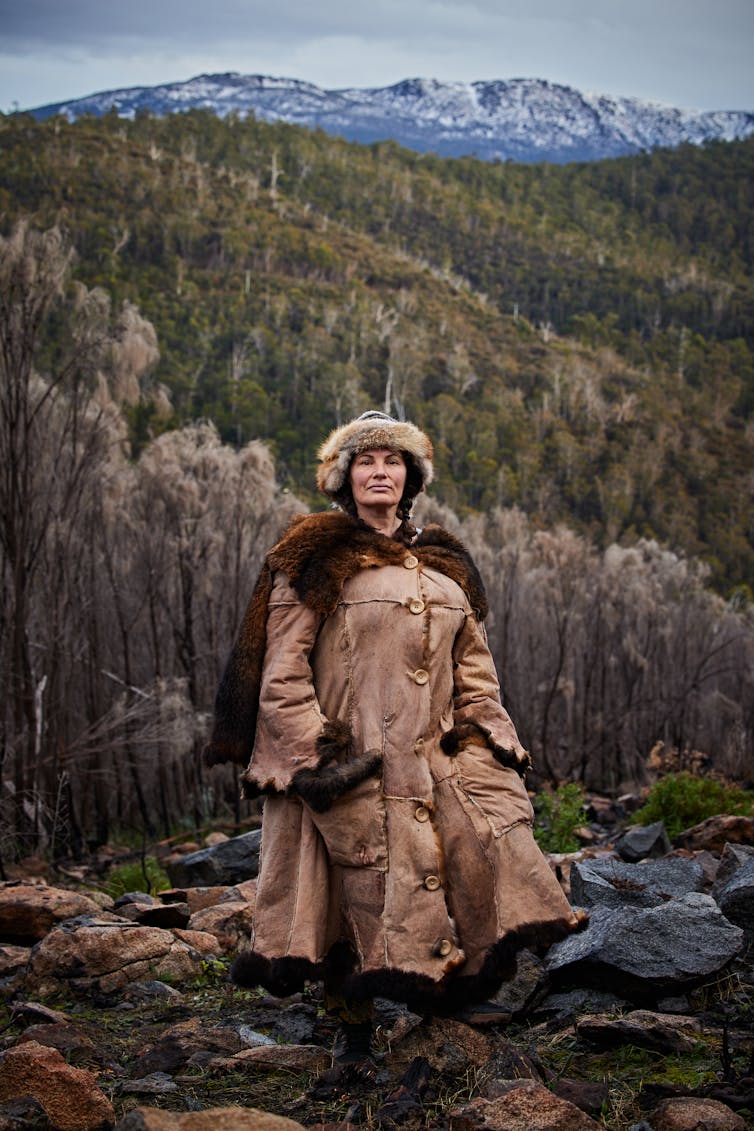
Alone Australia[1] follows individuals having an extreme adventure in wild Tasmania. From one perspective this seems like a foolish thing to do – participants must be crazy or fearless. Why else would anyone choose to be uncomfortable, alone and without a supermarket for weeks?
Based on the US reality TV show[2] of the same name, participants are dropped off in remote Tasmania where they need to survive alone. The contestants film themselves throughout the ordeal with the person who remains the longest in the wilderness winning A$250,000.
The contestants have to overcome many obstacles: basic survival, isolation and loneliness and extreme fear. The traditional notion[3] is that people who look for extreme opportunities in nature either feel “no fear” or have an inappropriate relationship to it. Participants doing similar extreme activities[4] in nature have been most commonly explored from a negative perspective – for example, focusing on the “need to take unnecessary risks”, or the desire to prove themselves by battling against nature.
While participants in Alone Australia do have a “get out” plan, it is very easy for a serious accident to happen and for participants to be gripped by the fear of that likelihood. For example, contestants in the show voiced concerns about embedding an axe in a limb or being trapped by a large falling branch or being stuck in a deep muddy bog.
Supposedly, adventurers are driven by a pathological relationship with fear[5] resulting from a personality disorder, yet these conjectures have never been scientifically substantiated.
Fear is seen as something that should be avoided, yet should this be so? Perhaps as the late president Roosevelt noted – paraphrasing the French philosopher Montaigne – we “have nothing to fear but fear itself”.
Research[6] with people who actively search out extreme activities suggests other motives. Alone Australia shows us fear is more nuanced, and positive than assumed.
Fear as a messenger and guide
Like other emotions, fear tends to ebb and flow. Rather than remaining at the same level of intensity at all times, it depends on both internal and external factors and relates to fluctuating levels of danger.
Essentially, knowing when a venture would be too dangerous to attempt or continue, requires deep self knowledge about one’s strengths and limitations as well as extensive experiential knowledge of the environment. This does not come from a mindset whereby one is in competition with nature, but from being attuned to nature.
An important function of intuition is to detect danger[7]. This can be felt through the body, where a response and systematic preparation for action originate before the intellect has a chance to ascertain the source of the danger and its various attributes such as immediacy, degree or complexity.

Intuition, like any other sense, triggers bodily responses to fear before clear factual data is brought into cognitive awareness. The intuitive bodily movements that occur in response to danger are partly what affords an extraordinarily rapid response when there is perhaps only a fraction of a second available to mitigate or avoid catastrophic danger.
Read more: Adrenaline zen: what 'normal people' can learn from extreme sports[8]
Fear is pragmatic
Aside from being a source of rapid information relay, fear has the pragmatic function[9] of integrating senses, thoughts and actions, so that dangers can be addressed immediately.
Fear is a force which demands a sharpened focus of attention toward the source of danger in preparation for action, such as escaping.
Fear is a reliable messenger between the senses and the cognitive faculties. The realisation of danger, such as tree branches falling on an Alone Australia contestant’s head, hypothermia, the need for food and effective shelter, or even the onset of severe illness, require a rapid shift in focus toward the danger, with all other concerns immediately falling by the wayside.
If the environmental information contained in fear were forced to “queue up and wait its turn”, before it could finally arrive into cognitive awareness, the window of opportunity in which the danger could have otherwise been effectively evaluated and addressed could have already passed.
Fear as a guide
Fear is a benevolent force or guide which is often felt in the context of high adventure[10].
The information contained in fear is information used to make wise decisions under extremely dangerous and uncertain conditions. An intimate and harmonious relationship with fear brings vital information relating to danger into conscious awareness more quickly than any other means. The nature of fear is to instantly ignite the power of the body and the mind simultaneously, so that there is no delay in executing responses to danger.
In adventurism, fear is a friend, an essential companion, not something to fear. In Alone Australia, accepting fear as something useful and necessary is essential for survival.
References
- ^ Alone Australia (www.imdb.com)
- ^ US reality TV show (www.imdb.com)
- ^ traditional notion (www.nationalgeographic.com)
- ^ similar extreme activities (theconversation.com)
- ^ pathological relationship with fear (www.routledge.com)
- ^ Research (thepsychologist.bps.org.uk)
- ^ detect danger (www.routledge.com)
- ^ Adrenaline zen: what 'normal people' can learn from extreme sports (theconversation.com)
- ^ pragmatic function (www.ncbi.nlm.nih.gov)
- ^ high adventure (www.nationalgeographic.com)
Read more https://theconversation.com/what-alone-australia-tells-us-about-fear-and-why-we-need-it-203399