How the sculpture and 'knitted paintings' of Renee So explore colonial legacies, male authority and women’s bodies
- Written by: Julie Shiels, Senior Industry Fellow, RMIT University
At first glance it would be easy to presume the artworks in Renee So’s survey exhibition are from another time and have come from distant shores.
Her commanding busts and figurines and large textile wall hangings are telling stories about ancient civilisations or adventurers who sailed the seas in search of new lands.
However there is a twist. So’s ceramic objects and “knitted paintings” not only look contemporary, they also challenge orthodoxies about our colonial histories, male authority, gender representation and women’s bodies.
Provenance, now at the Monash University Museum of Art, brings together more than a decade of So’s artworks. Inspired by art history and collections in museums, So has drawn on the visual language, provenance[1] and acquisition histories of figurative vessels and objects from Assyria, Egypt, Iran, Latin America and China.
Many of these antiquities were stolen and ransacked when colonising forces attempted to seize control of these countries. Some are on display in public museums in London where So has lived since 2010.
Read more: Stolen cultural objects: what's the role of Australian galleries?[2]
Long beards, boots and booze
In the first rooms, So’s flat knitted paintings and bulbous figurative clay forms mock and expose the fragility of male authority figures. Repeating motifs of beards and boots are used to explore outward symbols of masculinity, entitlement and military power.
However, a series of large, knitted motifs of male dominance are humorously undercut by the introduction of booze.
In Nightfall, the initial threats of the goose-stepping boots embellished with caricatures of bearded faces are neutralised by repeating, reversing and upending a mirrored set of legs.
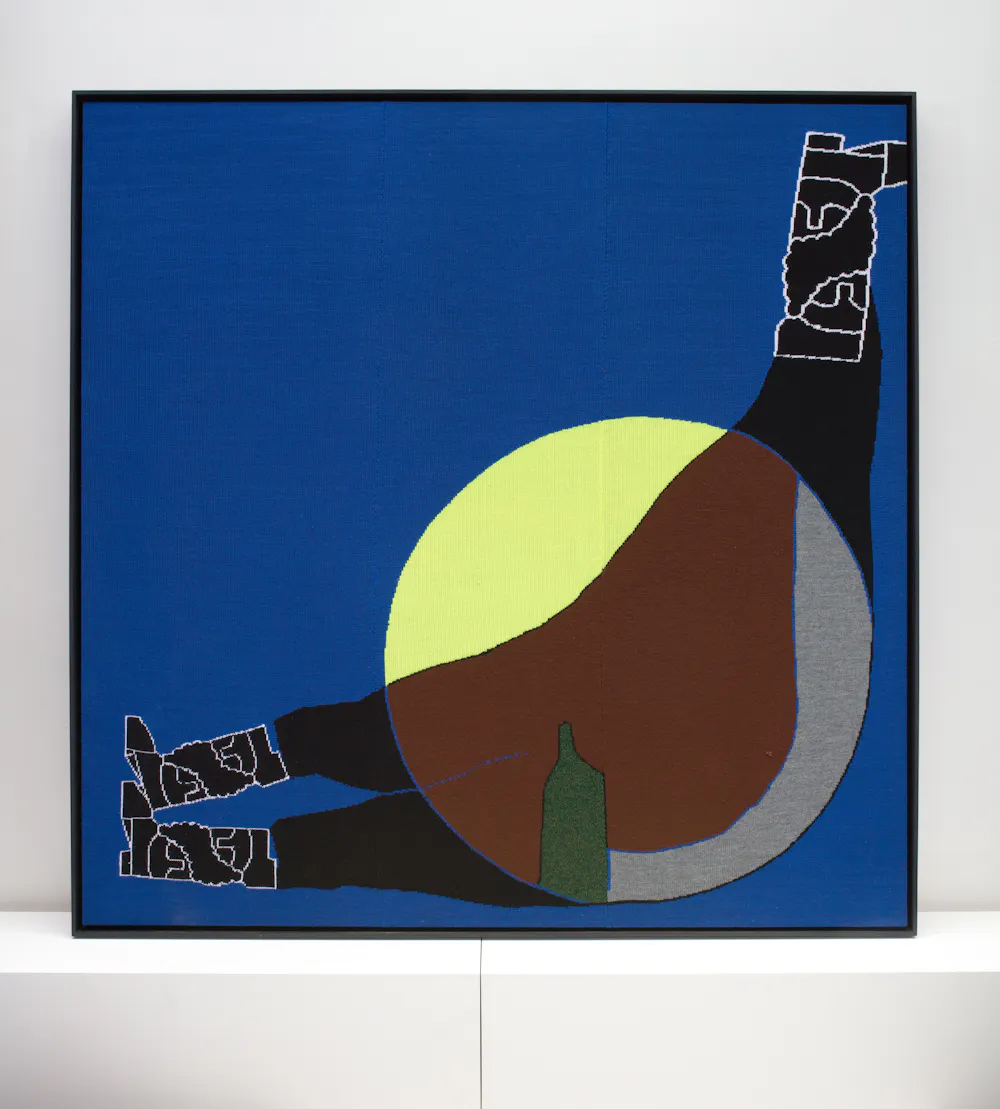
In Sunset, big-arsed figures collapse against an oversized moon. Only a bottle remains upright: a decadent and pathetic end to spent power.
 Renee So, Sunset 2016 knitted acrylic yarn and oak frame 154 x 154 x 6 cm (framed) Courtesy of the artist; Kate MacGarry, London; and Roslyn Oxley9 Gallery, Sydney.
Beards and booze also underpin So’s long-running interest in Bartmann (bearded man) or Bellarmine jugs[3], manufactured in Germany in the 16th and 17th centuries.
These ceramic vessels were decorated to look like bearded men – the necks of the bottle their head, with their bulbous bodies below – and used to ship wine and other commodities throughout Europe.
Translated into clay by So, the big beards threaten to take over the face and inflated trousers and add a satirical edge.
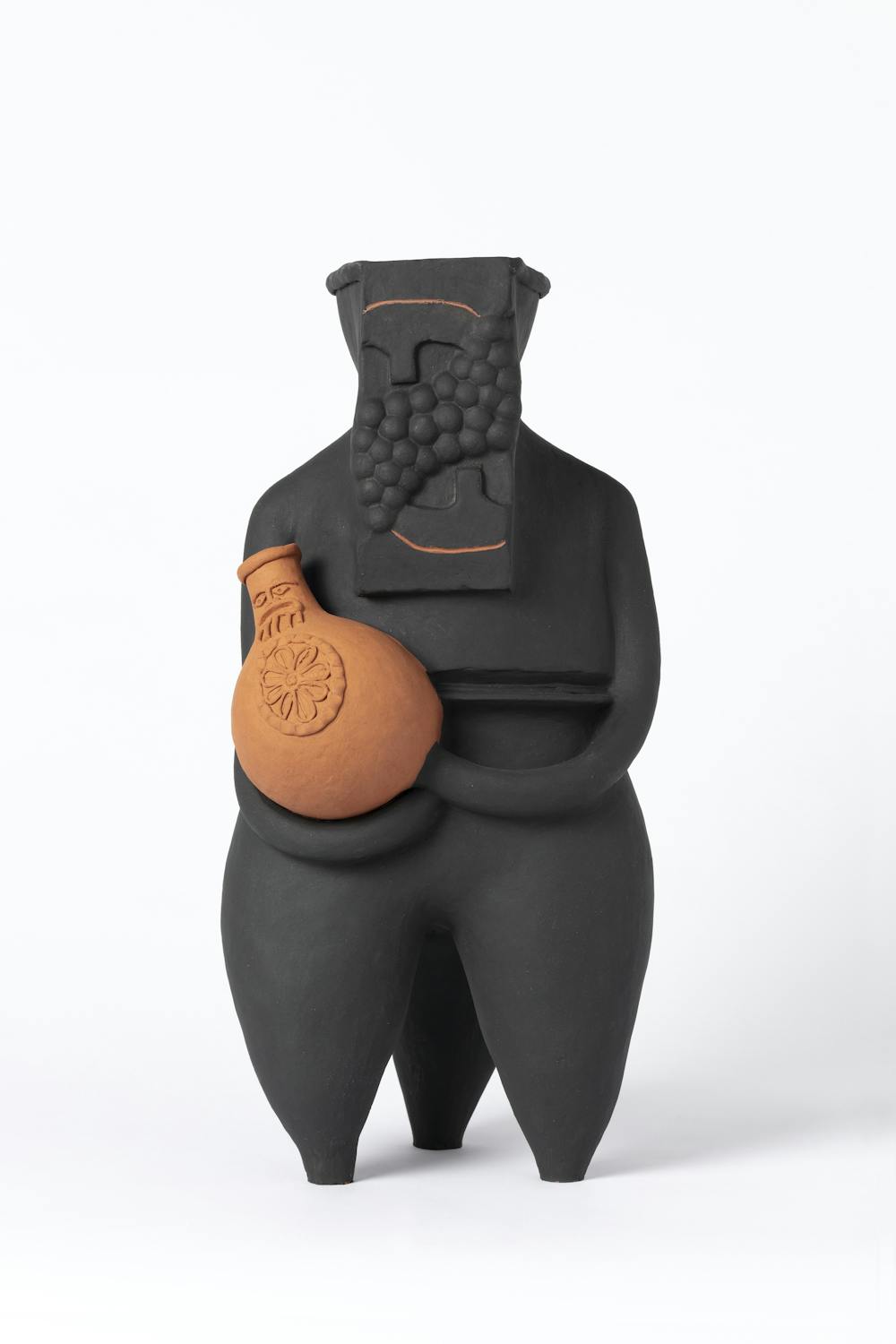 Renee So, Bellarmine Holding Bellarmine (Version II) 2020, earthenware, 49 × 22 × 27 cm. Powerhouse collection, Sydney, Barry Willoughby Bequest Commission, 2020. Photo: Stuart Humphreys.
In Bellarmine holding Bellarmine (Version II), the blocky head, scale and the bulk of the body are contrasted with spindly arms that cradle a wine jar, offering a critique of masculine archetypes and entitled authority.
In Steatopygous Bellarmine, the bravura of a hatted and bearded man is completely undone by skinny arms that connect to a body immobilised and emasculated by the heft and solidity of a pair of pantaloons – which can also be read as a magnificent set of breasts.
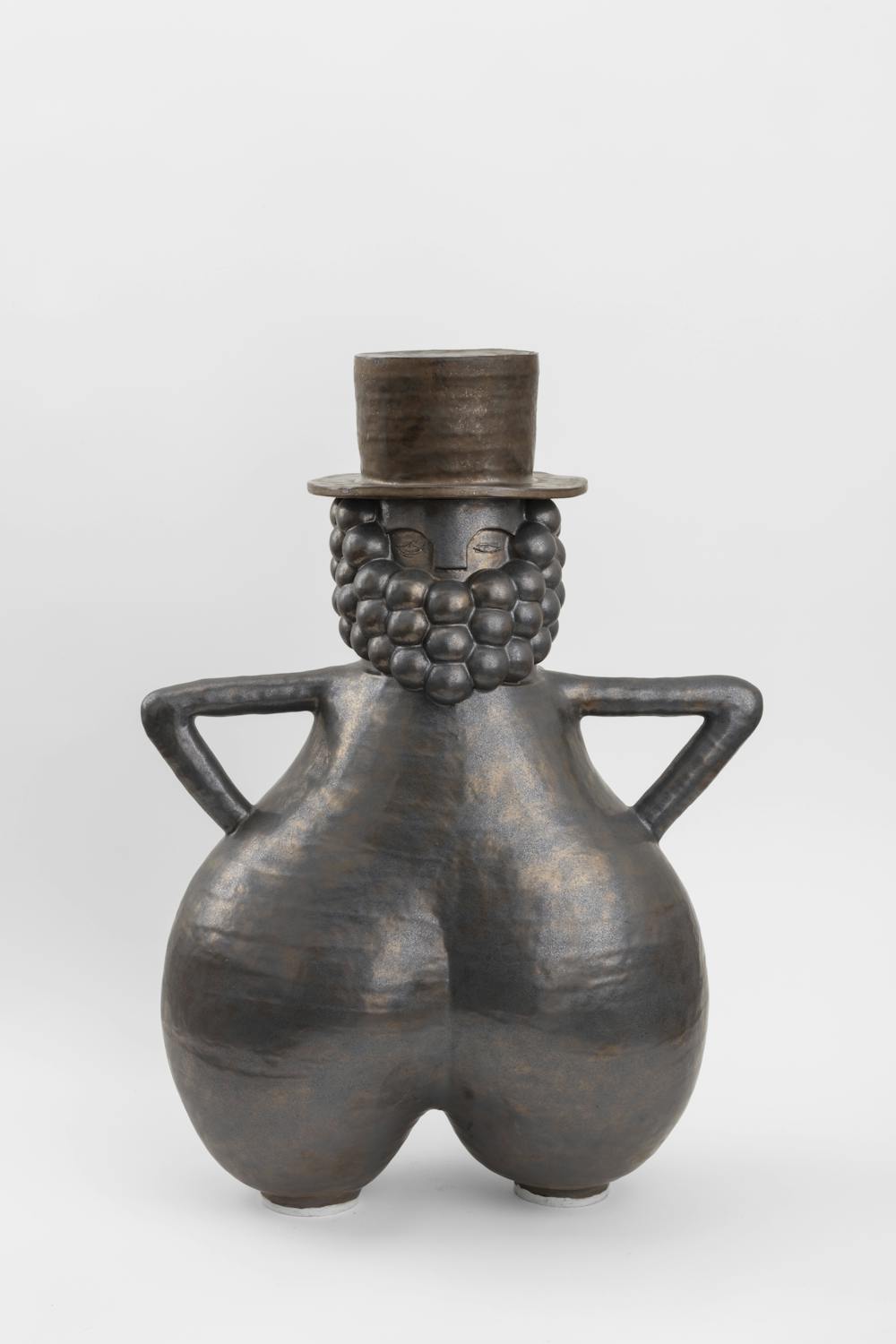 Renee So, Steatopygous Bellarmine 2022, glazed stoneware, 2 parts: figure 69 × 60 × 34 cm; hat 27 × 27 × 15 cm. Courtesy of the artist and Kate MacGarry, London. Photo: Angus Mill.
Drunken Bellarmine describes the ignominy of a drunken fall where a wayward pair of pantaloons have parted company from the body which dangles off the edges of what seems to be a stand or pedestal.
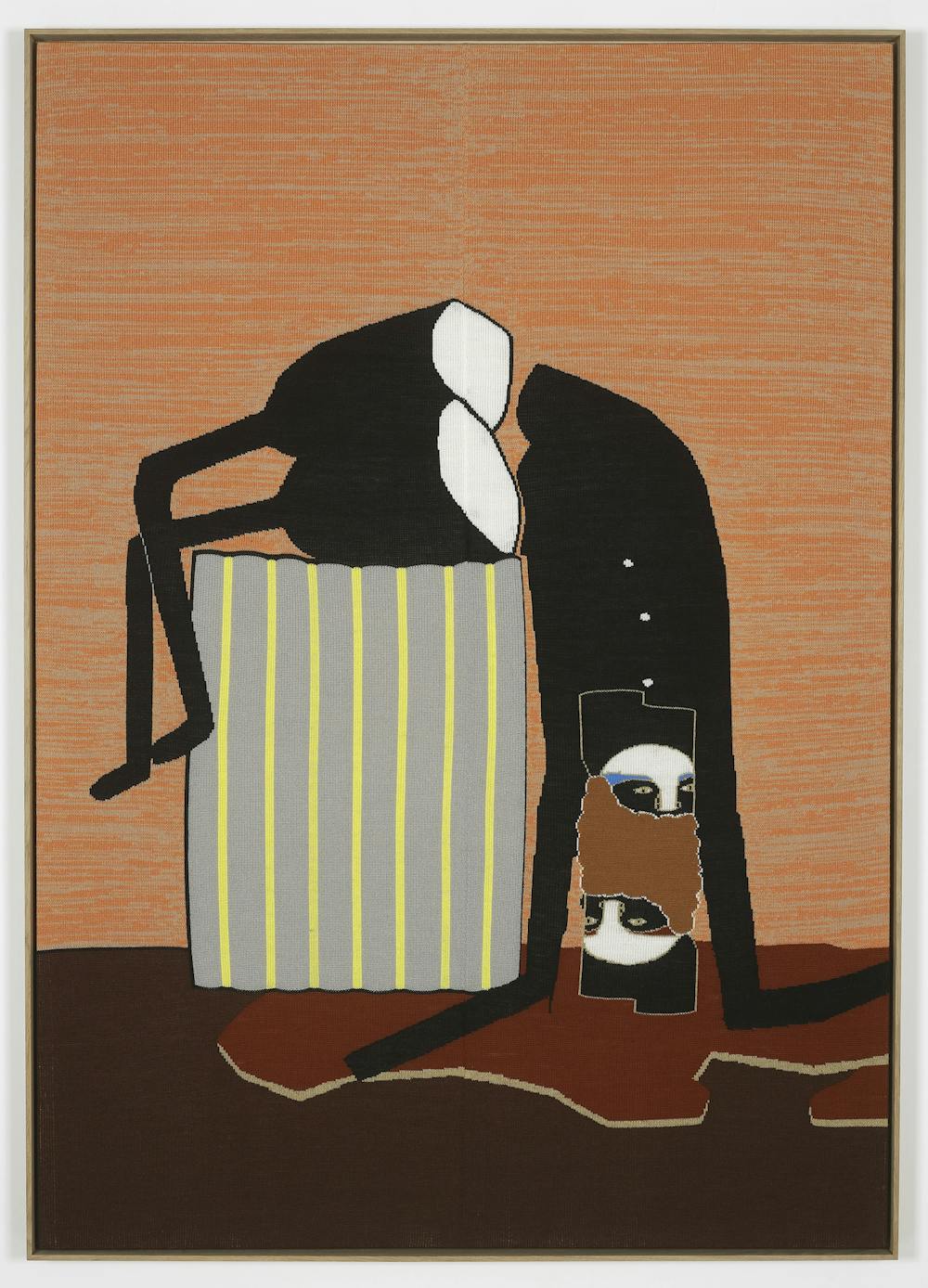 Renee So, Drunken Bellarmine 2012, knitted acrylic yarn and wool, and oak frame, 174 × 124 × 6 cm. Arts Council Collection, United Kingdom. Photo: Andy Keate.
Internal symbols and female bodies
In stark contrast to the externalised trappings of body hair and bad behaviour that So uses to parody and mock masculine figures, she emphasises agency when working with the female form.
So combines a visual language developed from figurative representations from the past with new visualisations of female anatomy drawn from Australian urologist Helen O’Connell’s work[4] mapping the hidden shape of the clitoris using MRI technology.
So links this knowledge of the clitoris with ancient depictions of Venus[5], often equated with fertility.
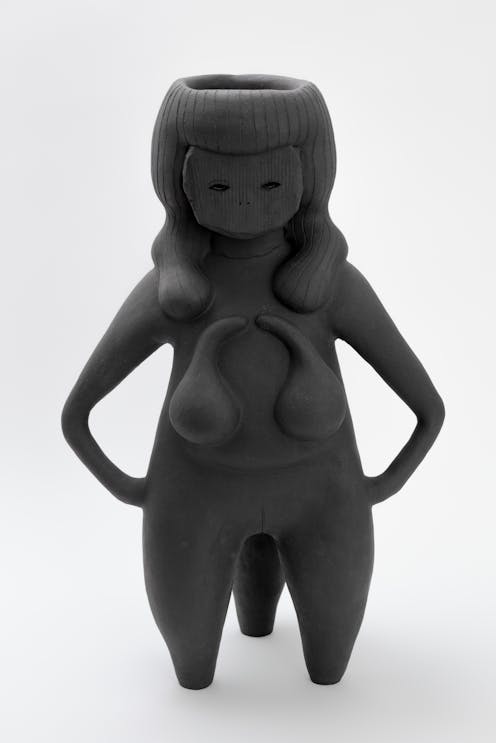
 Renee So, Woman I 2017 black stoneware 44 x 28 x 23 cm Buxton International Collection, Melbourne.
While similar in bulk and form to her masculine objects, her female archetypes have greater agency. The unglazed ceramic figures, many augmented with renderings of this “new clitoris”, have a fleshy fluidity and sexuality. The solidity of their three-legged bottoms give the figures gravitas.
In Woman XI, So’s interpretation of a pre-Columbian artefact has breasts shaped like the invisible clitoris.
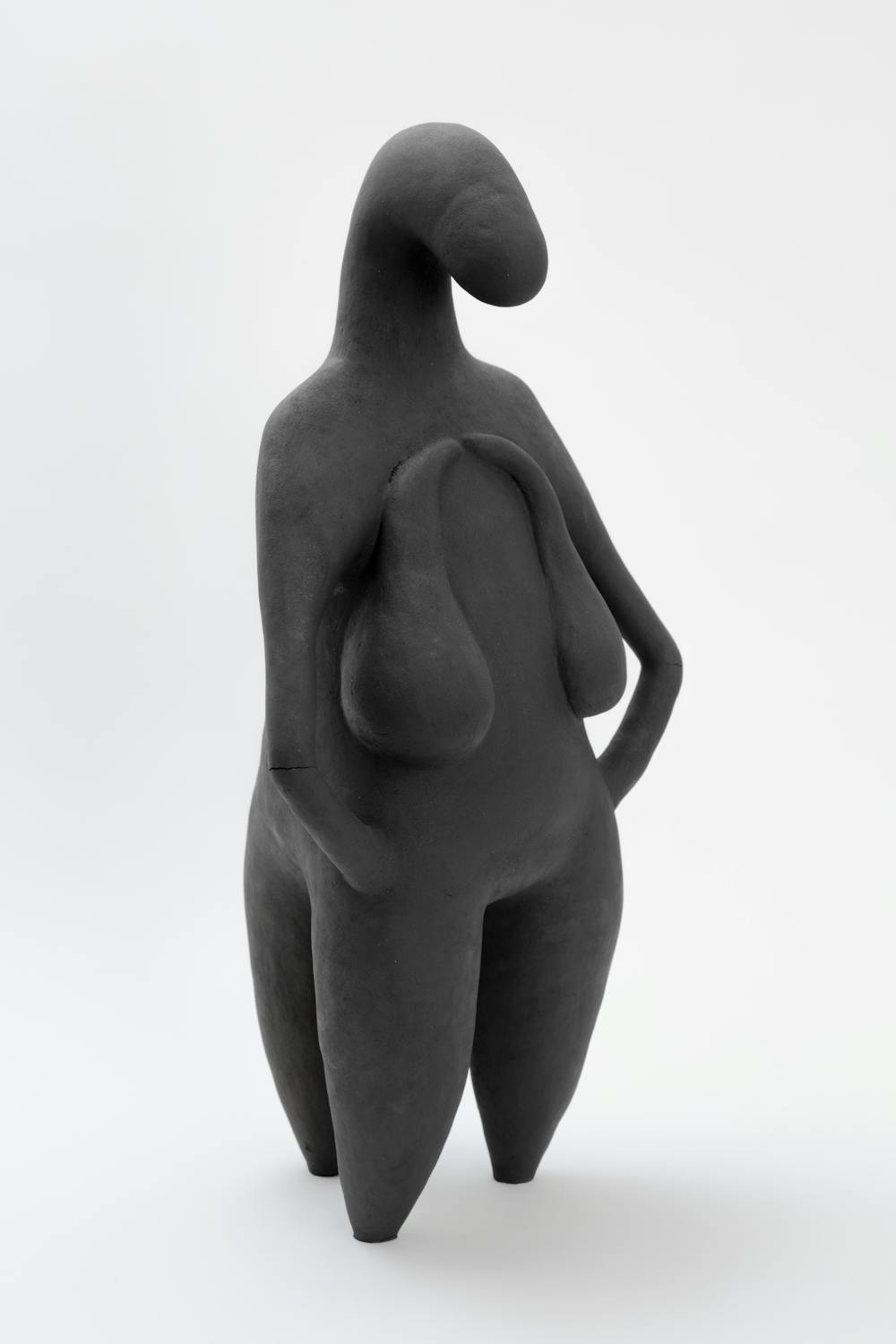 Renee So, Woman X 2021, stoneware, 60 × 31 × 24 cm, Courtesy of the artist and Kate MacGarry, London. Photo: Angus Mill.
In Woman X, So draws on the similarity between the tip of this pleasure centre and an ancient Egyptian “bird faced” figurine[6] dated 3500 to 3400 BCE. In a belated act of defiance, So cloths her bird-headed figure, Woman Sans Culottes XV, in the freedom cap and culottes worn by French Revolutionaries[7], a movement that did not welcome women.
Representations of the clitoris also appear in new two-dimensional works where So swaps her soft, flat-knitted, wool “paintings” for the rigidity of clay. The “bird head” and other translations of the clitoris are graphically interpreted and segmented onto hard shiny surfaces of glazed tiles.
Read more: Why the clitoris doesn't get the attention it deserves – and why this matters[8]
Old with the new
So’s survey exhibition tracks the development of her complex visual language and illustrates how she draws on the origins of new and old cultural objects to communicate her messages.
Figurative ceramics, one of the oldest forms of art making, are contrasted with the creative outputs from the new technology of a knitting machine. Here, So has also added imagery produced by MRI to her library of references.
Her reflections and discoveries about colonialism and gender stretch across time and provide new insights into overlooked histories and past and present injustices.
Renee So: Provenance is at Monash University Museum of Art (MUMA) until July 9.
References
- ^ provenance (en.wikipedia.org)
- ^ Stolen cultural objects: what's the role of Australian galleries? (theconversation.com)
- ^ Bartmann (bearded man) or Bellarmine jugs (en.wikipedia.org)
- ^ Helen O’Connell’s work (www.smh.com.au)
- ^ Venus (www.artmajeur.com)
- ^ “bird faced” figurine (www.brooklynmuseum.org)
- ^ French Revolutionaries (journals.sagepub.com)
- ^ Why the clitoris doesn't get the attention it deserves – and why this matters (theconversation.com)