More than 60 billion leaf litter invertebrates died in the Black Summer fires. Here's what that did to ecosystems
- Written by: Heloise Gibb, Professor, La Trobe University
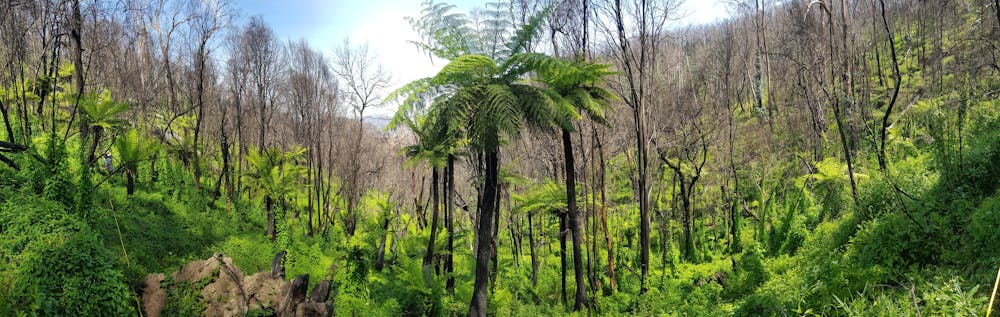
The Black Summer megafires engulfing south-eastern Australia in 2019–2020 were so intense they burned habitats rarely exposed to fire, such as southern warm temperate rainforest.
These rainforests range from East Gippsland in Victoria up to just south of Sydney. Usually, they stay moist enough to prevent major fires. But in that unprecedented summer of fire, 80,000 hectares burned. Our new research[1] estimates more than 60 billion invertebrates in the soil and leaf litter died too.
While our hearts went out to the burned koalas and kangaroos, this was a silent tragedy. These tiny creatures are enormously important in ecosystems. They eat dead leaves, create rich soil, and provide a key food source for bandicoots and lyrebirds. Many species have very small ranges, putting them at real risk of decline or even extinction from fire.
As renowned naturalist E. O. Wilson once said, invertebrates are the “the little things that run the world”. But because they are small and out of sight, we still underestimate their significance in ecosystems and their contribution to Australia’s biodiversity. They’re all but forgotten when ecological disasters strike.
How did we find out how many invertebrates died?
In warm temperate rainforests, there’s a layer of moist leaf litter which is home to an abundance of ancient lifeforms[2]. These include the macroinvertebrates big enough to see with the naked eye, such as velvet worms, snails, land hoppers, millipedes, slaters and beetles.
Many of these groups include species with very small ranges, putting them at particular risk from bushfire and other changes to their environments.
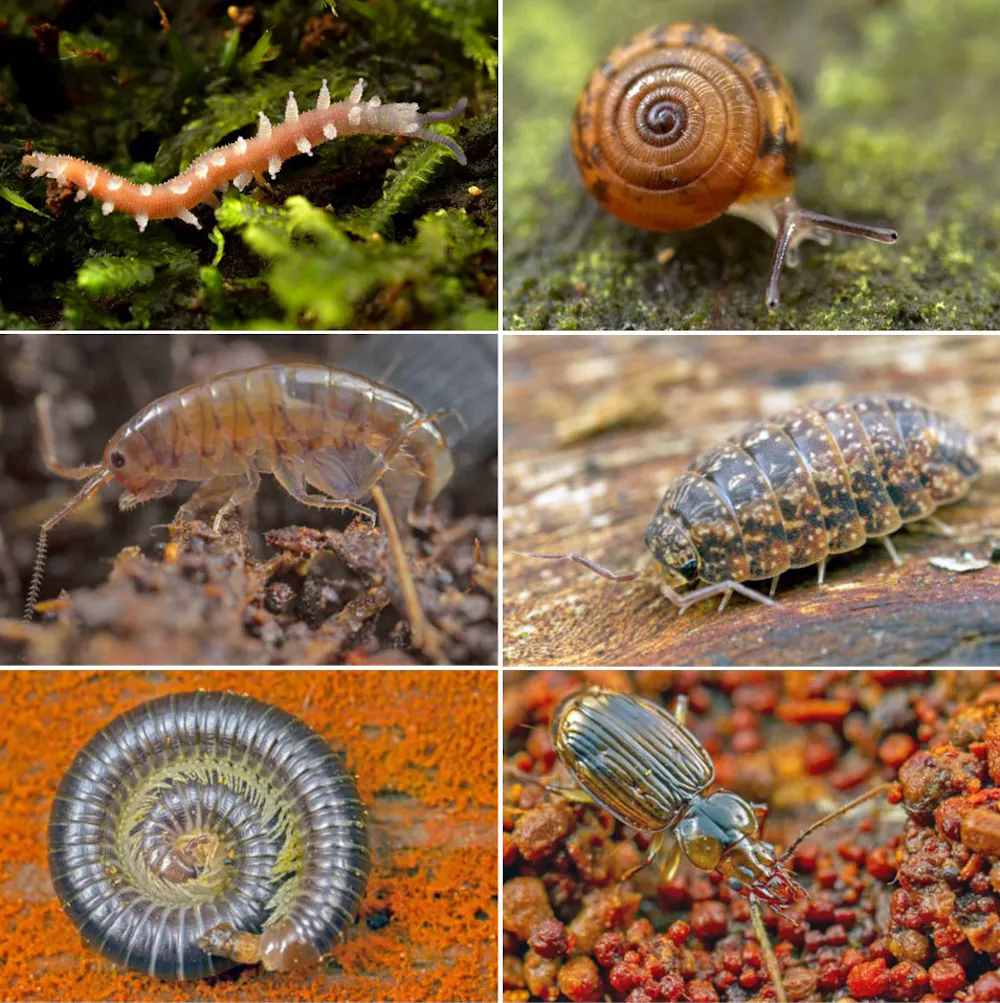 Common macroinvertebrates of these rainforests include velvet worms, snails, slaters, beetles, millipedes and land hoppers (clockwise from left)
Nick Porch, Author provided
Common macroinvertebrates of these rainforests include velvet worms, snails, slaters, beetles, millipedes and land hoppers (clockwise from left)
Nick Porch, Author provided
The fires incinerated much of the leaf litter and its inhabitants. To find out the toll on these creatures, a year after the fires we set out to collect leaf litter samples from 52 temperate rainforest sites ranging from Buchan in East Gippsland, Victoria, to Nowra in New South Wales, across the lands of the Kurnai, Bidawal and Yuin people. Then we compared sites subject to medium and high severity fires with those that had escaped the fire.
Back in the lab, we ran the samples through Tullgren funnels, which sort leaves from creatures, then counted the macroinvertebrates. We excluded the tiny springtails and mites, which are hugely abundant mesoinvertebrates. We found every hectare of unburnt rainforest had 2.5 million litter macroinvertebrates, while severely burnt forests had a quarter as many.
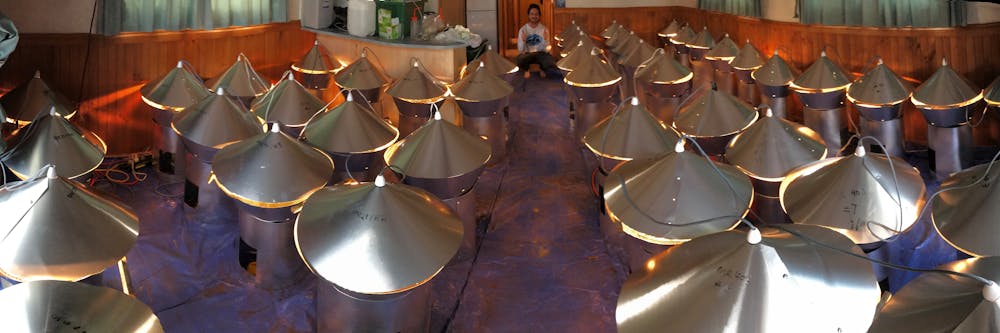 We used Tullgren funnels to sort leaf litter fron its inhabitants.
Heloise Gibb, Author provided
We used Tullgren funnels to sort leaf litter fron its inhabitants.
Heloise Gibb, Author provided
If we look at all temperate rainforest burned at different severities across the south-east that means 60 billion tiny deaths. But of all the forest that burned during that summer, rainforests made up only about 1%. The total loss might be closer to 6 trillion individuals. Then to get to truly extraordinary numbers, we can include mites and springtails which account for around 95% of individual invertebrates. That would give us an estimate of 120 trillion.
Why are these tiny creatures so important?
Invertebrates account for fully 99% of all animal species and most of the weight of animals on the planet. Renowned Australian scientist Baron Robert May is famously quoted as saying “to a good approximation, all species are insects”. Even now, an estimated 70% of all Australian invertebrate species remain undescribed[3]. Many will go extinct before we have time to document them.
Read more: Surprisingly few animals die in wildfires – and that means we can help more in the aftermath[4]
Although we know little of the ecology of most invertebrate species, collectively we know they play crucial roles in ecosystems. Losing this rich food source is likely to slow the recovery of key ecosystem engineers such as lyrebirds and bandicoots, which turn over large volumes of dirt in search of them.
When we try to replant forests without invertebrates, many plants and trees struggle. That’s why conservationists are using leaf litter transplants[5] to move vital invertebrates from healthy forests to new ones.
These critters are a vital way nutrients cycle through our forests by breaking down leaves and other organic matter. Globally, they’re directly responsible for converting about 40% of all leaf litter into soil. By turning over leaves or shredding them into pieces, they make it possible for microbes to help decompose organic matter. Without this work, leaf litter would begin to pile up, setting the scene for more fires.
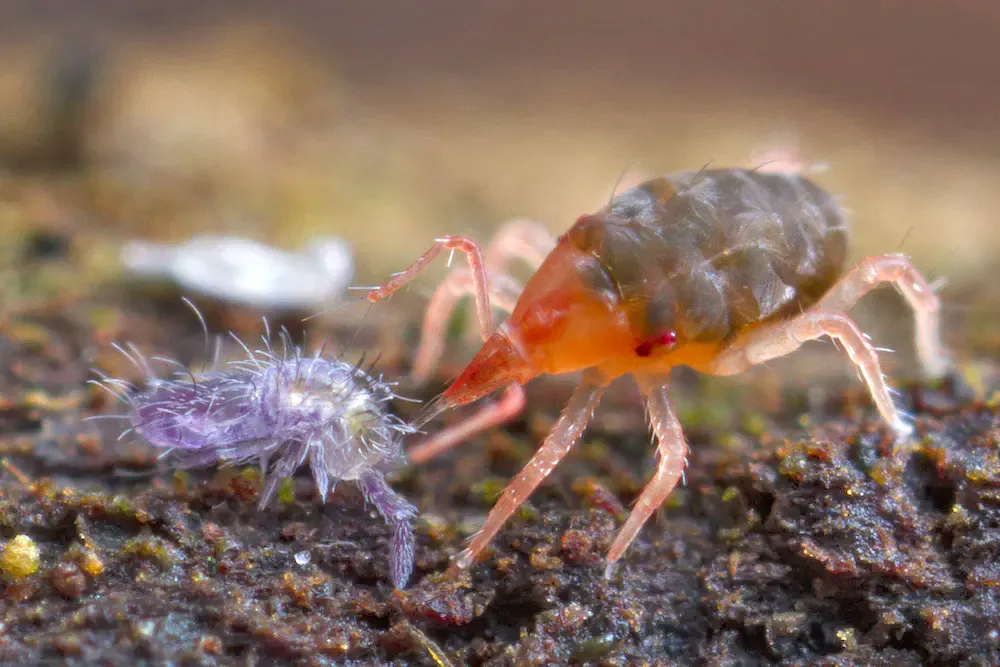 Springtails and mites are by far the most abundant invertebrates in leaf litter, with thousands in an average square metre. On the right is a predatory snout mite (Bdellidae) feeding on a purple springtail (Collembola).
Nick Porch, Author provided
Springtails and mites are by far the most abundant invertebrates in leaf litter, with thousands in an average square metre. On the right is a predatory snout mite (Bdellidae) feeding on a purple springtail (Collembola).
Nick Porch, Author provided
When we lose billions or trillions of invertebrates, we may see the area become more susceptible to future fires[6].
More frequent fires means slower decomposition[7], which means leaf litter builds up more rapidly. This might be a direct effect of the loss of invertebrates due to fire.
We found the most damaging fires were those where almost all of the canopy was burned. These intense treetop fires killed off three to four times as many invertebrates as fires where only half of the canopy burned.
That’s good news, as it suggests species can tolerate fires, as long as some litter habitat is left. Recovery efforts should focus on the sites where the most canopy burned.
In the wake of fires, rainforest species risk getting pushed out by surrounding eucalyptus trees, which are better at tolerating fire – and encourage more fires by dropping large volumes of litter.
You might think bugs can easily bounce back as the rainforest regrows. But recolonisation doesn’t always happen. Land hoppers, millipedes and isopods (slaters) can be extremely abundant in leaf litter, but none of them can fly to a new location. The dry forest between two sheltered rainforest gullies is so hostile to invertebrates like land hoppers that they can die in minutes when removed from their moist homes.
What can we do?
The future holds more fire[8], as the world heats up. How can we protect these vital invertebrates? One method is to make their habitats better connected wherever possible. Another is to rewild with minibeasts[9], seeding severely burnt sites with healthy litter invertebrates from nearby unburnt rainforests.
While we can calculate the numbers of individuals lost to fire, we don’t know much about whether the fires caused extinctions because many species are still unknown to science.
We can no longer overlook these minibeasts and the vital roles they play in ecosystems. We would miss them if they were gone.
Read more: Photos from the field: zooming in on Australia's hidden world of exquisite mites, snails and beetles[10]
References
- ^ new research (doi.org)
- ^ ancient lifeforms (theconversation.com)
- ^ remain undescribed (www.taxonomyaustralia.org.au)
- ^ Surprisingly few animals die in wildfires – and that means we can help more in the aftermath (theconversation.com)
- ^ leaf litter transplants (www.abc.net.au)
- ^ future fires (www.publish.csiro.au)
- ^ slower decomposition (onlinelibrary.wiley.com)
- ^ more fire (theconversation.com)
- ^ rewild with minibeasts (theconversation.com)
- ^ Photos from the field: zooming in on Australia's hidden world of exquisite mites, snails and beetles (theconversation.com)