Imagine the outcry if factories killed as many people as wood heaters
- Written by: Bill Dodd, Knowledge Broker, Centre for Safe Air (NHMRC CRE), University of Tasmania
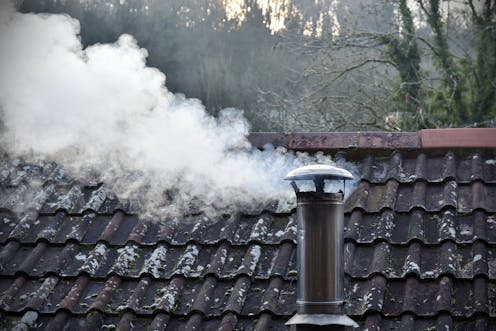
Imagine a fleet of ageing factories operating in neighbourhoods across Australia.
On most days the smoke from their stacks is hardly noticed. But on cold days when the smog settles in the densely populated valleys and towns, doctors notice unusually high numbers of people suffering from a range of problems, especially asthma.
Air-quality researchers are called in to study the problem in more detail. They confirm that neighbourhoods with these old factories have higher concentrations of fine particles, which are toxic air pollutants[1].
Invisible to the naked eye, particles are inhaled deep into the lungs, enter the bloodstream and cause a range of harms throughout the body. This air pollution is linked to higher rates of heart and lung diseases, strokes, dementia and some cancers. It also increases the risk of adverse pregnancy outcomes and poorer learning outcomes in children.
The researchers calculate that each year pollution from the factories causes 269 premature deaths in Sydney[2], 69 in Tasmania[3] and 14 in Armidale[4], New South Wales.
While the factories are supposed to be built, maintained and operated to certain standards, the regulations are rarely if ever enforced. There isn’t even a central register to tell authorities how many of these factories exist, how old they are, and where they are located.
As news of this research is made public, how would the affected communities react? What might they demand of government?
Would it matter if they knew we were not talking about factories, but wood heaters?
Read more: Blame wood-burning stoves for winter air pollution and health threats[5]
Heaters produce much of our air pollution
Every sentence of this story is true if you replace the word “factory” with “wood heater”.
Less than 10% of households[6] own a wood heater, but burning wood for heating is the largest source of air pollution in many Australian cities[7] and towns[8]. While vehicle manufacturers and industry have greatly reduced emissions following tightened government regulations, domestic heating technology has not kept pace.
Today you would have to drive a diesel truck 500 kilometres to emit as much air pollution[9] as a wood heater does in a single day. And that figure is for a wood heater that meets the current regulatory standards in Australia. Most do not.
Furthermore, wood heater pollution can be many times more severe when owners leave logs to smoulder overnight, burn poorly seasoned wood, or close down the air intake immediately after loading more wood.
Of course, particulate pollution is not all that wood heaters emit. When firewood is sourced from land clearing and illegal wood hooking, wood heaters add to net carbon dioxide and methane emissions in much the same as burning coal does because the carbon is no longer locked away in forests.
The best estimates[10] are that less than a quarter of firewood is sourced from sustainable plantation suppliers. Even from those sources, the carbon emissions take many years to be sequestered[11] into growing trees.
One study estimated that, if we stopped burning wood and clearing forest for heating, Australia would reduce its annual greenhouse gas emissions by 8.7 million tonnes[12]. That’s about one-fifth[13] of Australia’s car emissions.
Read more: 'Like having a truck idling in your living room': the toxic cost of wood-fired heaters[16]
The benefits of electrification
Inevitably, as Australia moves towards a zero-carbon future, the electrification of domestic heating will bring widespread health and economic benefits. It will prevent hundreds of premature deaths each year.
Hospitals will benefit from a reprieve in the cooler months, enabling doctors and nurses to better cope with seasonal pneumonia and COVID-19 outbreaks. And even those outbreaks will be less severe with reduced air pollution[17].
Besides being healthier, Australians will enjoy much lower heating costs as a result of using technologies such as reverse-cycle air conditioners (heat pumps). Remarkably, heat pumps are up to 600% efficient[18]. That means, for every unit of energy they consume, they generate up to six units of heating energy.
Read more: Air pollution can increase the risk of COVID infection and severe disease – a roundup of what we know[19]
Making the switch
As people learn about the impacts of wood heaters on their neighbours, friends and relatives — on pregnant women, young children and the elderly — many will make the switch.
Governments need to ensure safe and affordable heating technology is available to everyone regardless of their income.
Already, governments in the Australian Capital Territory[20], Tasmania[21] and New Zealand[22] have programs that reimburse households for the cost of replacing their wood heaters.
Buy-back schemes, home efficiency subsidies, regulation and enforcement, including property market regulation (ensuring wood heaters are removed prior to sale), and restrictions on new installations all have a role to play.
We are conducting economic modelling to determine the most cost-effective policy settings for maximising the benefits of policies to manage the problem of wood heaters.
Fire and smoke will remain important experiences for Australians. They can be savoured primarily outside the city, under bright stars, in open deserts and rugged coastlines, in beach shacks and farm cottages, and as part of Indigenous cultural practices.
One day we will look back in amazement that we once tolerated wood heaters in our cities, right next to schools, homes and hospitals. We’ll regard them in much the same way that we think of polluting factories today.
References
- ^ toxic air pollutants (www.health.nsw.gov.au)
- ^ Sydney (www.environment.nsw.gov.au)
- ^ Tasmania (www.mdpi.com)
- ^ Armidale (onlinelibrary.wiley.com)
- ^ Blame wood-burning stoves for winter air pollution and health threats (theconversation.com)
- ^ 10% of households (theconversation.com)
- ^ many Australian cities (doi.org)
- ^ towns (www.mja.com.au)
- ^ emit as much air pollution (theconversation.com)
- ^ best estimates (publications.csiro.au)
- ^ many years to be sequestered (www.cell.com)
- ^ 8.7 million tonnes (doi.org)
- ^ one-fifth (www.climatecouncil.org.au)
- ^ W. Carter/Wikimedia Commons (commons.wikimedia.org)
- ^ CC BY-SA (creativecommons.org)
- ^ 'Like having a truck idling in your living room': the toxic cost of wood-fired heaters (theconversation.com)
- ^ less severe with reduced air pollution (onlinelibrary.wiley.com)
- ^ 600% efficient (www.energy.gov.au)
- ^ Air pollution can increase the risk of COVID infection and severe disease – a roundup of what we know (theconversation.com)
- ^ Australian Capital Territory (www.climatechoices.act.gov.au)
- ^ Tasmania (www.abc.net.au)
- ^ New Zealand (www.eeca.govt.nz)