What is the story of maneki-neko, the Japanese beckoning cat?
- Written by: Tets Kimura, Adjunct Lecturer, Creative Arts, Flinders University
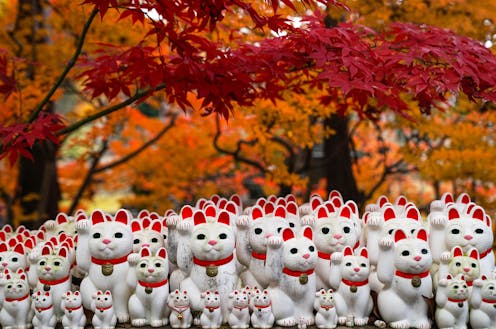
Maneki-neko, translated as beckoning cat but also known as lucky cat or welcome cat, is recognisable internationally, often found behind cash registers of restaurants and retail outlets – and also in your phone.
But how did the cat come to be, and what does it mean in Japan?
Cats, great companions and pets, probably arrived in Japan as early as a few thousand years ago[1], and by the eighth century[2] appeared in literature and mythology.
As in the rest of the world, cats were useful in catching rats and mice.

The population of domesticated cats, however, was relatively small. Because they were precious, some cats were kept on leashes to keep them close, rather than letting them run wild.
During the Edo period (1603-1868), paintings of cats were sold to silkworm farmers. These images were believed powerful enough to scare off silkworm predators: rats and mice.
 Paintings of cats were believed to keep mice away. This one was by Utagawa Kuniyoshi (1797–1861).
Tokyo National Museum/ColBase[3]
Paintings of cats were believed to keep mice away. This one was by Utagawa Kuniyoshi (1797–1861).
Tokyo National Museum/ColBase[3]
Read more: Ancient DNA reveals how cats conquered the world[4]
A symbol of good fortune
Maneki-neko style Japanese cat dolls can be traced back to the Edo period (1603-1868), or shortly beforehand. They probably first appeared in the Buddhist temples Gotokuji[5], Saihoji[6], or Jishoin[7], all located in Edo, today’s Tokyo.
Because the dolls have roots in the new eastern capital – instead of the traditional Japanese centre of Kyoto and its surrounding area of western Japan – we know maneki-neko is relatively new in Japanese history.
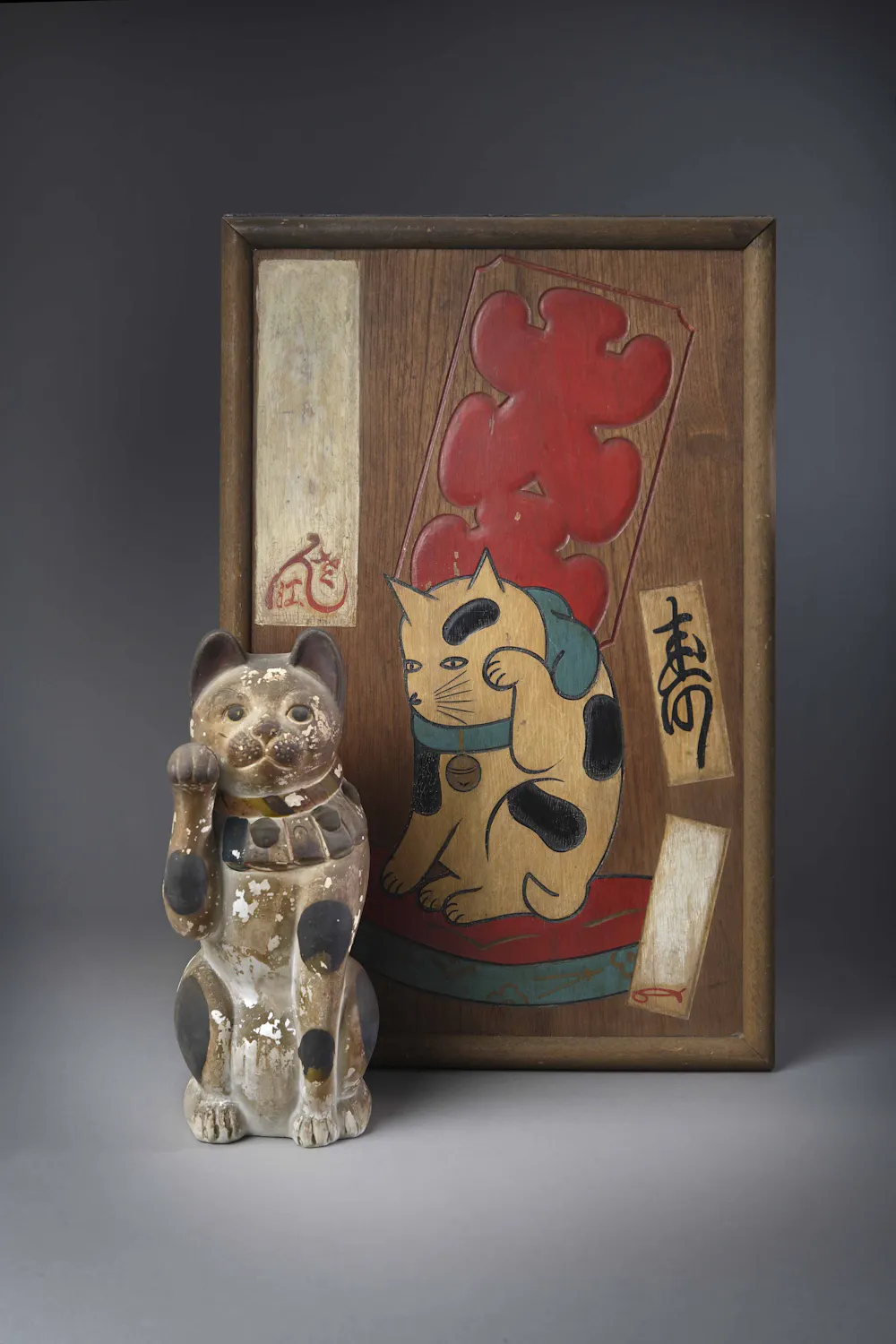 A ceramic maneki-neko from the 19th century.
Gift of Billie L. Moffitt/Mingei International Museum., CC BY-NC-SA[8][9]
A ceramic maneki-neko from the 19th century.
Gift of Billie L. Moffitt/Mingei International Museum., CC BY-NC-SA[8][9]
Each Edo temple has a different story about how maneki-neko came to be.
At the Gotokuji temple, the legend is based on the story of Ii Naotaka (1590-1659), the lord samurai of the Hikone domain. While passing Gotokuji, Naotka was beckoned by a cat at the temple gate. As he came inside he was saved from an unexpected heavy thunderstorm.
Out of gratitude, the samurai decided to provide continuous donations to the temple that had been struggling financially. The cat became the temple’s symbol and brought them continuous good fortune. Today, the temple attracts tourists from all over Japan and the world.
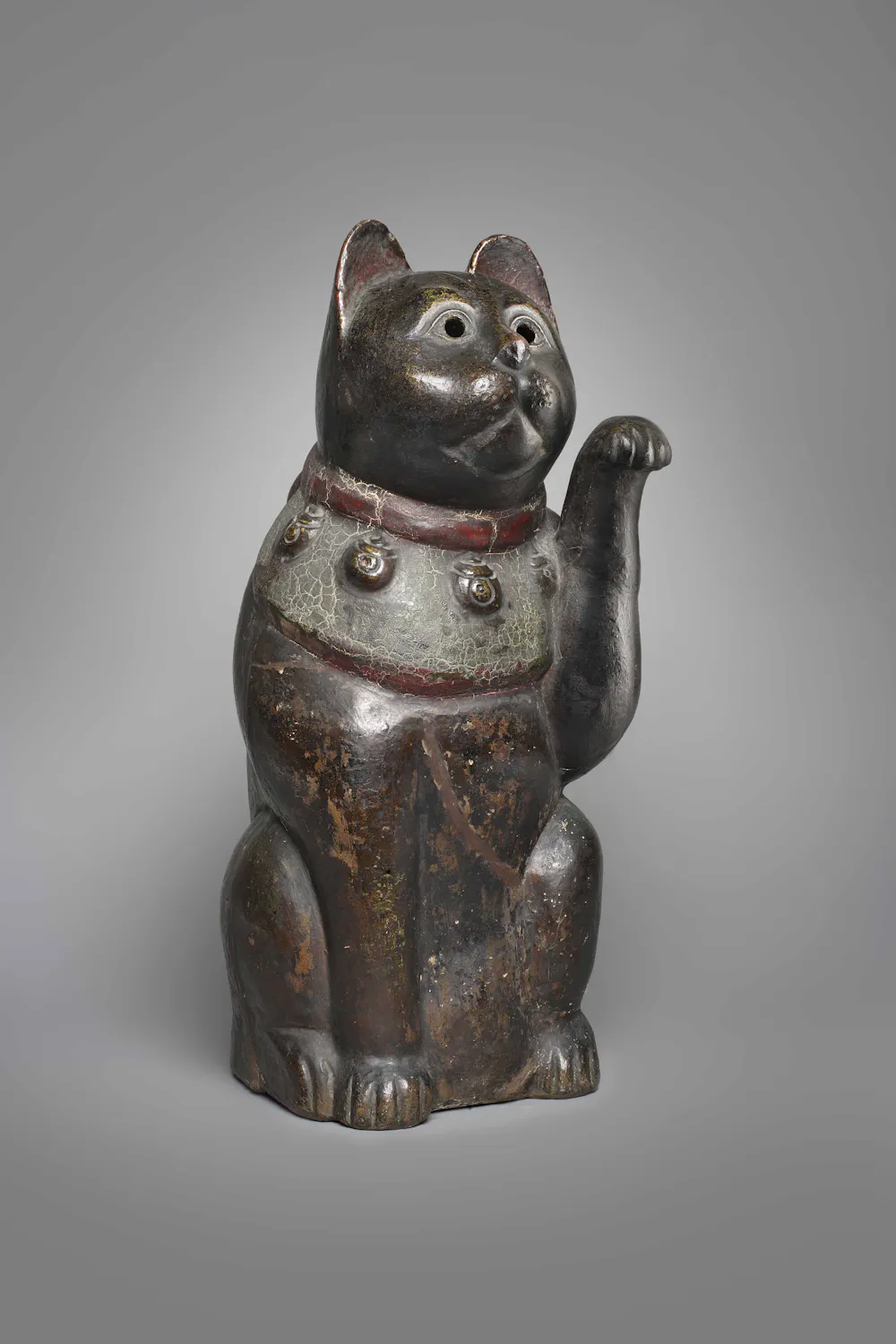 A ceramic maneki neko featuring bells around its neck, circa 1880.
Gift of Billie L. Moffitt/Mingei International Museum, CC BY-NC-SA[10][11]
A ceramic maneki neko featuring bells around its neck, circa 1880.
Gift of Billie L. Moffitt/Mingei International Museum, CC BY-NC-SA[10][11]
Economic prosperity
When and where the ceramic cats began to be sold remains a mystery, but by the late Edo period they found appeal with urban consumers.
Clear evidence of this is found in Utagawa Hiroshige’s ukiyo-e[12] print from 1852, which depicts[13] a stall selling numerous doll cats. But these cats look slightly different from many cats we see in the 21st century; they hold no koban gold coins.
These cats, as seen in today’s Gotokuji cats, wore a bell around their necks, and were said to bring good luck to the owner.
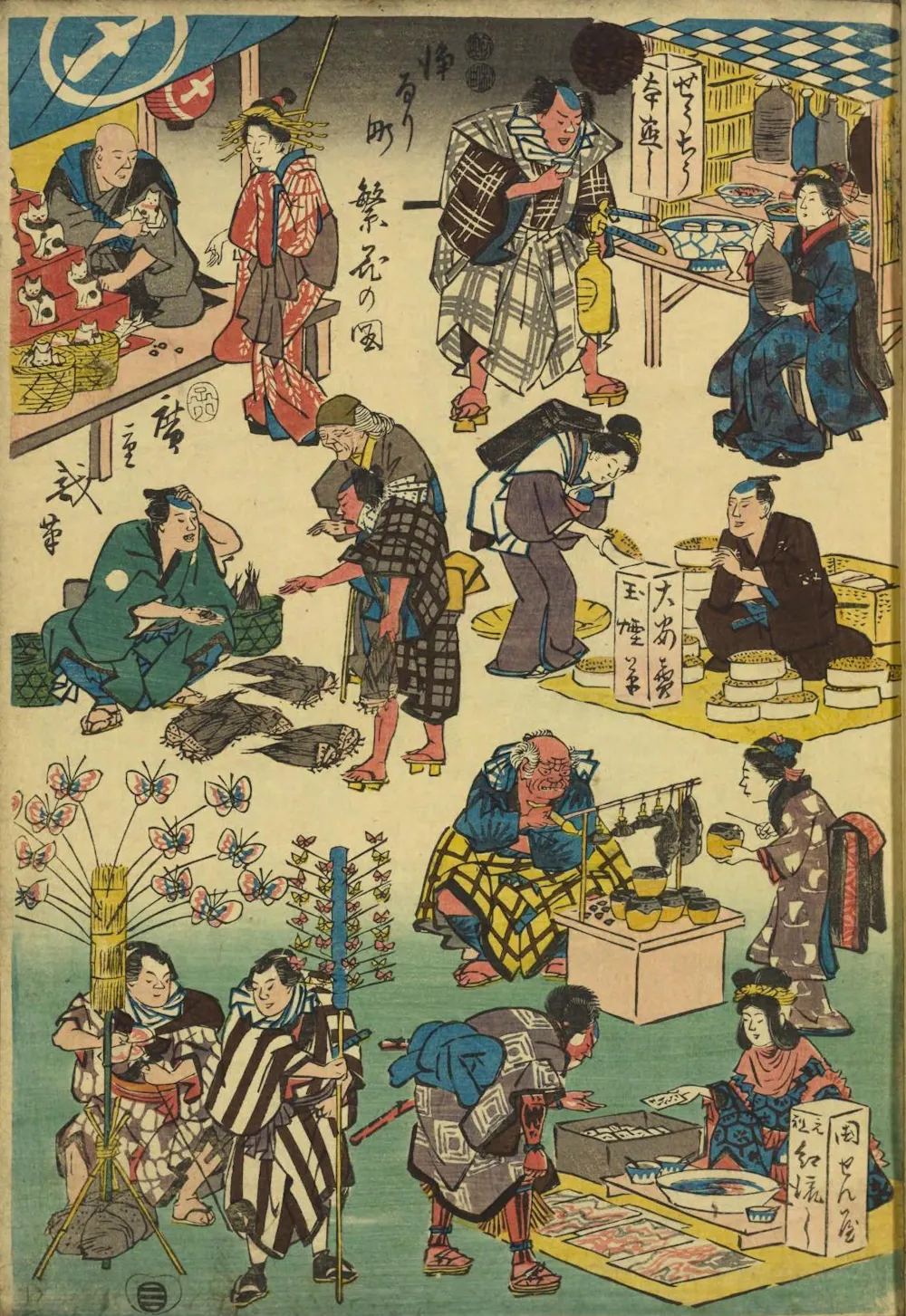 This book illustration from 1852 shows a shop selling maneki-neko.
NDL Digital Collections[14]
This book illustration from 1852 shows a shop selling maneki-neko.
NDL Digital Collections[14]
In the Meiji era (1868-1912) mass production[15] by using plaster moulds made the cat a popular figure nationwide. The cat came to represent material rather than emotional happiness.
By then, bells around cats’ necks were typically replaced with coins – perhaps linked to Japan’s increasing economic prosperity.
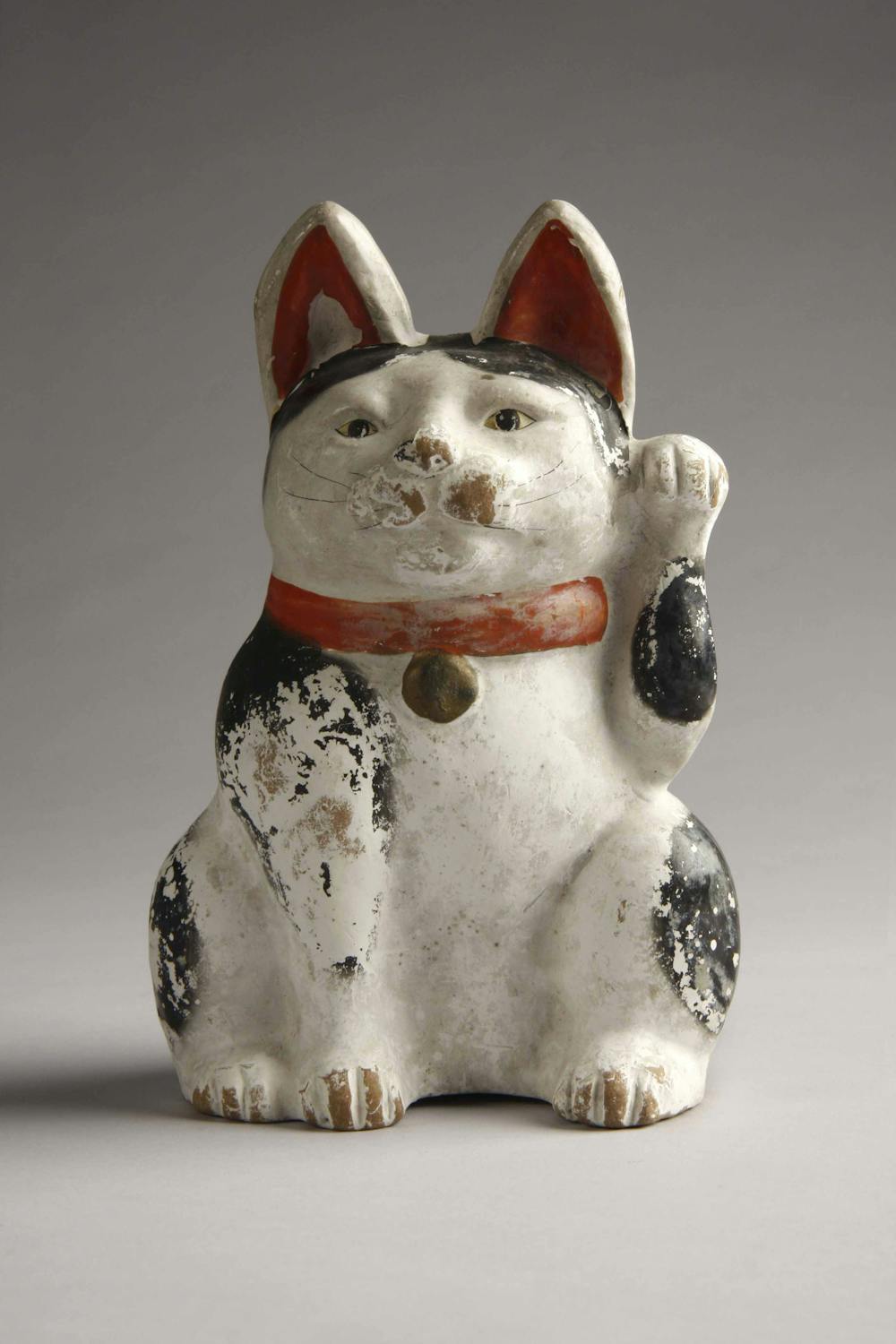 On this 20th century terracotta cat, the bell around its neck has been replaced with a coin.
Gift of Billie L. Moffitt/Mingei International Museum, CC BY-NC-SA[16][17]
On this 20th century terracotta cat, the bell around its neck has been replaced with a coin.
Gift of Billie L. Moffitt/Mingei International Museum, CC BY-NC-SA[16][17]
The earlier ceramic cats looked like cats rather than cartoon characters.
In the 1950s, makers in Aichi Prefecture adapted the form of its local dolls, Okkawa Ningyo[18], onto the dolls of cats. The head became as big as the body and eyes became widely opened.
Later in the century, maneki-neko gained popularity in the Chinese-speaking world through Hong Kong and Taiwan. Altars in Hong Kong tea houses had traditionally been dedicated to legends such as the 3rd century Chinese military general Guan Yu[19], but these days the pretty cats are also featured[20].
The cats then spread globally through a diffusion of Asian culture by Asian migrants.
Today, turn on your phone and launch the Pokemon app. You might soon capture Meowth, a maneki-neko pokemon with a koban (gold coin) on its forehead.
‘Cool Japan’
While in the English-speaking world, it is commonly held that “money doesn’t buy happiness,” it is permissible under Japan’s spiritual code to pray for personal material desires.
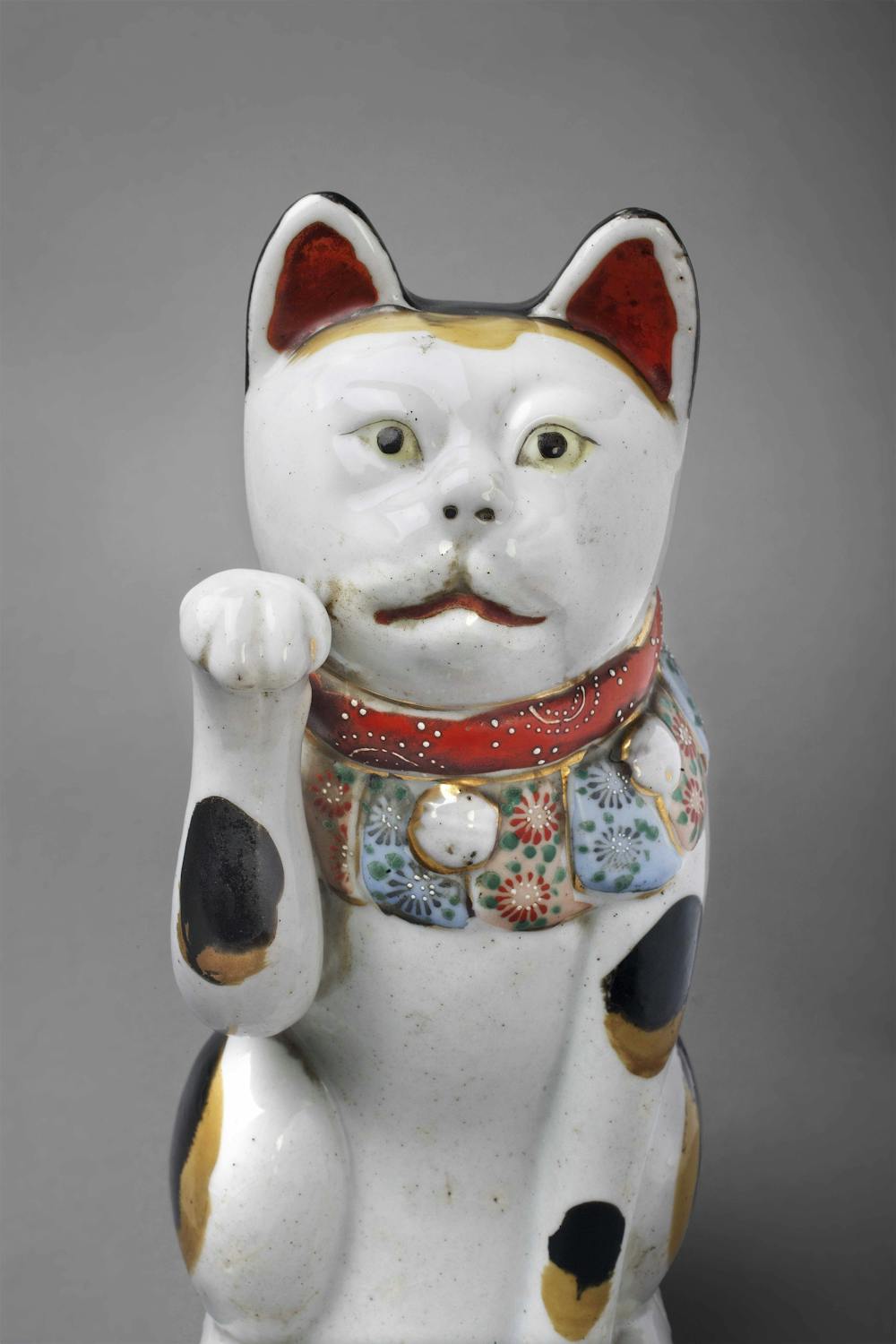 A porcelain maneki-neko from the 20th century.
Gift of Billie L. Moffitt/Mingei International Museum, CC BY-NC-SA[21][22]
A porcelain maneki-neko from the 20th century.
Gift of Billie L. Moffitt/Mingei International Museum, CC BY-NC-SA[21][22]
In contemporary Japan, you are free to ask for and seek what you want – even if what you want is just as simple as meeting the cat.
In addition to the Tokyo temples mentioned above, there are many places where you can meet the cat. Seto City in Aichi Prefecture, an area where ceramic cats have been produced over 100 years, is home to the Maneki-Neko Museum[23].
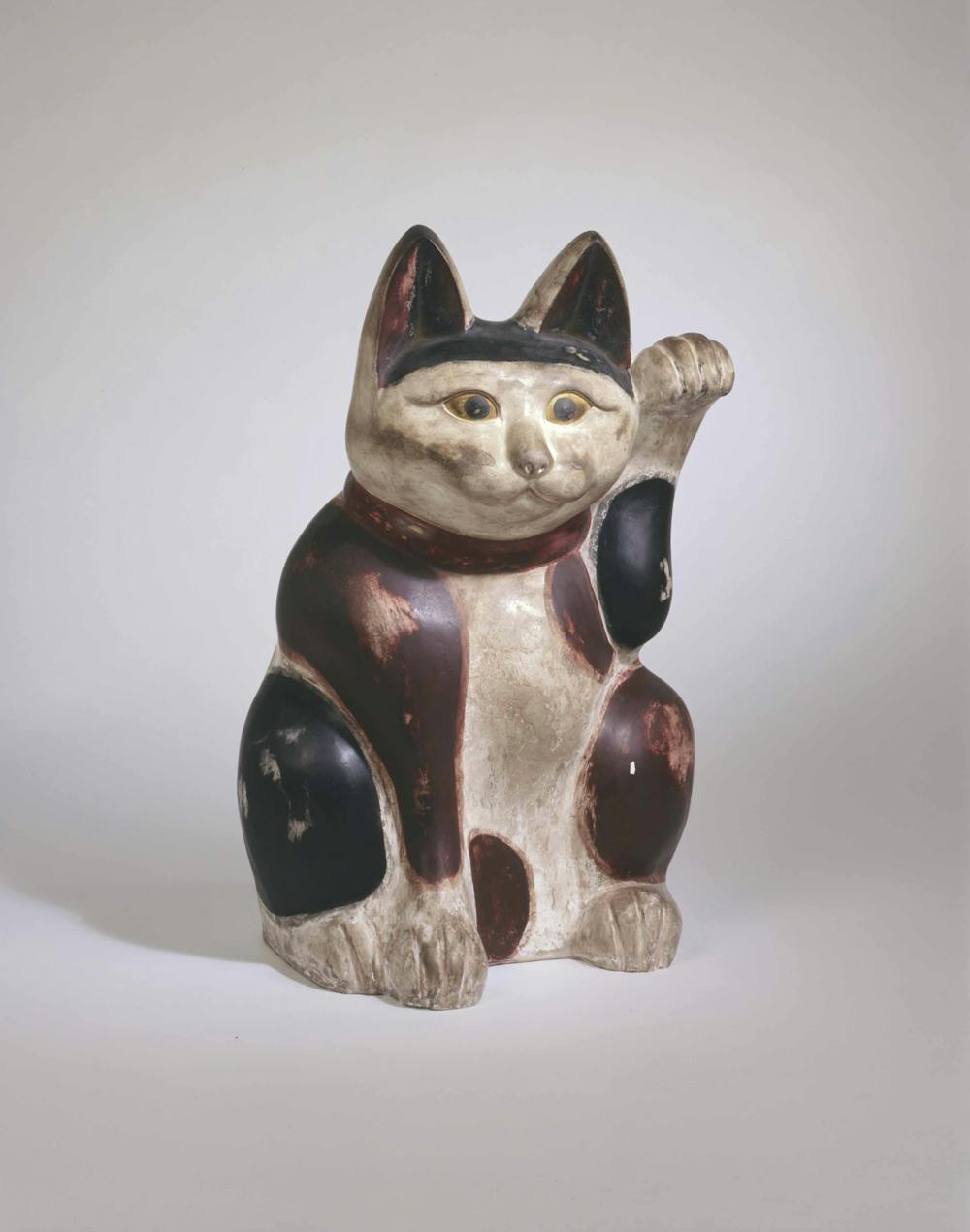 A ceramic cat from 1926.
Gift of Billie L. Moffitt/Mingei International Museum, CC BY-NC-SA[24][25]
A ceramic cat from 1926.
Gift of Billie L. Moffitt/Mingei International Museum, CC BY-NC-SA[24][25]
You can paint your own original cat at the Manekineko Art Museum[26] in Okayama.
At the Hikone Castle[27], you can meet Hikonyan, a mascot created by the local government in 2007 to celebrate the castle’s 400th anniversary. The mascot is a model of the Gotokuji cat that welcomed Ii Naotaka.
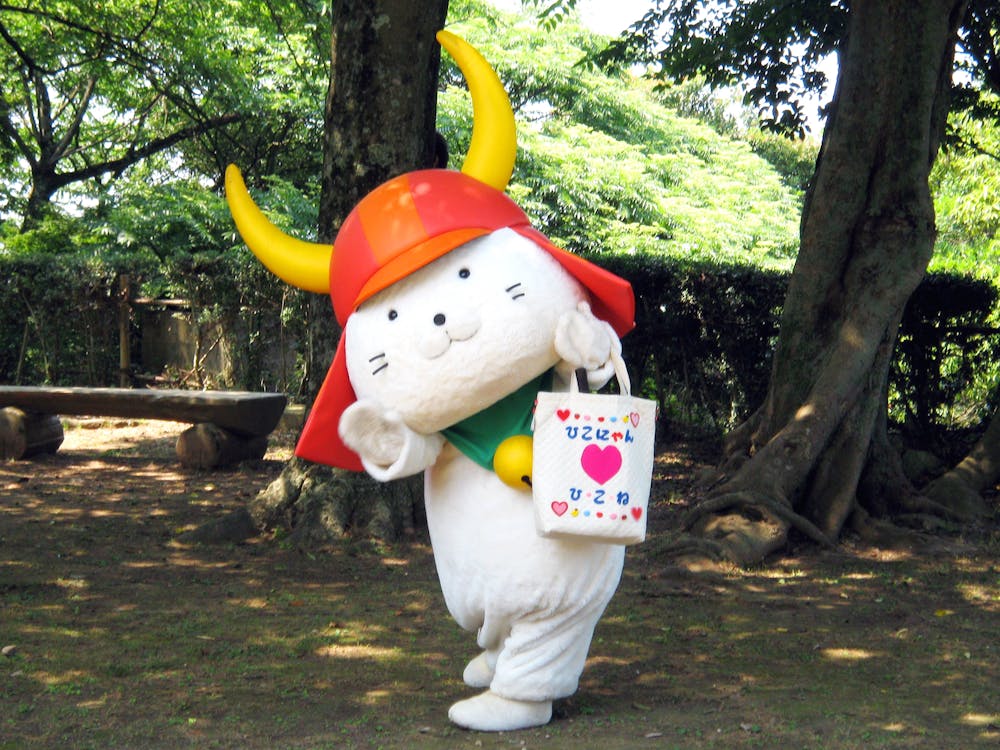 Hikonyan, the mascot of Hikone-jo Castle.
Toshihiro Gamo/flickr, CC BY-NC[28][29]
Hikonyan, the mascot of Hikone-jo Castle.
Toshihiro Gamo/flickr, CC BY-NC[28][29]
The Japanese equivalent of the phrase “cast pearls before swine” is “cast coins before cats[30]”.
And so maneki-neko, the pretty cat, welcomes you – and your money.
This feline welcome nicely reflects Japan’s soft power policy known as “Cool Japan[31]”. Japan wants to use its cultural assets to attract international consumers and visitors to contribute to its economic revitalisation in the era when the county’s population is declining. We are most welcome to spend money in Japan.
Read more: Suzume builds on a long line of Japanese art exploring the impacts of trauma on the individual and the collective[32]
References
- ^ few thousand years ago (www.gmnh.pref.gunma.jp)
- ^ eighth century (crd.ndl.go.jp)
- ^ Tokyo National Museum/ColBase (colbase.nich.go.jp)
- ^ Ancient DNA reveals how cats conquered the world (theconversation.com)
- ^ Gotokuji (gotokuji.jp)
- ^ Saihoji (nishisugamo-saihoji.com)
- ^ Jishoin (tesshow.jp)
- ^ Gift of Billie L. Moffitt/Mingei International Museum. (collections.mingei.org)
- ^ CC BY-NC-SA (creativecommons.org)
- ^ Gift of Billie L. Moffitt/Mingei International Museum (collections.mingei.org)
- ^ CC BY-NC-SA (creativecommons.org)
- ^ ukiyo-e (www.metmuseum.org)
- ^ which depicts (dl.ndl.go.jp)
- ^ NDL Digital Collections (dl.ndl.go.jp)
- ^ mass production (setomanekineko.jp)
- ^ Gift of Billie L. Moffitt/Mingei International Museum (collections.mingei.org)
- ^ CC BY-NC-SA (creativecommons.org)
- ^ Okkawa Ningyo (www.pref.aichi.jp)
- ^ Guan Yu (en.wikipedia.org)
- ^ also featured (spc.jst.go.jp)
- ^ Gift of Billie L. Moffitt/Mingei International Museum (collections.mingei.org)
- ^ CC BY-NC-SA (creativecommons.org)
- ^ Maneki-Neko Museum (luckycat.ne.jp)
- ^ Gift of Billie L. Moffitt/Mingei International Museum (collections.mingei.org)
- ^ CC BY-NC-SA (creativecommons.org)
- ^ Manekineko Art Museum (manekineko-m.jp)
- ^ Hikone Castle (hikone-hikonyan.jp)
- ^ Toshihiro Gamo/flickr (www.flickr.com)
- ^ CC BY-NC (creativecommons.org)
- ^ cast coins before cats (www.wasshoimagazine.org)
- ^ Cool Japan (www.globalasia.org)
- ^ Suzume builds on a long line of Japanese art exploring the impacts of trauma on the individual and the collective (theconversation.com)
Read more https://theconversation.com/what-is-the-story-of-maneki-neko-the-japanese-beckoning-cat-203906