An expert explains the stranding of 97 pilot whales in WA and their mysterious 'huddling' before the tragedy
- Written by: Kate Sprogis, Adjunct Research Fellow, UWA Oceans Institute, The University of Western Australia
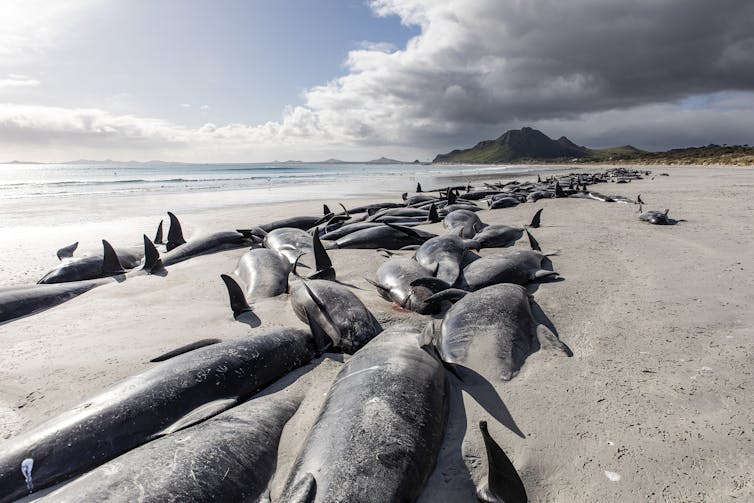
Sad scenes are unfolding in Western Australia after a pod of pilot whales became stranded[1] on a beach late on Tuesday. According to the latest reports, 51 of the whales have died. Some 46 remain beached and authorities are working desperately to get them back out to sea.
Pilot whale strandings unfortunately occur in WA, and other Australian states[2], from time to time. In recent years they have also occurred in New Zealand[3] and Scotland[4]. But this stranding is unusual because of the behaviour the whales exhibited prior to becoming beached.
The pod of long-finned pilot whales began congregating in the ocean off Cheynes Beach on Monday evening. They remained in a “huddle” on Tuesday, raising fears a stranding was imminent.
I am a marine biologist who specialises in marine mammals. I am based at the University of Western Australia’s Albany campus, about 70 kilometres from where the stranding occurred. Sadly, the chances of survival for the remaining whales is very low – and time is fast running out.
Understanding pilot whales
There are two species of pilot whales: short-finned (which live mainly in tropical and warm-temperate regions) and long-finned (generally found in colder waters). As the name suggests, the long-finned pilot whales have longer pectoral fins than their counterparts.
The pilot whales stranded at Cheynes Beach are long-finned. They are generally found offshore, in the deep open ocean. We rarely see them close to the coast. This makes the species hard to study.
Pilot whales are, however, known to inhabit Bremer Canyon[5], a very deep ocean area 70 kilometres off the WA coast.
Read more: About 200 dead whales have been towed out to sea off Tasmania – and what happens next is a true marvel of nature[6]
What happened at Cheynes Beach?
The group of whales was spotted swimming in shallow waters at Cheynes Beach late on Monday. An official from the Department of Biodiversity, Conservation and Attractions called me on Tuesday morning, and asked about the strange huddling behaviour. I was immediately concerned.
Healthy pilot whales do not form huddles, so something seemed very wrong. The department’s drone footage showed the pod was forming a very tight ball, then moving into a line, then back into the ball shape. And the pod was in very shallow coastal water, which is odd.
We suspected the behaviour was a precursor to a stranding. The department prepared its whale stranding kit and had officials on standby in case a stranding occurred. Unfortunately, it did.
By 4pm on Tuesday, almost 100 whales had beached themselves. Officials monitored them overnight. By Wednesday morning, 51 had died.
This is unsurprising. And sadly, the chance of survival for the remaining whales is very low. Cold, windy conditions means the whales are susceptible to hypothermia. And if they are already sick – as is sometimes the case with beached whales – this combination of factors can be fatal.
What’s more, whales are not used to the pressure of gravity we experience on land. When whales are stranded, their organs can collapse[7] due to the weight of their own body.
In some cases, long-finned pilot whales have been known to survive[8] after being stranded. But time is of the essence.
Why did the whales beach themselves?
In 2015, another pod of pilot whales beached itself[9] in Bunbury, north of Albany. Sadly, 12 died. At the time, I and a colleague conducted necropsies – scientific examinations of animals after death – but the findings were inconclusive.
Whale strandings cannot be predicted and we do not know exactly why they occur. But in the case of pilot whales, their social behaviour offers some clues.
Pilot whales are similar to elephants in that they live in tight-knit family groups[10]. It’s thought mass strandings may occur when the matriarch of the group is sick and swims into shallow water, and the others follow[11], or are “piloted”.
Whales may also become stranded due to an external stress. For example, whales use sound to communicate, navigate and search for food. Loud man-made underwater noises can disrupt[12] this system.
Read more: What causes whale mass strandings?[13]
What next?
Officials at Cheynes Beach are trying to refloat the whales. Researchers are also taking biopsy samples and nasal swabs from the dead whales.
Experts will examine the swabs and samples, to try and understand more about this stranding event. I anticipate they will look for evidence of illness such as influenza or cetacean morbillivirus, as well as stress from underwater noise.
You might also be wondering what everyday people can do to help. If you observe marine mammals behaving unusually or getting stranded, alert authorities. And please stand aside to let authorities and other experts do their work. This is vital for the welfare of the animals and the safety of both helpers and bystanders.
Right now, I feel a bit helpless. I would like to be able to answer everyone’s primary question: why do pilot whales become stranded? It is a long-standing mystery in marine mammal science, and we don’t really know the answer.
More research is needed. Scientists need funding to attend mass strandings, collect and analyse samples and write up the findings. That gives us the best chance of piecing together this complicated puzzle.
Read more: Whale-watching guidelines don't include boat noise. It's time they did[14]
Correction: An earlier version of this article said 87 whales were stranded, rather than 97.
References
- ^ became stranded (www.theguardian.com)
- ^ other Australian states (www.theguardian.com)
- ^ New Zealand (www.pbs.org)
- ^ Scotland (www.nytimes.com)
- ^ Bremer Canyon (www.jerramungup.wa.gov.au)
- ^ About 200 dead whales have been towed out to sea off Tasmania – and what happens next is a true marvel of nature (theconversation.com)
- ^ collapse (www.australiangeographic.com.au)
- ^ known to survive (www.publish.csiro.au)
- ^ beached itself (www.watoday.com.au)
- ^ tight-knit family groups (pubmed.ncbi.nlm.nih.gov)
- ^ follow (www.npr.org)
- ^ disrupt (www.cbd.int)
- ^ What causes whale mass strandings? (theconversation.com)
- ^ Whale-watching guidelines don't include boat noise. It's time they did (theconversation.com)