a bushfire scientist explains what the Hawaii tragedy means for our flammable continent
- Written by: David Bowman, Professor of Pyrogeography and Fire Science, University of Tasmania
As I hear reports of the fire tearing through the Hawaiian island of Maui, I feel utterly depressed. As a fire scientist, I know the unfolding horror – which has killed 36 people[1] so far – is just the beginning. It’s a portent of what Australia and other countries will experience in a warmer world.
For Australians, the reports inevitably bring back memories of our awful Black Summer in 2019-20. Like the Maui tragedy, those huge, uncontrollable bushfires were a terrifying glimpse of the intense fires we can expect as climate change worsens.
Global warming – the result of fossil fuel burning – means bushfires will become more frequent and severe. Of course, we must reduce greenhouse gas emissions. That is blindingly obvious.
But we must do more than that. Australians must urgently adapt to our fiery future.
Record-breaking heat and fires
The Maui fires have been fuelled by[2] strong winds, dry vegetation and low humidity. People were forced to run into the ocean for safety. Hundreds of structures have been damaged or ruined and many people are injured.
Hawaii is not the only part of the northern hemisphere being ravaged by fire.
In recent weeks, wildfires have ripped through through Canada, Greece, Spain, Portugal and elsewhere. At one point, 1,000 fires[3] were burning in Canada alone.
The fires have in part been fuelled by record-high temperatures. In July, temperatures reached 53.3℃ at California’s Death Valley. In fact, July was Earth’s hottest month[4] on record.
The southern hemisphere is also experiencing highly unusual conditions. Antarctica is struggling to freeze over; it’s reportedly missing a chunk of ice bigger than Greenland[5].
And Australia is experiencing an unseasonably warm[6] winter. The country looks set for a hot, dry, El Nino-fuelled summer, putting fire crews on high alert[7].
Read more: Maui's deadly wildfires burn through Lahaina – it's a reminder of the growing risk to communities that once seemed safe[8]
Australians must heed the warnings
Australia, too, is fast becoming a continent of more uncontrolled fire.
Let’s look at the two decades to 2001, compared to the two decades afterwards. In Australian forests, the average annual burned area in the second period was 350% greater than[9] in the first. If we include 2019 – the year the Black Summer fires began – the increase rises to 800%.
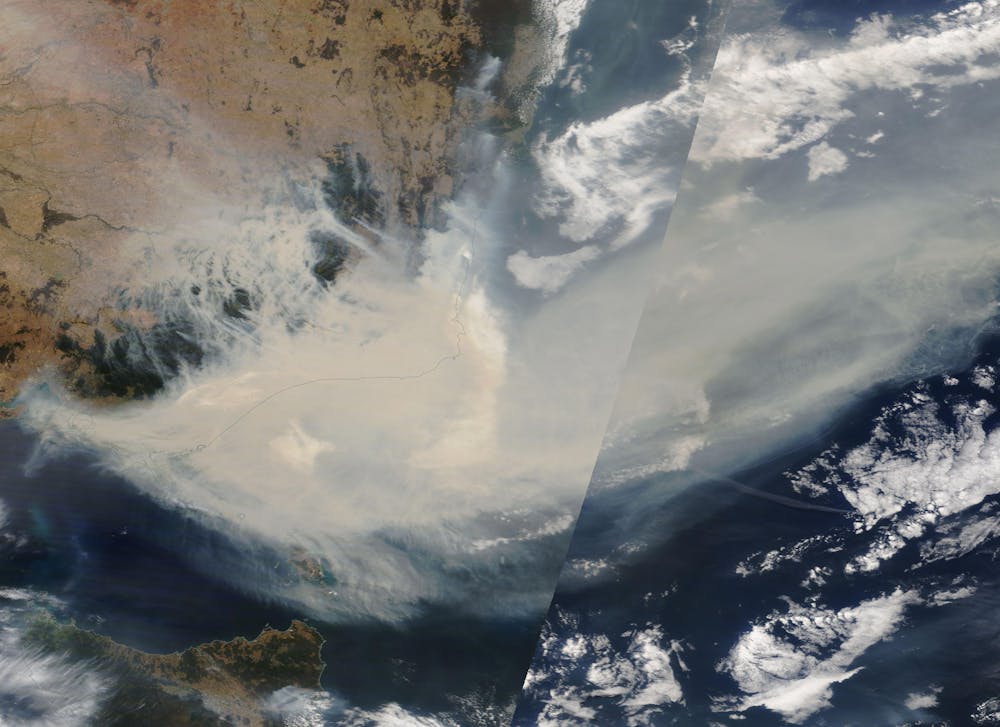
The Black Summer fires were started by lightning and human activity. They were fuelled by extreme heat, record low rainfall and widespread dieback of vegetation. It meant the fires burned at unprecendented[10] intensity.
The Black Summer fires burned more than 24 million hectares nationally. Some 33 people were killed by the fires, more than 429 died from smoke-related effects, and more than 3,000 homes were destroyed.
The drying and warming that drove the Black Summer fires are linked to human-caused climate change. These changes are resulting in longer fire seasons and extended periods of drought.
As I watch the fires blazing in Hawaii, I’m constantly asking myself: when will Australians – who live on one of the most fire-prone continents on Earth – get a grip on this escalating global problem? How many more warning signs do we need?
Read more: Australia's Black Summer of fire was not normal – and we can prove it[11]
What must be done
When the bushfire royal commission handed down its report in October 2020, I described it as a “clarion call for change[12]”. Finally, Australia had a map for its journey toward adapting to fires and other natural disasters.
The scope of the commission’s recommendations was vast. For governments alone, it called for changes across land-use planning, infrastructure, emergency management, social policy, agriculture, education, physical and mental health, community development, energy and the environment.
The commission also called for an acknowledgement of the role of Indigenous fire managers in mitigating bushfire risks.
Almost three years on, we haven’t seen the changes needed. We’re behaving as if we’ve got an endless amount of time. Australia is sleepwalking into our fiery future.
The pandemic shows humans are amazingly adaptable. We used an integrated approach to mitigate and adapt to that threat. We need an equivalent response to adapt to fire and climate change – but it’s just not happening.
There is much Australia can do to adapt to fire. We can improve our urban planning regimes and building standards. We can better manage fuel loads in our forests. We can increase our firefighting capacity and get much better at bushfire preparation and early warning systems.
And importantly, we should draw on Indigenous knowledge and the expertise of Aboriginal communities. These approaches could prove vital not only managing extreme fires in Australia, but elsewhere in the world.
Looking ahead
One thing Australians can all agree on is that we don’t want catastrophically uncontrolled fires.
As our Black Summer showed, these fires not only destroy lives, homes and biodiversity. They actually threaten the Earth’s systems. Black Summer pumped huge amounts of carbon into the atmosphere. It depleted[13] the ozone layer. It created an algal bloom[14] in the Southern Ocean bigger than the Australian continent.
It’s vital that we slash greenhouse gas emissions as quickly as possible, to stabilise Earth’s climate. But that’s not sufficient. Australians have to adapt to fire, too.
The fires in Hawaii remind Australians that our summer is just around the corner. We don’t have much time.
Read more: Canada wildfires: an area larger than the Netherlands has been burned so far this year -- here's what is causing them[15]
References
- ^ killed 36 people (theconversation.com)
- ^ fuelled by (www.scientificamerican.com)
- ^ 1,000 fires (www.theglobeandmail.com)
- ^ hottest month (theconversation.com)
- ^ bigger than Greenland (theconversation.com)
- ^ unseasonably warm (theconversation.com)
- ^ high alert (www.theguardian.com)
- ^ Maui's deadly wildfires burn through Lahaina – it's a reminder of the growing risk to communities that once seemed safe (theconversation.com)
- ^ 350% greater than (www.nature.com)
- ^ unprecendented (www.mdpi.com)
- ^ Australia's Black Summer of fire was not normal – and we can prove it (theconversation.com)
- ^ clarion call for change (theconversation.com)
- ^ depleted (www.abc.net.au)
- ^ algal bloom (theconversation.com)
- ^ Canada wildfires: an area larger than the Netherlands has been burned so far this year -- here's what is causing them (theconversation.com)