Can a Buddhist eat meat? It's complicated
- Written by: Anya Daly, Senior Lecturer in Philosophy and Ethics, University of Tasmania
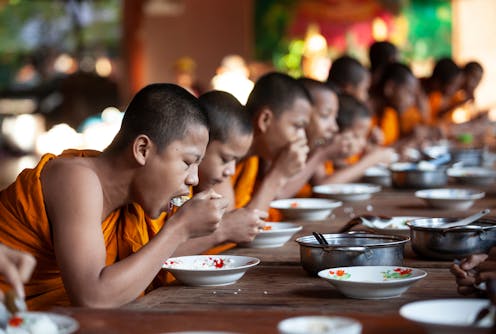
Some Buddhists are strictly vegetarian, and others eat meat. Both justify their positions on the basis of Buddhist texts and teachings.
In the Mahayana Buddhist traditions[1] of China, Taiwan, Vietnam and Korea, meat-eating is prohibited. In others, such as in some Theravadin traditions[2] and Tibetan Buddhism, meat-eating is acceptable. In certain circumstances it may be encouraged for health, or for ritual tantric practices, comparable to Christians eating the host – the body of Christ.
Being minimally Buddhist requires the practitioner to follow at least the first precept of non-killing. When someone makes a commitment to become a part of the Buddhist Community (called Sangha), the Buddha asks them to take five basic precepts. The first precept is usually formulated along these lines: “I shall abstain from destroying any breathing beings.”
This tradition of precept-taking was introduced by the Buddha himself. The implication is that the first precept pertains to all living sentient creatures. Dedicated practitioners will go to great lengths to avoid destroying any life, to the extent of being careful where they step so that they do not squash even an ant.

In the Long Discourses of the Buddha (Dīgha Nikāya)[3], it is written that the Buddhist practitioner must act in a manner that is “scrupulous, compassionate, trembling for the welfare of all living beings”.
Geography is a crucial factor in explaining why Tibetans have traditionally been big meat-eaters. Rice, vegetables and fruit were impossible to cultivate at the high elevations of the Himalayan mountains and plateaus. Altitude combined with the inaccessibility of much of Tibet thus prevented a diverse source of nutrition and so goat or yak meat, and various milk products, all high calorie foods, ensured survival.
To get around the direct responsibility for killing, Tibetan villages traditionally had resident Muslims who butchered the animals. Understandably, some might suggest this was a rather convenient arrangement.
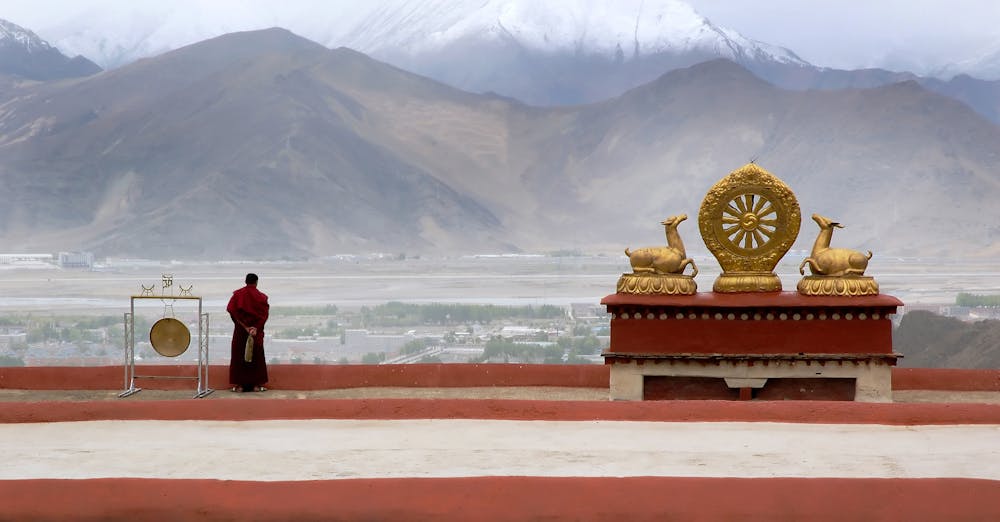 Geography is a key reason why Tibetan Buddhists have traditionally eaten meat.
Shutterstock
Geography is a key reason why Tibetan Buddhists have traditionally eaten meat.
Shutterstock
Meat-eating in the Theravadin tradition may have been justified partly because of legal precedent or permissibility. Firstly, the monks are required to dutifully accept whatever food is given to them by the laity to avoid attachment to any particular tastes, so if somebody offers meat to a monk, he has to consume it.
Secondly, a monk is allowed to consume meat if it is deemed “pure” on three grounds: if the killing of the animal has not been witnessed or heard by that monk and if it is not suspected to have been killed on purpose for them.
Read more: Guide to the classics: the Tibetan Book of the Dead[4]
An irony
In one of the key Buddhist texts, The Connected Discourses of the Buddha[5] (Saṃyutta Nikāya), Buddha presents the case against meat-eating within the context of a broader rejection of violence – which causes suffering to both victim and perpetrator. Connected with this is a rejection of working in the meat trades.
But this is challenged by the fact that under the Buddhist Vinaya (moral codes)[6] meat-eating is permissible for monks. A great irony is that the Buddha himself died eating contaminated pork.
As a monk he was obliged to eat whatever was offered, and so it is said that he ate the contaminated pork[7] – some suggest knowingly. Others dispute this by asserting he consumed poisoned mushrooms.
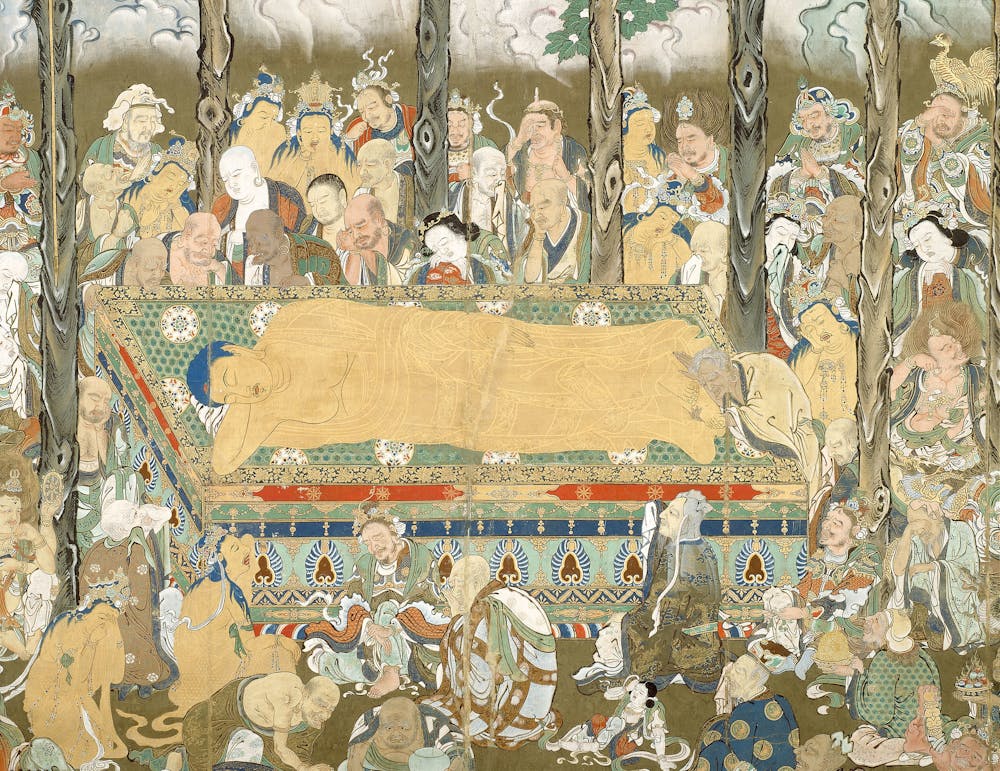 Nehan: Death of the Buddha by an anonymous artist, circa 1600-1700.
Wikimedia Commons
Nehan: Death of the Buddha by an anonymous artist, circa 1600-1700.
Wikimedia Commons
Two key Buddhist texts, the Descent into Lanka-sūtra (Laṅkāvatāra Sūtra)[8] and The Great Passing Away-Sūtra (Mahāparinirvāna Sūtra[9]) address the issues of meat-eating. They stress the importance of compassion and not using the Vinaya as an excuse to eat meat.
Comparisons with Christianity
Nevertheless, the contemporary Buddhist stance on animal ethics and meat-eating appears very inconsistent to outsiders and sometimes even to Buddhists themselves.
Here, a brief comparison with Christianity is instructive. Christian authorities propose that God gave humans dominion over animals. For much of the history of Christianity, the suffering of animals has been ignored. Humans are seen as higher on the Chain of Being due to their having souls.
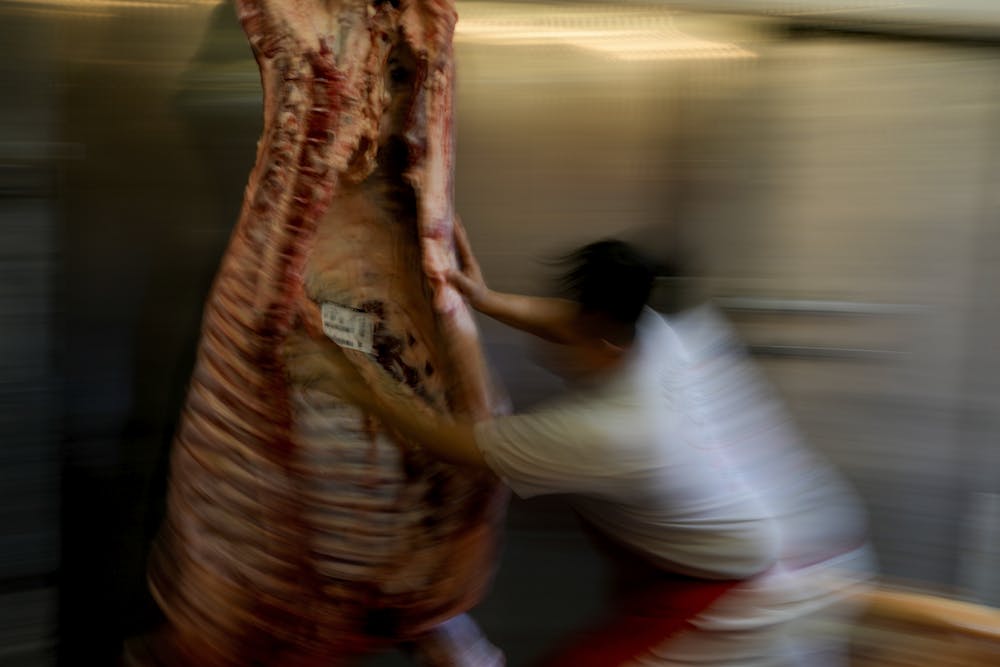 Meat in a butcher’s shop: Christianity proposes that God gave humans dominion over animals.
Natacha Pisarenko/AP
Meat in a butcher’s shop: Christianity proposes that God gave humans dominion over animals.
Natacha Pisarenko/AP
Read more: Friday essay: what do the 5 great religions say about the existence of the soul?[10]
More recently, stewardship has been emphasised – while humans can use animals for survival they must do so in a humane manner.
Buddhism presents two conflicting views. All sentient beings deserve compassion and have Buddha-Nature. However, humans are a higher life-form by virtue of their capacities to pursue ethical and meditational practices leading to enlightenment.
The inherent Buddha Nature of any animal or even insect is the same as that of a human being. Nonetheless, some Buddhists would argue that meat-eating is acceptable for health as long as the energy gained from the dead animal is dedicated to pursuing an ethical life, which ultimately benefits all sentient beings.
Indeed it is said in the tantric tradition of Buddhism[11], that when a highly realised teacher eats meat it serves to benefit the dead animal in the next life. Within the context of tantric ritual practice, both meat and alcohol are consumed. However, a tiny meat morsel, as well as a finger-dip of alcohol, is sufficient.
Buddhist meat-eaters thus invoke a very particular form of human exceptionalism grounded in metaphysics and in the spiritual aspirations and capacities of humans.
Read more: How the Buddha became a Christian saint[12]
Animal ethics
Why might this be of interest to the general public? Thanks to the UK’s Animal Welfare (Sentience) Act, 2022[13]), animals are now formally recognised as sentient beings. This is a momentous advance for animal ethics.
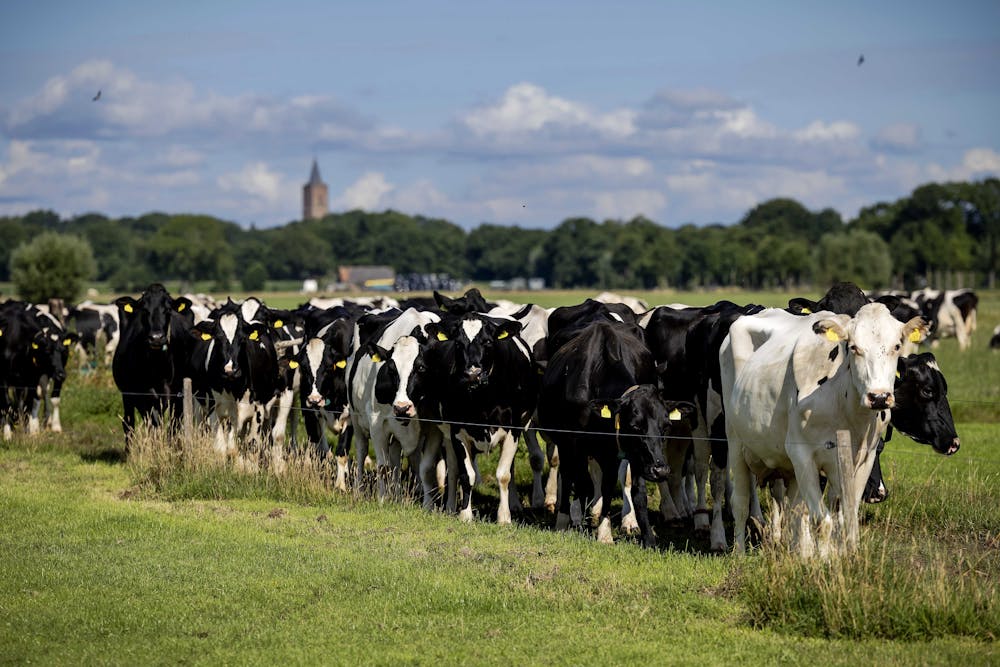 Under UK law, animals are now recognised as sentient beings.
Robin Van Lonkhuijsen/EPA
Under UK law, animals are now recognised as sentient beings.
Robin Van Lonkhuijsen/EPA
Buddhism is one of the fastest growing religions in many countries due to migration patterns and the religion’s adaptability and coherence with science, so its stance on animal ethics[14] is important.
What this non-violent religion proposes on such issues is especially relevant in our times with many people adopting vegetarian and vegan lifestyles due to the link between meat-eating, industrial farming and climate change.
Can or even should a Buddhist eat meat? The answer is complicated and needs to take account of tradition and circumstances. Many practising Buddhist Tibetans in the West have now become vegetarian due to the diversity of foods available. There are even vegetarian momos[15]!
For those interested in the broader debates around animal ethics and Buddhism try Sentience and the Primordial ‘We’: Contributions to Animal Ethics from Phenomenology and Buddhist Philosophy or Environmental Values, online.[16][17]
References
- ^ Mahayana Buddhist traditions (medium.com)
- ^ Theravadin traditions (bswa.org)
- ^ Long Discourses of the Buddha (Dīgha Nikāya) (www.goodreads.com)
- ^ Guide to the classics: the Tibetan Book of the Dead (theconversation.com)
- ^ The Connected Discourses of the Buddha (www.simonandschuster.com)
- ^ Buddhist Vinaya (moral codes) (bswa.org)
- ^ contaminated pork (pubmed.ncbi.nlm.nih.gov)
- ^ the Descent into Lanka-sūtra (Laṅkāvatāra Sūtra) (www.mnzencenter.org)
- ^ The Great Passing Away-Sūtra (Mahāparinirvāna Sūtra (www.buddhism.org)
- ^ Friday essay: what do the 5 great religions say about the existence of the soul? (theconversation.com)
- ^ tantric tradition of Buddhism (tricycle.org)
- ^ How the Buddha became a Christian saint (theconversation.com)
- ^ Animal Welfare (Sentience) Act, 2022 (theconversation.com)
- ^ animal ethics (www.abc.net.au)
- ^ momos (www.yowangdu.com)
- ^ Sentience and the Primordial ‘We’: Contributions to Animal Ethics from Phenomenology and Buddhist Philosophy (www.ingentaconnect.com)
- ^ Environmental Values, online. (www.ingentaconnect.com)
Read more https://theconversation.com/can-a-buddhist-eat-meat-its-complicated-207117