Hopes fade for ‘room temperature superconductor’ LK-99, but quantum zero-resistance research continues
- Written by: Michael Fuhrer, Professor of Physics, Monash University
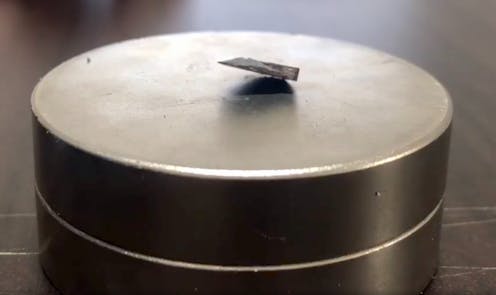
The past few weeks have seen a huge surge of interest among scientists and the public in a material called LK-99[1] after it was claimed to be a superconductor at room temperature and ambient pressure.
LK-99 garnered attention after South Korean researchers posted two[2] papers[3] about it on arXiv, a non-peer-reviewed repository for scientific reports, on July 22. The researchers reported possible indicators of superconductivity in LK-99, including unexpectedly low electrical resistance and partial levitation in a magnetic field.
The potential discovery drew enthusiasm on social media and was widely reported in traditional[4] media too. As a physicist working on quantum phenomena in materials, I was gratified to see the interest in superconductivity, and I shared in the excitement about the report. But I also approached the results with scepticism, especially since many previous reports of room-temperature superconductivity have failed to be reproduced.
Now, after follow-up experiments by scientists around the world, it seems LK-99 is not so special after all[5]. However, while this particular avenue of research may be a dead end, the dream of a room-temperature superconductor is still very much alive.
What is a superconductor, and why are they useful?
You’re probably familiar with ordinary conductors, like metals, in which electrons can move fairly easily through the “crystal lattice” of atoms that makes up the material. This means an electric current can flow – but the electrons are jostled around a bit as they move, so they lose energy as they travel. (This jostling is called electrical resistance.)
In a superconductor, there is zero resistance and an electrical current can flow perfectly smoothly without losing any energy. Many metals become superconductors at very low temperatures.
Superconductivity occurs when the electrons slightly distort the crystal lattice of the metal in a way that makes them team up into “Cooper pairs”. These pairs of electrons then “condense” into a superfluid, a state of matter that can flow without friction.
Superconductors are very useful. They can be used to create extremely powerful electromagnets, such as those in MRI scanners, particle accelerators, fusion reactors and maglev trains.
Current superconductors work only at ultra-cold temperatures, so they require expensive refrigeration. A material that superconducts at everyday temperature and pressure could be used much more widely.
Currently, the highest superconducting temperatures at ambient pressure are around –138℃ (135 Kelvin), found in “cuprate” superconductors, a family of copper-containing compounds discovered unexpectedly in 1986. Electron pairing in the cuprates appears to involve a different mechanism than interaction with the lattice.
However, while our understanding of such exotic superconductors has improved, we still can’t yet predict with any certainty new materials which could superconduct at even higher temperature. Still, there is no reason to think this can’t be achieved. Moreover, many if not most superconducting materials are discovered serendipitously – so a claimed discovery of an unexpected room-temperature superconductor can’t be dismissed out of hand.
So what about LK-99?
LK-99 is a compound containing oxygen, phosphorus, lead and copper. Little was known about the material when the papers claiming superconductivity emerged. For example, it wasn’t even known whether it should conduct electricity at all.
The report of superconductivity at ambient conditions sparked a crash effort from researchers around the world to understand the material and reproduce the results. While it is still early days, and neither the initial report nor the follow-ups[6] have been peer-reviewed, a picture has started to emerge that the LK-99 compound described by the authors is not[7] a superconductor[8], and not even[9] a metal[10].
Read more: Viral room-temperature superconductor claims spark excitement – and skepticism[11]
So if it’s not a superconductor, why did the original researchers think it was? One study has pointed out[12] that an impurity in the initial LK-99 samples, cuprous sulfide, could explain some of what they saw.
Cuprous sulfide experiences a sudden, large change in resistance at a temperature of around 127℃ (400K). The first researchers saw this drop in resistance and attributed it to superconductivity in LK-99, but it is more likely explained by very low (not zero) resistance in the cuprous sulfide impurity.
The partial levitation of LK-99, which might have indicated a property of superconductors called “magnetic flux pinning[13]”, seems to be caused by ferromagnetism, a familiar effect that occurs in iron and many other materials.
So while nobody has proven the LK-99 samples studied in the original reports don’t superconduct, the balance of evidence right now is strongly in favour of other explanations. Most scientists studying superconductivity don’t see much reason to continue looking at LK-99.
Excitons and beyond
What’s next for superconductivity research? Well, we can cross LK-99 off the list of materials to study, but the search goes on.
In fact, there has been a lot of progress in the past few years towards creating zero resistance under ordinary conditions.
Read more: Room-temperature superconductors could revolutionize electronics – an electrical engineer explains the materials' potential[14]
Making electrons pair together is the key to superconductivity, but this is hard to do as they naturally repel each other. However, it’s possible to make an electron pair up with a “hole” in a material – a gap where an electron should be.
These electron–hole pairs are called excitons, and they can be combined with light to form a frictionless superfluid[15] at room temperature. This superfluid doesn’t carry an electrical current (because the charges of the electron and the hole cancel out), but separating the electron and hole[16] might allow supercurrents without resistance[17].
Topological insulators
An alternate route to zero resistance at room temperature has been found in so-called topological insulators[18]. These are materials that only allow electrons to move along their edges or surfaces, in some cases with no resistance.
Graphene, a material made of sheets of carbon only a single atom thick, can be turned into a topological insulator[19] in a strong magnetic field. But the required magnetic field is so extreme it can only be realised in a few laboratories in the world.
There are also other types of topological insulators that work without an externally applied magnetic field. Current versions of these materials show zero resistance only at very low temperatures, but there appears to be no reason they couldn’t work at room temperature.
Unfortunately superfluid excitons and topological insulators can only carry a limited amount of current, and are probably not useful for creating powerful magnets. But they could still be useful for transmitting the tiny electrical signals used in computer chips, and my colleagues and I[21] are using them to create low-power electronic and computing technologies.
References
- ^ LK-99 (en.wikipedia.org)
- ^ two (arxiv.org)
- ^ papers (arxiv.org)
- ^ traditional (www.nytimes.com)
- ^ it seems LK-99 is not so special after all (www.nature.com)
- ^ the follow-ups (arxiv.org)
- ^ not (arxiv.org)
- ^ superconductor (arxiv.org)
- ^ not even (arxiv.org)
- ^ metal (arxiv.org)
- ^ Viral room-temperature superconductor claims spark excitement – and skepticism (theconversation.com)
- ^ pointed out (arxiv.org)
- ^ magnetic flux pinning (www.fleet.org.au)
- ^ Room-temperature superconductors could revolutionize electronics – an electrical engineer explains the materials' potential (theconversation.com)
- ^ frictionless superfluid (doi.org)
- ^ separating the electron and hole (doi.org)
- ^ supercurrents without resistance (doi.org)
- ^ topological insulators (www.youtube.com)
- ^ turned into a topological insulator (doi.org)
- ^ Michelmond / Shutterstock (www.shutterstock.com)
- ^ my colleagues and I (fleet.org.au)