Murray-Darling Basin Plan to be extended under a new agreement, without Victoria – but an uphill battle lies ahead
- Written by: Jamie Pittock, Professor, Fenner School of Environment & Society, Australian National University
Federal Minister for Water Tanya Plibersek today announced a new agreement[1] to restore Australia’s largest and most important river basin. It comes just months before the original Murray-Darling Basin Plan was to be completed.
This was a plan to benefit people and nature, to protect river communities, industries and the environment against future droughts. It was forged in response to the gruelling Millennium Drought[2], when the Murray River stopped flowing to the sea.
It was clear too much water was being taken out of the system and everyone would suffer if Basin states could not find a better way to share. But it has been much harder to strike the right balance than first hoped.
When it became clear in July it was no longer possible[3] to deliver the plan in full and on time, the federal government started hatching a new plan.
Now Plibersek is offering “more time, more money, more options, and more accountability”, acutely aware that “the next drought is just around the corner”. But she faces an uphill battle, with Victoria still holding out. Further, the legislation is yet to go before parliament and needs to be passed before Christmas.
Read more: With less than a year to go, the Murray-Darling Basin Plan is in a dreadful mess. These 5 steps are needed to fix it[4]
How did we get here?
Management of the Basin rivers today is a far cry from the hope engendered in 2007 when Prime Minister John Howard announced[5] the National Plan for Water Security, at the peak of the Millenium Drought.
He proposed reforms to Basin water governance, saying “nothing can change the basic facts of our continent” and calling for action to end “the tyranny of incrementalism and the lowest common denominator” governance. These “once and for all” reforms were intended to prevent “economic and environmental decline”.
But the Basin states were loathe to hand their powers over to the Commonwealth. Victoria and New South Wales resisted reallocating water from agriculture. Amid navigating the complex science and trade offs, it was another five years before the controversial Basin Plan was adopted in 2012.
Unfortunately, the plan then languished over the past decade as the federal, New South Wales and Victorian governments frustrated measures[6] originally agreed to return water from agricultural use to the environment.
This week’s announcement represents the federal government taking firm steps to implement the first part of Prime Minister Anthony Albanese’s five-point election commitment[7] for the Basin.
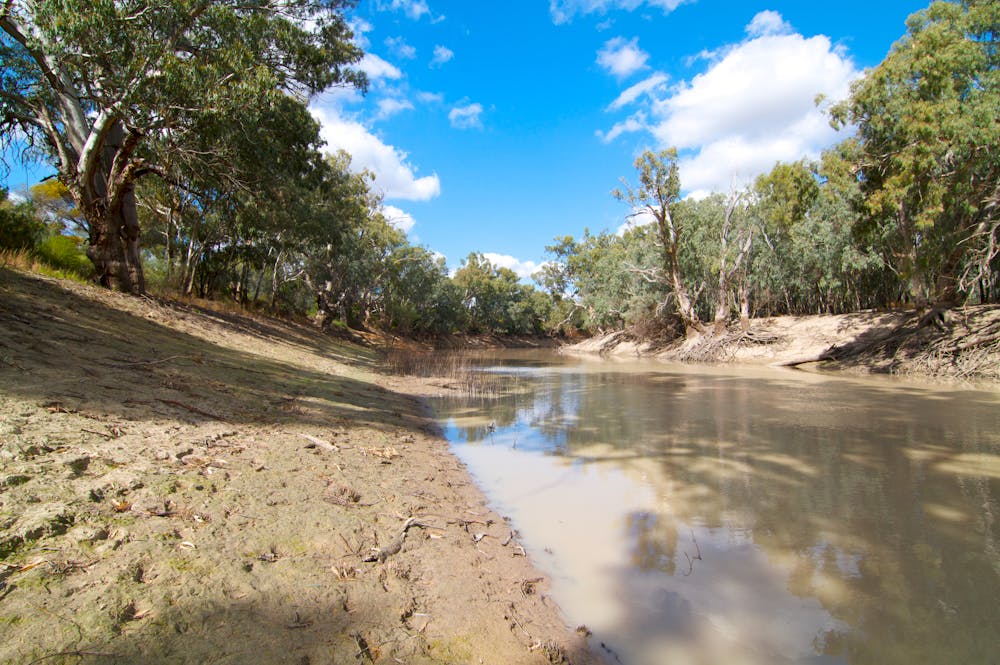
Now the federal government has reached agreements with most states who share management of the river system – Queensland, New South Wales, the Australian Capital Territory and South Australia – but not Victoria. The Victorian government appears to be rivalling the National Party in its opposition[8] to buying more water entitlements from irrigators (water buybacks).
The federal government is looking to purchase water entitlements from willing sellers. This is because past investments in water efficiency projects have proven to be too slow, very expensive and have had unexpected outcomes for agricultural industries and the rivers.
Victoria continues to argue its irrigation-based industries would be harmed by more water buybacks, and that the state has borne an unfair share of the burden compared to New South Wales. The Victorian government has knowledgeable staff and is well resourced, and resistance could be fierce.
Read more: Water buybacks are back on the table in the Murray-Darling Basin. Here's a refresher on how they work[9]
Plibersek appears to be counting on her alliance with other states enabling required amendments to the Water Act and Basin Plan to be passed before Christmas. Given almost certain rejection by the Opposition of more water reallocation, she will require the support of cross bench Senators who may demand stronger environmental measures. The Greens have already criticised[10] the minister’s announcement as a move that “kicks the can down the road”, but buying such a large volume of water will take years.
If the legislation is not amended, and existing deadlines remain, the federal government may be forced into recovering even more water[11]. In particular, they would need to respond to the states’ failure to deliver on projects that are supposed to conserve wetland with less water by building water supply infrastructure.
A welcome development
The new agreement is welcome in doubling down on the original plan to recover 3,200 billion litres a year of additional water essential to maintain the health of the rivers and the people who rely on them. The federal government has focused on recovering 450 billion litres a year of water within this target that was agreed with the former South Australian premier. Premier Jay Weatherill drew on scientific advice to insist the minimum volume of water was recovered that is needed to keep the lower River Murray floodplain, lower lakes and Coorong healthy.
Unfortunately, the past decade of stalling by the federal, NSW and Victorian governments means the 2023-24 Basin Plan deadlines must be extended by two to three years if key projects are to be completed.
Much greater public assurance with transparency and accountability measures is needed if the new targets are to be met. The federal government needs to find more effective carrots and sticks to engender state compliance. This time it would be wise to withhold payments to the states[12] until they deliver the promised action.
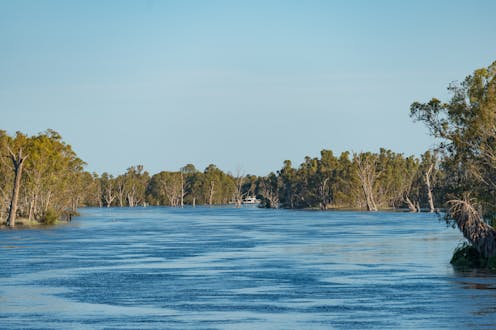
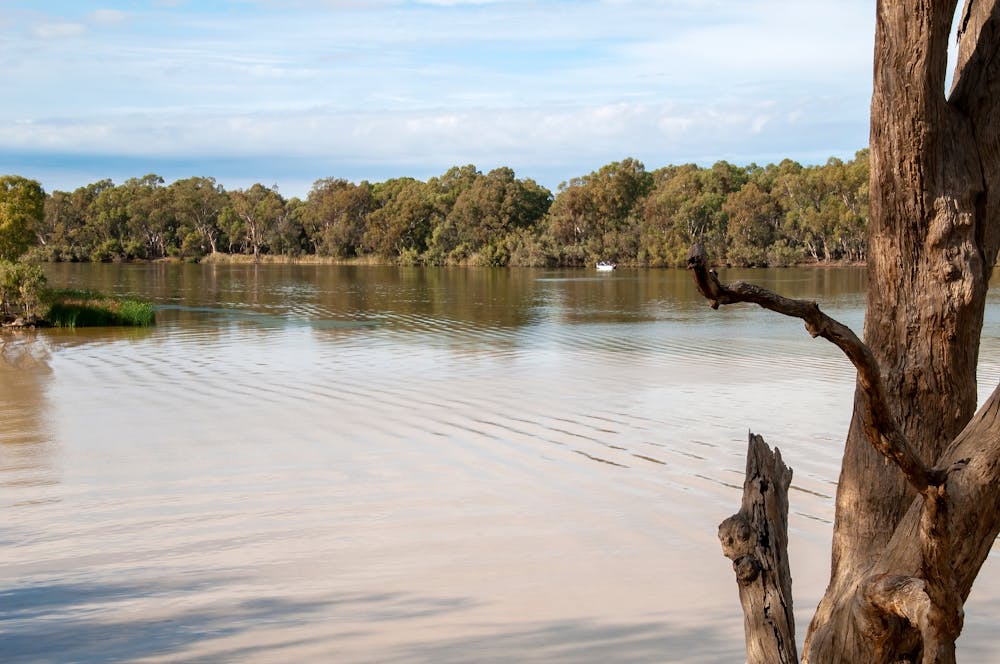 The muddy waters of the Darling meet the clearer Murray at Wentworth in New South Wales.
Shutterstock
The muddy waters of the Darling meet the clearer Murray at Wentworth in New South Wales.
Shutterstock
The federal government’s intention to redouble efforts to “relax constraints[13]” and enable more water to flow to where it’s most needed to conserve flora and fauna is crucial. This is essential to get the most benefits for freshwater ecosystems by allowing environmental water to spill out of river channels onto floodplain wetlands. Despite a recent flurry of activity, NSW and Victoria have not delivered promised agreements with river side land owners to enable this watering.
The one disappointing aspect of the agreement is the proposal to allow more water offset projects (under the Sustainable Diversion Limit Adjustment Mechanism[14]). These ecologically dubious projects have been problematic[15], with at least one being abandoned and many delayed. It is inconceivable that new projects could be identified and delivered by 2026.
But the new agreement only deals with the most immediate problems in implementing the Basin Plan. The Plan is due to be revised in 2026. The current measures do not deal with two major issues[16]. First, ways need to be found to restore the rights of Indigenous nations to own and manage water. Currently they hold only 0.2% of issued entitlements. Second, a new Plan is needed to manage the project loss of a lot of water to climate and other environmental change.
The federal government’s agreement with most states (but not Victoria) is a really welcome initiative to get Basin Plan implementation back on track. However, even harder decisions await.
Read more: Victoria’s plans for engineered wetlands on the Murray are environmentally dubious. Here’s a better option[17]
References
- ^ announced a new agreement (minister.dcceew.gov.au)
- ^ Millennium Drought (www.environment.sa.gov.au)
- ^ no longer possible (www.mdba.gov.au)
- ^ With less than a year to go, the Murray-Darling Basin Plan is in a dreadful mess. These 5 steps are needed to fix it (theconversation.com)
- ^ John Howard announced (parlinfo.aph.gov.au)
- ^ frustrated measures (doi.org)
- ^ five-point election commitment (anthonyalbanese.com.au)
- ^ opposition (www.abc.net.au)
- ^ Water buybacks are back on the table in the Murray-Darling Basin. Here's a refresher on how they work (theconversation.com)
- ^ criticised (www.theaustralian.com.au)
- ^ recovering even more water (www.npc.org.au)
- ^ withhold payments to the states (dx.doi.org)
- ^ relax constraints (theconversation.com)
- ^ Sustainable Diversion Limit Adjustment Mechanism (getinvolved.mdba.gov.au)
- ^ problematic (theconversation.com)
- ^ two major issues (theconversation.com)
- ^ Victoria’s plans for engineered wetlands on the Murray are environmentally dubious. Here’s a better option (theconversation.com)