We urgently need $100bn for renewable energy. But call it statecraft, not 'industry policy'
- Written by: Elizabeth Thurbon, Professor in International Relations / International Political Economy, UNSW Sydney
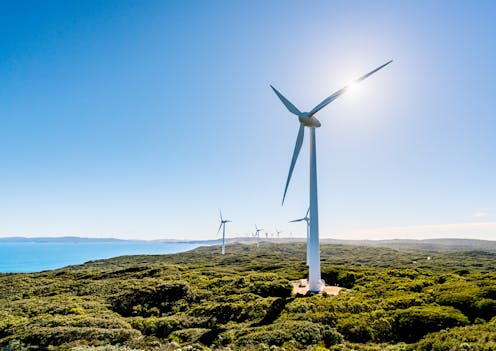
This week, a diverse group of organisations called on the Australian federal government to establish a A$100 billion, ten-year policy package to turbocharge Australia’s green energy transition[1].
Proposed by groups including the Australian Council of Trade Unions, Australian Conservation Foundation, Climate Energy Finance, Rewiring Australia and the Smart Energy Council, the Australian Renewable Industry Package (ARIP) would dwarf the government’s existing commitments.
Its proponents claim that by 2035[2], the package would generate at least $300 billion annual clean export revenue and 700,000 much needed jobs, mainly in rural and regional Australia.
So will Australian policymakers from across the political spectrum heed this call and agree to spend big on Australia’s green energy industry capabilities?
If we want policymakers to unify and to act, we have to use language that widely resonates. This, we argue, must be the language of green energy statecraft, not industry policy.
A response to the US
The ARIP is explicitly framed as a response to the United States’ impactful Inflation Reduction Act (IRA). The act, passed in August 2022[3], is Washington’s response to its pressing geostrategic, economic, energy and environmental security challenges.
The IRA contains US$370 billion worth of incentives[4] for clean tech and is estimated to spur US$2.9 trillion[5] of cumulative investment opportunity by 2032.
This comprehensive suite of policy supports has put Australian efforts to shame. As a result, the IRA is now drawing much needed green energy investment away from Australia[6]. Given the support on offer, it is no surprise US manufacturing spending has nearly doubled[7] in the last 12 months, while Australia remains stuck in the investment slow lane[8].
Even more worrying for Australia is the fact the US is not the only rapid mover in the green energy space. A number of middle powers more similar to us in capacity – such as Canada[9] and Japan[10] – have also announced hugely ambitious green energy investment packages that leave Australia lagging.
There is no question Australia needs the ARIP, and needs it urgently.
Read more: We need a national renewables approach, or some states – like NSW – will miss out[11]
Industry policy – Australia’s dirtiest word
In arguing for a new big renewables push, some proponents[12] have couched it in the language of a “new industry policy”. But this language is problematic for two main reasons.
First, this language in Australia is highly politicised and divisive. Since the 1980s, “industry policy” has arguably become one of the most misused and abused terms[13] in our nation’s political discourse.
To even utter the words “industry policy” is often enough to spark fierce ideological objection, or to cause people’s eyes to glaze over with disinterest, disillusionment or both. In this sense, the term has become the ultimate thought blocker and conversation stopper.
Unfortunately, such reactions make it almost impossible to have a sensible national debate about what effective industry policy actually looks like. For its many detractors “industry policy” means protectionism and picking winners[14], and should therefore be avoided at all costs.
This unsophisticated view ignores the fact that in countries that have historically practised highly effective and strategic industry policy – including our northeast Asian neighbours of Japan, South Korea and Taiwan – “protectionism” and “picking winners” was far from the norm.
Indeed, because of the goal orientation of East Asian policymakers, who wanted to catch up[15] with developed countries extremely quickly, industry policy was a highly disciplined affair tied to stringent performance incentives.
In this context, East Asian governments did not pick winners. Rather, winning firms self-selected by opting into government support programs, and by then outperforming competitors to keep earning that support.
By contrast, in Australia “industry policy” has become a highly politicised and partisan affair. For this reason, calls for industry policy often fall on deaf ears, and do more to divide policymakers and business leaders than unite them.
Read more: Industrial policy is back on the agenda -- and it's never been needed more than it is now[16]
Towards ‘statecraft’, not industry policy
But there is another, even more compelling reason for advocates of the renewables package to avoid the language of “industry policy”. The term doesn’t adequately capture the kinds of policies our competitors – both rivals and partners – are now enacting in the green energy space[17], or the kind of response we require.
Instead, Australia needs to embrace “green energy statecraft[18]”.
Such statecraft involves bold government initiatives[19] to build, grow and dominate the high-technology markets essential to the green transition, and to fend off or outflank rival powers[20], be they economic, geo-strategic or both.
Green energy statecraft is different from plain old energy policy, or even “industry policy”. Its focus is squarely on building new industries with the intention of ensuring success in hyper-competitive global markets and, simultaneously, bolstering national security.
We argue that in recent years, the most significant obstacle to Australia’s success in the green energy arena has been the prevailing policymaking mindset: viewing the green energy shift principally as an energy and climate policy challenge, rather than statecraft.
With national security motivations at play, governments that practice green energy statecraft create bold visions for new industries like green hydrogen, green steel and bioenergy. They set clear production, export and, most importantly, technology-upgrading targets. They also mobilise all available financial incentives and policy instruments to ensure these targets are met.
To become a green energy superpower, Australia needs to match our strategic vision[21] with a new green energy statecraft.
Language matters. If we want policymakers to act, and if we want our calls to unite rather than divide, we need to choose our words very carefully.
References
- ^ turbocharge Australia’s green energy transition (www.theguardian.com)
- ^ claim that by 2035 (www.afr.com)
- ^ passed in August 2022 (www.cleanenergycouncil.org.au)
- ^ US$370 billion worth of incentives (www.whitehouse.gov)
- ^ US$2.9 trillion (www.goldmansachs.com)
- ^ green energy investment away from Australia (www.deloitte.com)
- ^ nearly doubled (fred.stlouisfed.org)
- ^ stuck in the investment slow lane (www.bca.com.au)
- ^ Canada (www.energymonitor.ai)
- ^ Japan (japannews.yomiuri.co.jp)
- ^ We need a national renewables approach, or some states – like NSW – will miss out (theconversation.com)
- ^ some proponents (grattan.edu.au)
- ^ most misused and abused terms (link.springer.com)
- ^ protectionism and picking winners (www.eastasiaforum.org)
- ^ who wanted to catch up (www.cornellpress.cornell.edu)
- ^ Industrial policy is back on the agenda -- and it's never been needed more than it is now (theconversation.com)
- ^ now enacting in the green energy space (global.oup.com)
- ^ green energy statecraft (asiasociety.org)
- ^ involves bold government initiatives (www.themandarin.com.au)
- ^ fend off or outflank rival powers (www.tandfonline.com)
- ^ match our strategic vision (asiasociety.org)