Electric vehicle fires are very rare. The risk for petrol and diesel vehicles is at least 20 times higher
- Written by: Hussein Dia, Professor of Future Urban Mobility, Swinburne University of Technology
Two electric vehicle fires have been reported in Australia this week. Five cars were destroyed after a lithium battery ignited[1] in a car parked at Sydney Airport on Monday. Firefighters believed[2] the battery had been detached from the car because it was damaged.
On the same day, another vehicle caught fire[3] after it hit debris on a road near Penrose in the New South Wales southern highlands. It’s believed the debris[4] pierced the battery pack[5], starting a fire.
Despite these incidents, electric vehicle battery fires are rare. Indeed, the available data indicate the fire risk is between 20 and 80 times greater for petrol and diesel vehicles. Fire risks are also greater for electric scooters and electric bikes.
However, battery fires do pose particular problems, which I’ll discuss later.
How common are these fires?
Australian firm EV FireSafe[6] tracks passenger electric vehicle battery fires worldwide. From 2010 to June 2023, its database records only 393[7] verified fires globally, out of some 30 million electric vehicles on the road[8].
Australia recorded only four[9] electric vehicle battery fires over the same period. One was linked to arson. The other three vehicles were parked in structures that burned down and destroyed the vehicles. So it appears these fires didn’t start in the batteries.
But electric vehicle numbers in Australia were low[10] during this 13-year period.
Read more: Australia’s adoption of electric vehicles has been maddeningly slow, but we’re well placed to catch up fast[11]
Are the risks higher than for petrol or diesel cars?
As electric vehicle numbers grow[12], this week’s reports might lead some people to fear fire risks will increase. However, data for the past 13 years suggest quite the opposite is true as electric vehicles replace petrol and diesel vehicles.
A May 2023 report[13] by the Swedish Civil Contingencies Agency found vehicles powered by internal combustion engines were 20 times more likely[14] to catch fire than electric vehicles in Sweden.
Sweden recorded 106 fires in various electrified modes of transport in 2022. More than half were in e-scooters (38) and e-bikes (20). Out of Sweden’s 611,000 electric vehicles, 23 fires (0.004%) were reported. The fleet of 4.4 million petrol and diesel vehicles recorded 3,400 fires (0.08%).
Globally, EV FireSafe[15] found about 0.0012% of electric passenger vehicles caught fire from 2010 to 2023. While it was difficult to find similar global statistics for petrol and diesel vehicles, EV Firesafe used a range of country reports and found a much higher 0.1% risk of catching fire. That’s more than 80 times the rate EV Firesafe found for electric vehicles.
As well as 393 verified fires worldwide, the EV Firesafe database[16] includes 74 incidents that are being investigated and 21 that have not been verified.
A 2020 Tesla[17] internal report (not verified independently) suggested there was one Tesla[18] fire for every 205 million miles (330 million kilometres) travelled. The Tesla report notes National Fire Protection Association data for the United States showed a much higher rate of one fire for every 19 million miles (30.6 million kilometres).
We still have limited data on fire risk in electric vehicles, most of which are relatively new. More statistically reliable comparisons require more data over much longer time frames.
What causes electric vehicle fires?
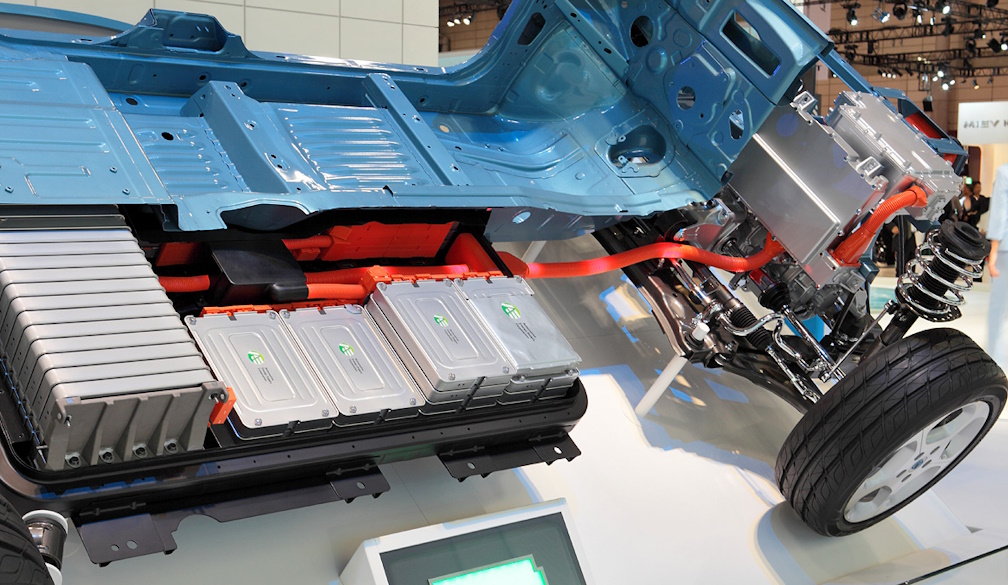
Electric vehicle battery packs store a lot of energy in a very small space. When damaged, an internal short circuit triggers a chain reaction called thermal runaway[19]. The battery pack then generates more heat than it can dissipate and catches fire.
About 95% of battery fires are classed as ignition fires, which produce jet-like directional flames. The other 5% involve a vapour cloud explosion.
Under test conditions, thermal runaway in cylindrical lithium ion battery cells causes an ignition fire.A battery can catch fire for various reasons. It may be caused by physical damage from a collision, manufacturing defects, battery faults, workshop repairs, arson, external fires or overheating.
The EV FireSafe database[20] shows about 18% of fires occurred when vehicles were charging, and 2% within an hour of disconnecting from the charger.
About 25% of incidents occurred in underground spaces, 31% while parked outside and 29% while driving (remaining 15% unknown). Of the vapour cloud explosion fires, 70% occurred in underground spaces and 30% in open-air conditions.
Thermal runaway leads to a vapour cloud explosion in a parked bus.Read more: How far to the next electric vehicle charging station – and will I be able to use it? Here's how to create a reliable network[21]
A battery fire is challenging
Electric vehicle fires do present new problems. Fires must be carefully managed to ensure the safety of firefighters and the public.
Once batteries are on fire, they can be hard to manage. Lithium battery fires burn at extremely high temperatures, can last for days and cause extensive damage. They often reignite just when the fire seems to have subsided.
If not managed properly, battery fires can emit highly toxic gases and chemicals for many hours[22]. Properly trained[23] firefighting crews are needed to handle these fires.
Methods to control a fire include cooling the battery with water, or using a crane to lift the vehicle and submerge[24] it in a large water container.
An electric vehicle fire is suppressed using a ‘dunk tank’.Read more: Batteries are the environmental Achilles heel of electric vehicles – unless we repair, reuse and recycle them[25]
Why are the risks higher in e-scooters and e-bikes?
Fire and road safety incident rates are higher for e-scooters and e-bikes. In the first half of 2023, EV Firesafe data[26] show they accounted for more than 500 battery fires, 138 injuries and 36 deaths worldwide. Over the same six months, 35 electric vehicle battery fires resulted in eight injuries and four deaths.
The higher risk for e-scooters and e-bikes is mainly linked to poor-quality battery design and construction, and the use of unapproved[27] chargers.
Electric cars and trucks use the same battery technology but have more sophisticated designs. Advanced cooling systems keep their batteries at optimal temperatures during everyday driving and recharging. This makes them much safer than batteries in e-scooters and e-bikes.
A national approach to electric vehicle fire safety
The recent National EV Strategy[28] considered[29] the risk of fires.
As part of the strategy, the federal government committed to funding[30] the development of world-leading guidance on electric vehicles, road rescue demonstrations and fire safety training.
The surge[31] in electric vehicle numbers means this funding is needed now to ensure firefighters[32] can deal effectively with any fires that do happen.
Read more: Australia finally has an electric vehicle strategy. How does it stack up?[33]
References
- ^ ignited (www.abc.net.au)
- ^ Firefighters believed (www.theguardian.com)
- ^ caught fire (www.abc.net.au)
- ^ debris (www.southernhighlandnews.com.au)
- ^ battery pack (www.thecarexpert.co.uk)
- ^ EV FireSafe (www.evfiresafe.com)
- ^ 393 (www.evfiresafe.com)
- ^ on the road (transportgeography.org)
- ^ four (www.carexpert.com.au)
- ^ were low (theconversation.com)
- ^ Australia’s adoption of electric vehicles has been maddeningly slow, but we’re well placed to catch up fast (theconversation.com)
- ^ numbers grow (theconversation.com)
- ^ May 2023 report (www.msb.se)
- ^ 20 times more likely (thedriven.io)
- ^ EV FireSafe (www.evfiresafe.com)
- ^ database (www.evfiresafe.com)
- ^ Tesla (www.tesla.com)
- ^ Tesla (www.drive.com.au)
- ^ thermal runaway (www.evfiresafe.com)
- ^ EV FireSafe database (www.evfiresafe.com)
- ^ How far to the next electric vehicle charging station – and will I be able to use it? Here's how to create a reliable network (theconversation.com)
- ^ hours (www.cnbc.com)
- ^ trained (evfiresafe-training.thinkific.com)
- ^ submerge (www.hazardexonthenet.net)
- ^ Batteries are the environmental Achilles heel of electric vehicles – unless we repair, reuse and recycle them (theconversation.com)
- ^ data (www.evfiresafe.com)
- ^ unapproved (www.brisbanetimes.com.au)
- ^ National EV Strategy (theconversation.com)
- ^ considered (www.carexpert.com.au)
- ^ funding (www.dcceew.gov.au)
- ^ surge (www.abc.net.au)
- ^ firefighters (www.abc.net.au)
- ^ Australia finally has an electric vehicle strategy. How does it stack up? (theconversation.com)