When you have a baby, can you stay friends with people who don't have kids?
- Written by: Catherine E Wood, Associate Professor and Clinical Psychologist, Swinburne University of Technology
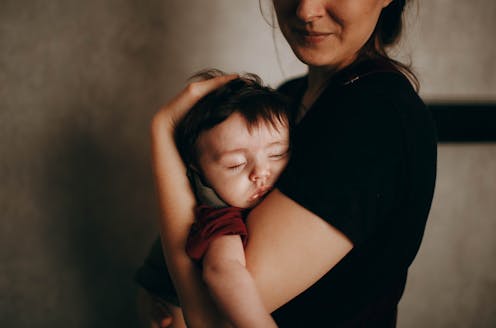
If you have a baby, does this mean you can’t be friends anymore with your child-free friends?
In a high-profile article[1] for New Yorker magazine in September, journalist Allison Davis wrote about a “slow-rolling tectonic shift that neither side notices at first (especially the parents)”.
It becomes us vs. them. On one side: People With Kids (PWIKS: frazzled, distracted, boring, rigid, covered in spit-up; can’t talk about movies, only about how they wish they had time to see them). And on the other: People Without Kids (PWOKS: self-absorbed, entitled, attention whores, grumpy about life’s inconveniences even though their life is easy).
Davis also refers to a 2017 Dutch study[2] which found a decline in contact with friends after having children. This decline was greater the earlier in life parents had their children.
TikTok is full of similar stories[3], painting children as friendship-enders.
Why is this so? And is there a way to protect against this?
A baby is a huge change
Having a baby is a new life stage[4] like no other. Not only does pregnancy come with a new surge in hormones but parenthood also brings a great deal of uncertainty[5] with it.
When we find ourselves in such a state, we often look for an anchor[6] – to help create a sense of control. So new parents can turn to other parents who have similar-aged babies.
This can quickly create an in-group/out-group and friends without babies can soon feel part of the latter. They don’t have any baby sleep, poo or feeding stories to share, and this lack of a shared experience and understanding can impact the friendship.
Parents often have nothing left in the tank to give after a day of parenting. They are also simply not capable of doing some of the things they used to, such as staying out late or socialising without their children (without a lot of organisation).
The casual drop in is also no longer okay because the baby might be asleep and an unplanned visit could disrupt the routine.
Friends without kids can feel neglected without fully understanding that it is not about them.
There can be new sensitivities
As Davis also notes[8], friends without children can also experience grief if they have been experiencing infertility. Under these circumstances, it can be really hard to be around women who are pregnant, or with a child when this is all that you want for your own family.
The business of having children, and the associated stress and uncertainty can also mean new parents don’t always know what they need and therefore can’t (or don’t) ask for it. Rather they tend to seek comfort and reassurance from other parents.
So expectations within a friendship can change – but this might not always be clearly communicated.
Read more: Bluey casts a tender light on being childless not by choice. Here's what women told me about living with involuntary childlessness[9]
How can you hold onto old friends?
If old friendships are worth hanging onto, what can new parents do to help protect these relationships from the arrival of a baby?
First try to have the conversation before the baby arrives – there might be a change in the friendship but commit to talking about it. Talk about your worries and how you might approach things differently with a baby in the picture even if this might change.
When the baby arrives, be as clear as you can about what you need and where you are up to (for example, “I’m sorry I can’t have dinner, I’m totally exhausted, but I want to see you soon”).
Also keep trying to engage with your friend on their terms (at least sometimes!). You’re going through a big life event, but their life is still happening, so ask about their work, their issues and their family.
For friends without kids, offer to do something that makes life easier or more enjoyable: drop off meals, or leave supplies at the door. Show you understand their life has changed. Check when might be the best time to drop offer, send texts without expecting a quick reply. When the children are older, offer to babysit.
Also make an effort to show you are interested in the baby - buy a gift, ask how the baby is going.
The key is both sides of the friendship acknowledging there will be or has been a change – and that things may be tough and challenging.
But if you keep talking and keep trying to understand the other person’s needs, you will both still have a role in each other’s lives if you want one.
Read more: Friday essay: how philosophy can help us become better friends[11]
References
- ^ article (www.thecut.com)
- ^ a 2017 Dutch study (www.jstor.org)
- ^ full of similar stories (www.tiktok.com)
- ^ new life stage (nobaproject.com)
- ^ great deal of uncertainty (pubmed.ncbi.nlm.nih.gov)
- ^ look for an anchor (www.cope.org.au)
- ^ RDNE Stock Project/Pexels (www.pexels.com)
- ^ also notes (www.thecut.com)
- ^ Bluey casts a tender light on being childless not by choice. Here's what women told me about living with involuntary childlessness (theconversation.com)
- ^ Elevate/Pexels (www.pexels.com)
- ^ Friday essay: how philosophy can help us become better friends (theconversation.com)