A monster eddy current is spinning into existence off the coast of Sydney. Will it bring a new marine heatwave?
- Written by: Moninya Roughan, Professor in Oceanography, UNSW Sydney
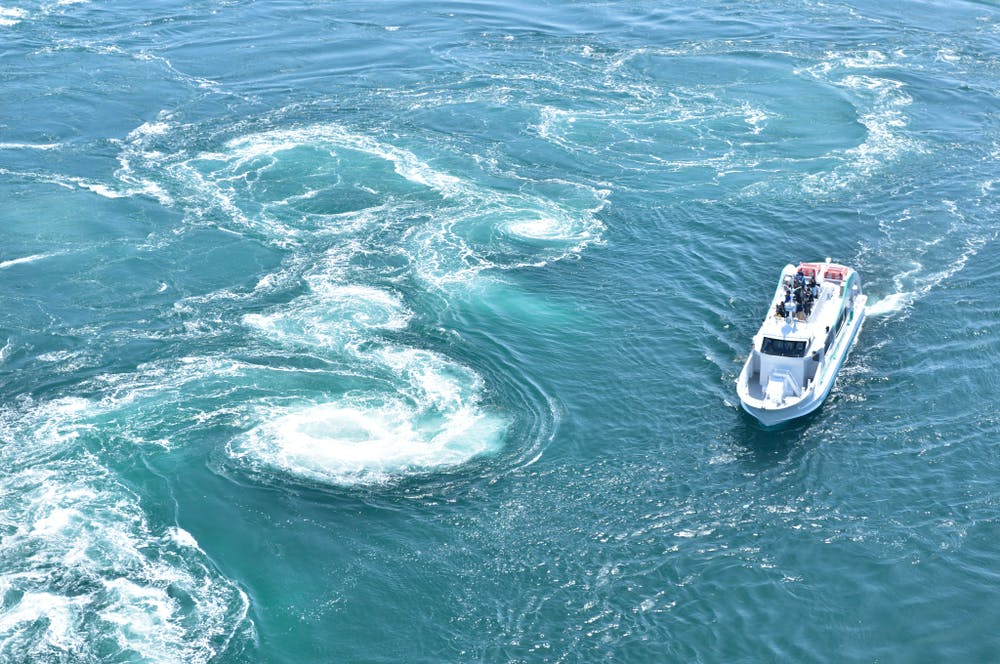
Right now, there’s something big spinning off the coast from Sydney – a giant rotating vortex of sea water, powerful enough to dominate the ocean currents off south-eastern Australia.
Oceanographers describe these spinning water bodies as “eddies” – but they’re not the small eddy currents you see in creeks or rivers. Ocean eddies are enormous. They’re usually hundreds of kilometres across (100–300km), up to 2km deep and can be visible from space.
It turns out these eddies drive change underwater by spawning marine heatwaves. Our new research[1] demonstrates the link between a warm ocean eddy and a record-breaking marine heatwave which struck off Sydney from December 2021 to February 2022.
Now it’s happening again. An even bigger eddy is forming about 50km off Sydney. We have just returned from a 24-day research voyage on CSIRO’s research vessel RV Investigator[2] to explore this monster eddy.
Our estimates suggest this 400km wide beast holds 30% more heat than normal for this part of the ocean. Its currents are spinning at 8km per hour. And the temperatures deep underwater are up to 3°C above normal. If it moves close to shore, it could trigger another coastal marine heatwave.
Read more: Doritos, duckies and disembodied feet: how tragedy and luck reveals the ocean's hidden highways[3]
Eddies are the ocean equivalent of storms in the atmosphere. Like weather patterns, they can be warm or cold. But ocean eddies can shape the ocean’s patterns of life.
Warm eddies are like ocean deserts with little life, while cold eddies are typically much more productive. That’s because they draw up nutrients like nitrogen and phosphorous from the deep sea, which become food for plankton.
Just as storms can in the atmosphere, ocean eddies can drive extreme “ocean weather”. That’s because warm eddies can bring in masses of warm water and keep it there for months. Sea life is often very finely attuned to temperature, so a sudden heatwave like this can heavily impact ecosystems.
It’s important to better understand how eddy currents grow, move and decay better. That’s because they can store large amounts of heat[4] and can temporarily increase coastal sea levels.
What we do know is that warm eddies along Australia’s east coast can be fed by the East Australian Current when it becomes unstable. The current wobbles back and forth until eventually the wobbles form a coherent circle – an eddy – or adding to an existing one. It’s like a garden hose thrashing around on the grass when the flow is too great. These unstable currents can be small, on the kilometre scale, or huge.
Our research pinpointed the root cause of the 2021 marine heatwave off Sydney. A large warm eddy formed. But it couldn’t spiral away into deeper waters, because there were cold eddies to the north and south preventing it. That’s very similar to what can happen in the atmosphere, where a high pressure system can be held in place by other weather systems.
Now, it looks as if history is repeating.
Over the past month, an enormous eddy – fully 400km wide and 3km deep – has been spinning up just off southeastern Australia. It’s being fed by the warm East Australian Current, which brings warm water from the tropics down to more temperate waters. This eddy is bigger and warmer than most eddies in the region, especially at this time of year. It has been growing over the past month, and is pushing up against cold waters to the south. Where the two systems meet there are very strong temperature differences – up to 5°C over just 4km.
Read more: Explainer: the RV Investigator’s role in marine science[5]
You can get some insight into how eddy currents behave from satellites[6].
Our trip on the research vessel RV Investigator made it possible for us to grasp how this powerful current was behaving – in three dimensions.
 CSIRO’s marine research vessel, the RV Investigator, has cutting edge sensors and buoys.
Alex Ingall/UNSW
CSIRO’s marine research vessel, the RV Investigator, has cutting edge sensors and buoys.
Alex Ingall/UNSW
We also released drifters, GPS-tracked buoys which float around the eddy centre in a massive circle. Some have been carried more than 2,000km in the last month, passing where they originally started. Others have escaped the eddy and headed east into the Pacific.
These sensors and instruments have given us vital information. Now we know the water in the eddy is flowing at a fast walking pace, around 8km per hour. And we know that while the currents within the eddy are rotating quickly, the eddy itself has remained fairly stationary off the NSW coast, growing with warm waters from further north.
We also deployed five diving Argo floats[7]. Satellite data shows us surface temperatures in the eddy have hit 23°C, two degrees above average for a month. But Argo floats show us the temperatures are even more extreme 500m below the surface, more than 3°C above average.
 Argo floats spend years at sea, collecting data from the surface or down deep.
Bella Charlesworth/UNSW, Author provided (no reuse)
Argo floats spend years at sea, collecting data from the surface or down deep.
Bella Charlesworth/UNSW, Author provided (no reuse)
What happens to eddies? Like atmospheric systems, these are effectively heat engines. They transport heat to new areas as they whirl in the ocean. While they hold heat a long time, eventually it’s lost to the atmosphere and through mixing at the edges of the current. Eventually, they disappear.
But as we head into summer, the mega eddy is unlikely to go anywhere. If it moves towards the coast, where marine life is concentrated, we will see water temperatures spike – and possibly, underwater disaster for many species.
Read more: Doritos, duckies and disembodied feet: how tragedy and luck reveals the ocean's hidden highways[8]
We would like to thank the RV Investigator’s Master, Captain Andrew Roebuck, Deck Officers and crew and the CSIRO technical staff.
References
- ^ new research (www.nature.com)
- ^ RV Investigator (mnf.csiro.au)
- ^ Doritos, duckies and disembodied feet: how tragedy and luck reveals the ocean's hidden highways (theconversation.com)
- ^ store large amounts of heat (theconversation.com)
- ^ Explainer: the RV Investigator’s role in marine science (theconversation.com)
- ^ eddy currents behave from satellites (oceancurrent.aodn.org.au)
- ^ Argo floats (imos.org.au)
- ^ Doritos, duckies and disembodied feet: how tragedy and luck reveals the ocean's hidden highways (theconversation.com)