how stem cell science may change how we reproduce
- Written by: Julian Koplin, Lecturer in Bioethics, Monash University & Honorary fellow, Melbourne Law School, Monash University
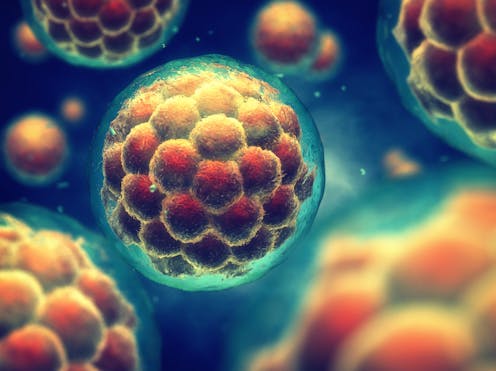
It may soon be possible to coax human skin cells into becoming functional eggs and sperm using a technique known as “in vitro gametogenesis”. This involves the creation (genesis) of eggs and sperm (gametes) outside the human body (in vitro).
In theory, a skin cell from a man could be turned into an egg and a skin cell from a woman can become a sperm. Then there’s the possibility of a child having multiple genetically-related parents, or only one.
Some scientists believe human applications of in vitro gametogenesis are a long way off[1].
However, scientists who work on human stem cells are actively working[2] on overcoming the barriers. New[3] biotechnology[4] start-ups[5] are also seeking to commercialise this technology.
Here’s what we know about the prospect of human in vitro gametogenesis and why we need to start talking about this now.
Read more: Explainer: what are stem cells?[6]
Is the technology available?
In vitro gametogenesis begins with “pluripotent stem cells”, a kind of cell that can develop into many different cell types. The aim is to persuade these stem cells to become eggs or sperm.
These techniques could use stem cells taken from early embryos. But scientists have also worked out how to revert adult cells[7] to a pluripotent state. This opens up the possibility of creating eggs or sperm that “belong to” an existing human adult.
Animal studies have been promising. In 2012[8], scientists created live-born baby mice using eggs that began their life as skin cells on a mouse tail.
More recently, the technique has been used to facilitate same-sex reproduction. Earlier this year, scientists created mouse pups with two genetic fathers[9] after transforming skin cells from male mice into eggs. Mouse pups with two genetic mothers[10] have also been created.
How scientists bred mice with two fathers.Scientists have not yet managed to adapt these techniques to create human gametes. Perhaps because the technology is still in its infancy, Australia’s legal and regulatory systems do not address whether and how the technology should be used.
For example, the National Health and Medical Research Council’s assisted reproduction guidelines[11], which were updated in 2023, do not include specific guidance for in vitro-derived gametes. These guidelines will need to be updated if in vitro gametogenesis becomes viable in humans.
Read more: The future of stem cells: tackling hype versus hope[12]
The potential
There are three distinct clinical applications of this technology.
First, in vitro gametogenesis could streamline IVF. Egg retrieval currently involves repeated hormone injections, a minor surgical procedure, and the risk[13] of overstimulating the ovaries. In vitro gametogenesis could eliminate these problems.
Second, the technology could circumvent some forms of medical infertility. For example, it could be used to generate eggs for women born without functioning ovaries or following early menopause.
Third, the technology could allow same-sex couples to have children who are genetically related to both parents.
Read more: Promising assisted reproductive technologies come with ethical, legal and social challenges – a developmental biologist and a bioethicist discuss IVF, abortion and the mice with two dads[14]
Legal, regulatory and ethical issues
If the technology becomes viable, in vitro gametogenesis will alter the dynamics of how we create families in unprecedented ways. How we should respond requires careful consideration.
1. Is it safe?
Careful trials, rigorous monitoring, and follow-up of any children born will be essential – as it has been for other reproductive[15] technologies[16], including IVF.
2. Is it equitable?
Other issues relate to access. It might seem unjust if the technology is only available to the wealthy. Public funding could help – but whether this is appropriate depends on whether the state ought to support[17] people’s reproductive projects.
3. Should we restrict access?
For instance, pregnancy is rare in older women, largely because egg count and quality decline with age[18]. In vitro gametogenesis would theoretically provide “fresh” eggs for women of any age. But helping older women become parents is controversial[19], due to physical, psychological and other factors associated with having babies later in life.
4. We’d still need surrogates
If we took skin cells from each male partner and created an embryo, that embryo would still need a surrogate to carry the pregnancy. Unfortunately, Australia has a shortfall of surrogates. International surrogacy provides an alternative, but carries legal, ethical and practical difficulties[20]. Unless access to surrogacy is improved domestically, benefits to male couples will be limited.
5. Who are the legal parents?
In vitro gametogenesis also raises questions about who are the future child’s legal parents. We already see related legal debates surrounding non-traditional families formed through surrogacy, egg donation and sperm donation.
In vitro gametogenesis could theoretically also be used to create children with more than two genetic parents, or with only one. These possibilities likewise require us to update our current understandings of parenthood.
Read more: We may one day grow babies outside the womb, but there are many things to consider first[21]
How far is too far?
Of the potential uses already mentioned, same-sex reproduction is the most controversial. The reproductive limitations imposed by being in a same-sex relationship are sometimes seen as a “social” form of infertility the medical profession is not obligated to fix.
The moral stakes, however, are virtually identical regardless of whether in vitro gametogenesis is used by same-sex or opposite-sex couples. Both uses of the technology fulfil exactly the same goal: helping couples fulfil their desire to have a child genetically related to both parents. It would be unjust to deny access to only one of these groups.

But same-sex reproduction is only the tip of the iceberg. In vitro gametogenesis could theoretically facilitate “solo reproduction[23]” by deriving both eggs and sperm from the same individual. Interestingly, a child created this way would not be a clone of its parent, since the process of gamete formation would shuffle the parent’s genetic material and create a genetically distinct individual.
Or people could engage in “multiplex parenting[24]” combining genetic material from more than two individuals. Imagine, for example, that two couples create embryos via IVF. In vitro gametogenesis could then be used to derive eggs and sperm from each of these two separate embryos, which could subsequently be used to conceive a single child that is genetically related to all four adults.
Finally, in vitro gametogenesis could revolutionise prenatal genetic selection. We’d have many more embryos[25] than available during regular IVF to screen for genetic diseases and traits.
So it would be urgent to discuss “designer babies”, eugenics, and whether we have a moral obligation[26] to conceive children with the best chance of a good life.
Read more: World's first 'synthetic embryo': why this research is more important than you think[27]
We need to start talking about this now
Both law and ethics can lag behind new technologies, particularly when their implications are as profound and far-reaching as the implications of in vitro gametogenesis.
We need to discuss how this technology should be regulated before it is rolled out. Given how rapidly the science is developing, we should begin this discussion now.
Laura Smith, a masters student from Monash University, contributed to this article.
References
- ^ long way off (www.statnews.com)
- ^ actively working (www.ncbi.nlm.nih.gov)
- ^ New (www.statnews.com)
- ^ biotechnology (www.technologyreview.com)
- ^ start-ups (www.newyorker.com)
- ^ Explainer: what are stem cells? (theconversation.com)
- ^ revert adult cells (www.eurostemcell.org)
- ^ 2012 (www.nature.com)
- ^ two genetic fathers (www.nature.com)
- ^ two genetic mothers (www.nature.com)
- ^ assisted reproduction guidelines (www.nhmrc.gov.au)
- ^ The future of stem cells: tackling hype versus hope (theconversation.com)
- ^ risk (www.mayoclinic.org)
- ^ Promising assisted reproductive technologies come with ethical, legal and social challenges – a developmental biologist and a bioethicist discuss IVF, abortion and the mice with two dads (theconversation.com)
- ^ reproductive (theconversation.com)
- ^ technologies (theconversation.com)
- ^ ought to support (theconversation.com)
- ^ decline with age (www.betterhealth.vic.gov.au)
- ^ controversial (www.ncbi.nlm.nih.gov)
- ^ legal, ethical and practical difficulties (theconversation.com)
- ^ We may one day grow babies outside the womb, but there are many things to consider first (theconversation.com)
- ^ Rawpixel.com/Shutterstock (www.shutterstock.com)
- ^ solo reproduction (www.ncbi.nlm.nih.gov)
- ^ multiplex parenting (www.ncbi.nlm.nih.gov)
- ^ many more embryos (rmanetwork.com)
- ^ moral obligation (bioedge.org)
- ^ World's first 'synthetic embryo': why this research is more important than you think (theconversation.com)