Is it OK if my child eats lots of fruit but no vegetables?
- Written by: Yasmine Probst, Associate Professor, School of Medical, Indigenous and Health Sciences, University of Wollongong
Does it seem like most vegetables you serve your children end up left on the plate, or worse, strewn across the floor? But mention dessert, and your fruit skewers are polished off in an instant.
Or maybe the carrot and cucumber sticks keep coming home in your child’s lunchbox untouched, yet the orange slices are nowhere to be seen.
If you’re facing these struggles with your child, you’re not alone. Many children prefer fruit to vegetables.
So if your child eats lots of fruit but minimal or no vegetables, is that OK? And how can you get them to eat more veggies?
Children have an innate preference for fruit
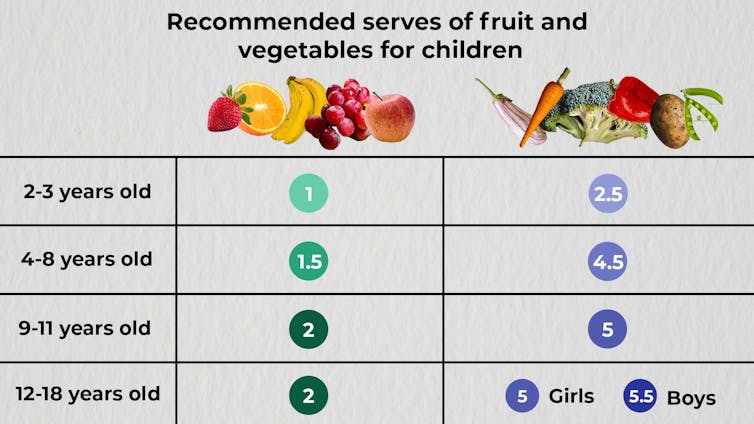
The Australian Dietary Guidelines’[1] recommended daily intakes for vegetables and fruit depend on a child’s age.
Consumption among Australian children falls well below recommendations[4]. Around 62.6% of children aged over two meet the recommended daily fruit intake, but only 9% meet the recommended vegetable intake[5].
This is not surprising given children have a natural preference for fruit. At least in part, this is due to its sweetness and texture, whether crispy, crunchy or juicy. The texture of fruit has been linked to a positive sensory experience[6] among children.
Vegetables, on the other hand, are more of an acquired taste, and certain types, such as cruciferous vegetables[7], can be perceived by children as bitter[8].
Read more: How to get children to eat a rainbow of fruit and vegetables[9]
The reason children often prefer fruit over vegetables could also be related to the parents’ preferences[10]. Some research has even suggested we develop food preferences before birth[11] based on what our mother consumes during pregnancy.
Balance is key
So, a preference for fruit is common. But is it OK if your child eats lots of fruit but little to no vegetables? This is a question we, as dietitians, get asked regularly.
You might be thinking, at least my child is eating fruit. They could be eating no veggies and no fruit. This is true. But while it’s great your child loves fruit, vegetables are just as important as part of a balanced eating pattern.
Vegetables provide us with energy, essential vitamins and minerals[12], as well as water and fibre[13], which help keep our bowels regular. They also support a strong immune system[14].
If your child is only eating fruit, they are missing some essential nutrients. But the same is true if they are eating only veggies.
Fruit likewise provides the body with a variety of essential vitamins and minerals[16], as well as phytochemicals[17], which can help reduce inflammation[18].
Evidence[19] shows healthy consumption of fruit and vegetables protects against chronic diseases including high blood pressure, heart disease and stroke.
Consumed together, fruit and vegetables in a variety of colours provide different nutrients we need, some of which we can’t get from other foods. We should encourage kids to eat a “rainbow” of fruit and vegetables each day to support their growth and development[20].
Read more: Eat your vegetables – studies show plant-based diets are good for immunity[21]
What if my child eats too much fruit?
If your child is eating slightly more fruit than what’s recommended each day, it’s not usually a problem.
Fruit contains natural sugar which is good for you. But too much of a good thing, even if it’s natural, can create problems. Fruit also contains[22] virtually no fat and very little to no protein, both essential for a growing child.
When overindulging in fruit starts to displace other food groups such as vegetables, dairy products and meat, that’s when things can get tricky.
6 tips to get your kids to love vegetables
1. Get them involved
Take your child with you when you go shopping. Let them choose new vegetables. See if you can find vegetables even you haven’t tried, so you’re both having a new experience. Then ask them to help you with preparing or cooking the vegetables using a recipe you have chosen together. This will expose your child to veggies in a positive way and encourage them[23] to eat more.
2. Sensory learning
Try to expose your child to vegetables rather than hiding them. Kids are more likely to eat veggies[24] when they see, smell and feel them. This is called sensory learning.
3. Have fun with food
Use colourful vegetables of different sizes and textures. Make them fun by creating scenes or faces on your child’s plate. Add edible flowers or mint for decoration. You can even serve this with a side of veggie-based dip such as hummus or guacamole for some bonus healthy fats.
4. Teach them to grow their own
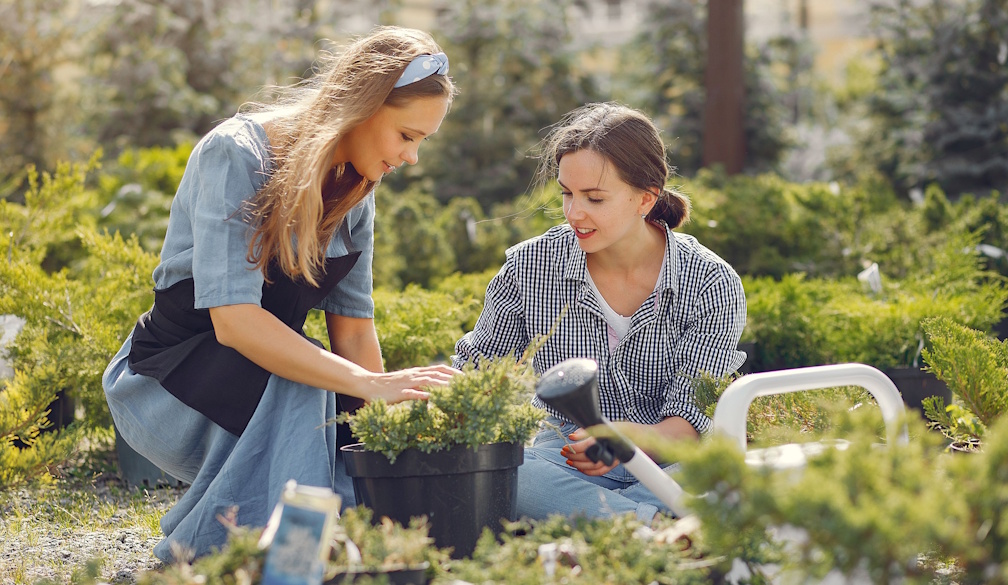
Teach your child how to grow their own vegetables[26]. Evidence shows kids are more inclined to try the food they have helped and watched grow[27]. You don’t need to have a big backyard to do this. A windowsill with a pot plant is a perfect start.
5. Lead by example
Your child learns from you, and your eating habits will influence theirs[28]. Ensure they see you eating and enjoying veggies, whether in meals or as snacks.
6. Practise persistence
If your child refuses a particular vegetable once, don’t give up. It can take many attempts to encourage children to try a new food.
References
- ^ Australian Dietary Guidelines’ (www.eatforhealth.gov.au)
- ^ National Health and Medical Research Council (www.eatforhealth.gov.au)
- ^ CC BY-SA (creativecommons.org)
- ^ recommendations (www.eatforhealth.gov.au)
- ^ recommended vegetable intake (www.abs.gov.au)
- ^ positive sensory experience (www.ncbi.nlm.nih.gov)
- ^ cruciferous vegetables (www.ncbi.nlm.nih.gov)
- ^ bitter (pubmed.ncbi.nlm.nih.gov)
- ^ How to get children to eat a rainbow of fruit and vegetables (theconversation.com)
- ^ parents’ preferences (www.ncbi.nlm.nih.gov)
- ^ food preferences before birth (lozierinstitute.org)
- ^ vitamins and minerals (www.ncbi.nlm.nih.gov)
- ^ fibre (www.ncbi.nlm.nih.gov)
- ^ immune system (www.ncbi.nlm.nih.gov)
- ^ Inspiration GP/Shutterstock (www.shutterstock.com)
- ^ vitamins and minerals (www.ncbi.nlm.nih.gov)
- ^ phytochemicals (www.eatforhealth.gov.au)
- ^ reduce inflammation (theconversation.com)
- ^ Evidence (www.ncbi.nlm.nih.gov)
- ^ growth and development (www.ncbi.nlm.nih.gov)
- ^ Eat your vegetables – studies show plant-based diets are good for immunity (theconversation.com)
- ^ also contains (www.streetdirectory.com)
- ^ encourage them (www.ncbi.nlm.nih.gov)
- ^ to eat veggies (pubmed.ncbi.nlm.nih.gov)
- ^ skynesher/Getty (www.gettyimages.com.au)
- ^ grow their own vegetables (runwildmychild.com)
- ^ grow (calag.ucanr.edu)
- ^ influence theirs (www.ncbi.nlm.nih.gov)
Read more https://theconversation.com/is-it-ok-if-my-child-eats-lots-of-fruit-but-no-vegetables-217282