How do I use air conditioning efficiently? Is it better to blast it briefly throughout the day, or just leave it on?
- Written by: Mark Goldsworthy, Senior Research Scientist, CSIRO
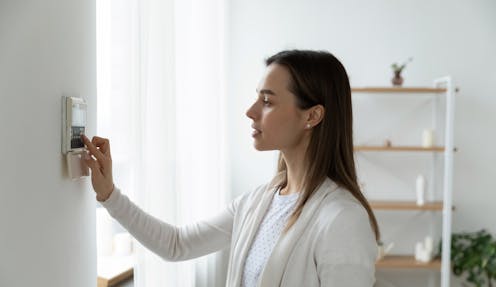
Despite so many people having air conditioning at home now, many are still unsure how to use it efficiently. And air conditioning uses a lot of energy. For example, running all the lights in an average home all day and night consumes about the same energy as one hour of air conditioning of the same space.
Many people think they can save money and energy by just blasting the air conditioning at a very low temperature, such as 17°C, for a short period of time to chill the room – before switching it off and enjoying the chilled air until another blast is needed later on. But it requires a lot of energy to get a room to a very chilly temperature.
While running it briefly and intermittently at a very cool temperature may feel thrifty, it won’t be the most energy efficient choice. Here’s what to do instead.
Read more: Heat pumps can cut your energy costs by up to 90%. It’s not magic, just a smart use of the laws of physics[1]
Start by reducing how hot your home gets
First, try to minimise the need for air conditioning. Look for ways to stop your house getting hot in the first place.
Heat can come in from outside through surfaces such as walls, windows, and ceilings. Hot air can creep in under doors or through open windows and vents. Appliances and people inside can also generate heat (although the heat impact of people is generally relatively small, unless there’s a large group).
To reduce some of this heat, you can:
close blinds and windows before it starts getting hot
use draft stoppers around external doors to stop hot air wafting inside
plant trees (deciduous trees will let sunlight through in winter)
install external shading, particularly on north and western aspects of your house
improving ceiling and wall insulation, window glazing and sealing (if time and budget allow)
reduce use of the oven and cooktop on very hot days (more efficient appliances, however, reduce this heating effect and save energy).
Rooftop solar systems provide a dual benefit of adding shade on the roof to stop heat coming in that way, as well as offsetting power usage.
If you’re in a double storey house, the lower level can be a few degrees cooler; it can help just to hang out downstairs on a very hot day.
Read more: Spare a thought for air-conditioning repair people. As the planet warms, they're really up against it[2]
Set your air conditioning to the highest level that’s comfortable
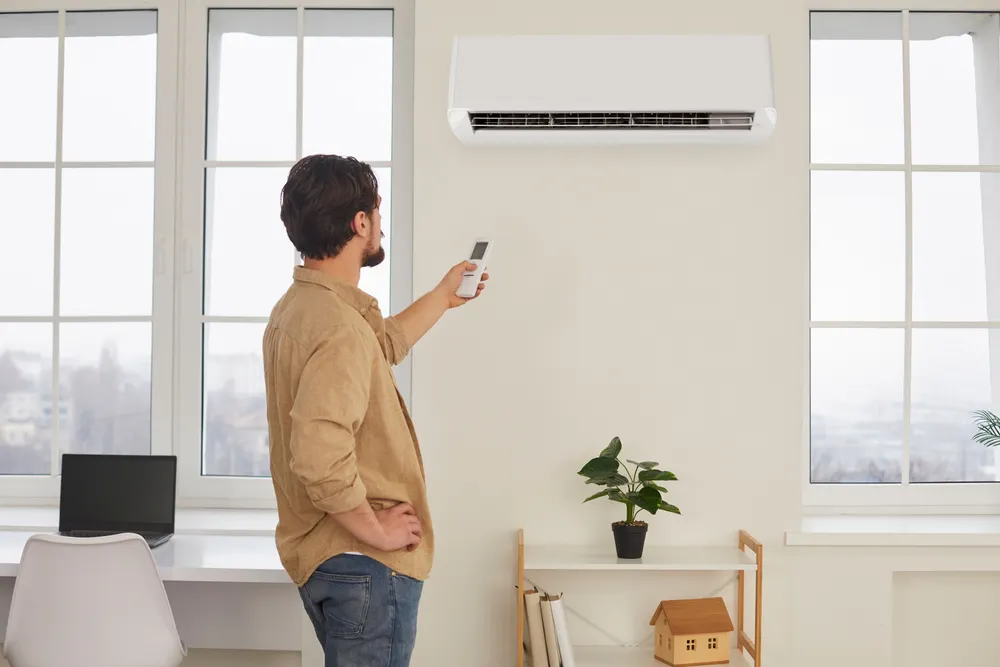
Turning our attention to the air conditioning unit itself, the most energy efficient action is to set the temperature to the highest value that’s still comfortable (26°C during the day and 22°C when sleeping is often recommended). Then, just let it run.
Modern units (that feature technology known as an “inverter”) will adjust their output efficiently to maintain the indoor temperature at the setting you’ve chosen.
Be careful, however; setting the temperature too low can result in the unit using more power than you think it’s using (based on star rating label).
Older non-inverter units will cycle on and off to maintain the temperature, and you will generally be able to hear and feel it going on and off. (The newer inverter units, by contrast, don’t tend to cycle on and off as much; they usually just stay on and continuously modulate their output).
For non-inverter units, in general, remaining on for much longer than it is off indicates the air conditioning is working very hard. This may suggest the unit is too small for the space you’re trying to cool, or that you just have a lot of heat in the house (are you cooking a roast?). It could also suggest a fault.
Ceiling fans and servicing can help
Regardless of the type of air conditioning you have, for each 1°C the temperature is lowered, energy use increases by 5 to 10%[4]. So it’s important not to over-cool. That’s why repeatedly blasting the air conditioning at a very low temperature over the course of the day isn’t wise.
Using ceiling fans along with air conditioning can make things feel cooler by 2-3°C[5] due to the air movement, meaning you can set your air conditioning at a higher temperature. Fans use minimal power compared to air conditioning.
Clean the air filters regularly (your manual will explain how) and make sure air grills and vents are not blocked by furniture or, for outdoor units, by vegetation.
If parts of your outdoor units are heavily corroded or badly bent, the unit likely won’t work as well. Animals can cause damage to outdoor units but parts can often be easily replaced.
If your air conditioning doesn’t seem to work well, makes unusual sounds, or if fault codes show up on the display unit, get it serviced.
And if a cool change comes through, switch off the air conditioning and open as many windows and doors as possible to allow the breeze to flow through the house.
If you have a time-of-use electricity tariff (it’ll say on your electricity bill if you do), reducing use in the afternoon and early evening can save a lot. Energy prices can be double or more at these times.
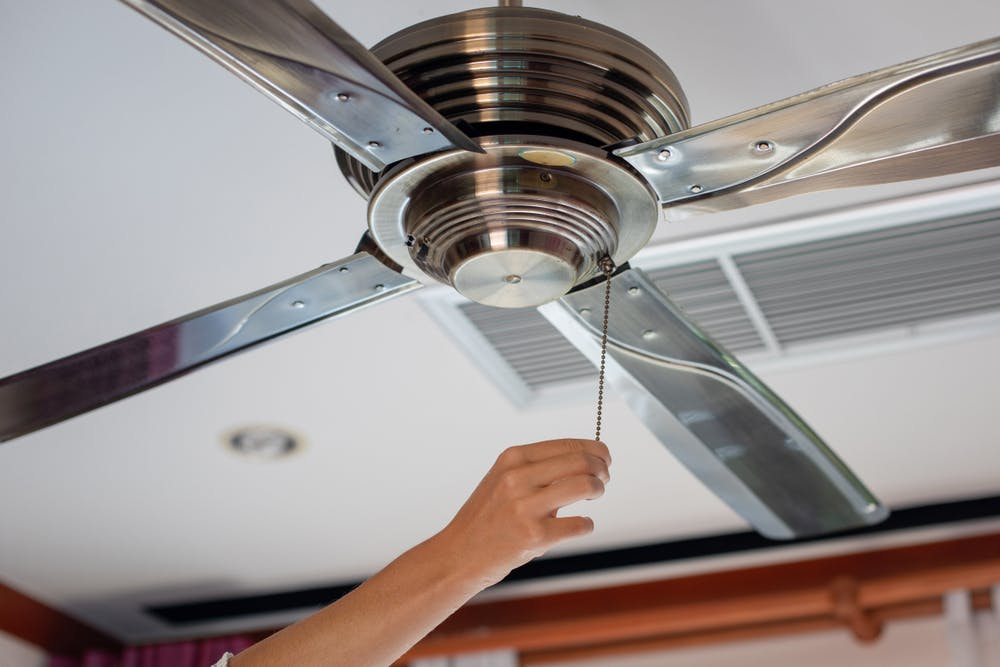 Using fans along with AC can help cool the room more.
Semachkovsky/Shutterstock[6]
Using fans along with AC can help cool the room more.
Semachkovsky/Shutterstock[6]
An efficient unit can save you money in the long run
When it comes time to replace your air conditioning, carefully consider the energy efficiency or star rating[7].
The more stars the better; even a half star higher could more than pay for itself over the life of the unit (especially if you also use it in winter for heating).
Several state governments also have incentive schemes that can help cover the cost of upgrades or replacements.
References
- ^ Heat pumps can cut your energy costs by up to 90%. It’s not magic, just a smart use of the laws of physics (theconversation.com)
- ^ Spare a thought for air-conditioning repair people. As the planet warms, they're really up against it (theconversation.com)
- ^ Studio Romantic/Shutterstock (www.shutterstock.com)
- ^ energy use increases by 5 to 10% (www.yourhome.gov.au)
- ^ 2-3°C (www.nathers.gov.au)
- ^ Semachkovsky/Shutterstock (www.shutterstock.com)
- ^ energy efficiency or star rating (www.energyrating.gov.au)