These fierce, tiny marsupials drop dead after lengthy sex fests – and sometimes become cannibals
- Written by: Andrew M. Baker, Associate Professor in Ecology and Environmental Science, Queensland University of Technology
If you are exploring our beautiful Australian wilderness this year, keep an eye out for animals behaving in interesting ways. You never know what you might see, as our research team discovered.
In 2023, our colleague from Sunshine Coast Council, Elliot Bowerman, took a two-night trip to New England National Park[1] – its 1,500 metre-high mountain peaks are some of the loftiest on Australia’s mid-east coast.
On the afternoon of 17 August, Elliot trekked the path to Point Lookout. While inspecting some plants on the trail, he heard a rustle in the bushes ahead and peering more closely, saw something of interest. A small mammal had abruptly appeared, dragging the carcass of another mammal, which it then began to devour.
At first glance, this was not so strange. Mammals eat each other all the time. However, it is unusual to see small mammals during the day at such close quarters, so Elliot recorded the scene, taking a video on his mobile phone.
It was only several days later when looking over the footage that our research team realised it featured something rarely seen in the wild, the record of which is now published in the journal Australian Mammalogy[2].
Read more: Meet 5 of Australia’s tiniest mammals, who tread a tightrope between life and death every night[3]
A native marsupial… cannibal
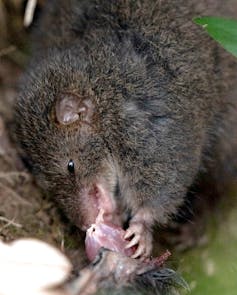
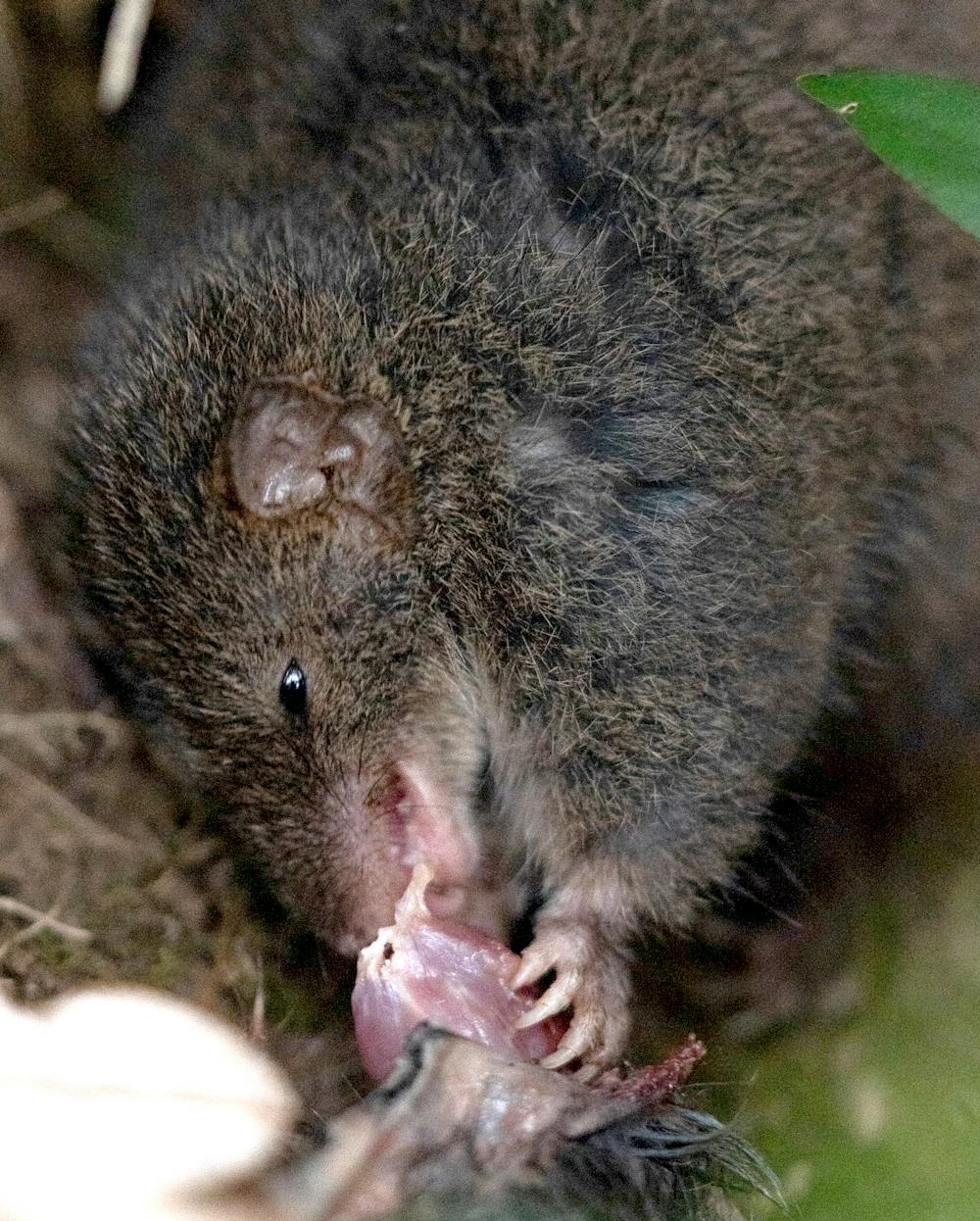
The furry critter on film was an antechinus[4], a native marsupial denizen of forested areas in eastern, south-western and northern Australia. Antechinuses usually eat a range of insects and spiders, occasionally taking small vertebrates such as birds, lizards, or even other mammals.
But this camera footage[5] clearly showed a mainland dusky antechinus (Antechinus mimetes mimetes), and it was eating a dead member of its own species!
Antechinuses are perhaps best known for exhibiting semelparity[6], or “suicidal reproduction”. This is death after reproducing in a single breeding period. The phenomenon is known in a range of plants, invertebrates and vertebrates, but it is rare in mammals.
Each year, all antechinus males drop dead at the end of a one to three week breeding season, poisoned by their own raging hormones.
This is because the stress hormone cortisol rises during the breeding period. At the same time, surging testosterone from the super-sized testes in males causes a failure in the biological mechanism that mops up the cortisol. The flood of unbound cortisol results in systemic organ failure and the inevitable, gruesome death of every male[7].
Mercifully, death occurs only after the males have unloaded their precious cargo of sperm, mating with as many promiscuous females[8] as possible in marathon, energy-sapping sessions lasting up to 14 hours. The pregnant females are then responsible for ensuring the survival of the species.
So, exactly what was happening that day at Point Lookout – why had an antechinus turned cannibal?
Cheap calories
August is the breeding period for mainland dusky antechinuses at that location. Intense mating burns calories, and at the end of winter it is cold and there isn’t as much invertebrate food about.
If there are male antechinuses dropping dead from sex-fuelled exhaustion, our thinking is that still-living male and female antechinuses are taking advantage of the cheap energy boost via a hearty feast of a fallen comrade.
After all, animal flesh provides plenty of energetic bang for the buck, particularly if its owner does not have to be pursued or overpowered before being devoured.
In many areas of Australia, two antechinus species (of the known fifteen) occur together, and usually their breeding periods are separated by only a few weeks[9]. One can imagine a scenario where individuals may not only feed on the carcasses of their own species but consume the other species as well.
 An endangered silver-headed antechinus, Antechinus argentus.
Andrew Baker
An endangered silver-headed antechinus, Antechinus argentus.
Andrew Baker
Each species may benefit from eating the dead males of the other. For the earlier-breeding species, females may be pregnant or lactating, which is a huge energy drain.
For the later-breeding species, both sexes need to pack on weight and body condition before their own breeding period commences.
Plausibly then, antechinus engage in orgiastic breeding and, when opportune, cannibalistic feeding.
So, the next time you are out and about in the bush, keep your eyes and ears peeled – you never know what secrets nature might reveal to you just around the next corner.
The author would like to acknowledge the co-authors of the paper, Elliot Bowerman from Sunshine Coast Council, and Ian Gynther from the Queensland Department of Environment, Science and Innovation.
Read more: Torpor: a neat survival trick once thought rare in Australian animals is actually widespread[10]
References
- ^ New England National Park (www.nationalparks.nsw.gov.au)
- ^ in the journal Australian Mammalogy (doi.org)
- ^ Meet 5 of Australia’s tiniest mammals, who tread a tightrope between life and death every night (theconversation.com)
- ^ antechinus (animalia.bio)
- ^ camera footage (www.youtube.com)
- ^ semelparity (daily.jstor.org)
- ^ gruesome death of every male (link.springer.com)
- ^ mating with as many promiscuous females (theconversation.com)
- ^ are separated by only a few weeks (doi.org)
- ^ Torpor: a neat survival trick once thought rare in Australian animals is actually widespread (theconversation.com)