The Doomsday Clock is still at 90 seconds to midnight. But what does that mean?
- Written by: Rumtin Sepasspour, Visiting Fellow, School of Regulation and Global Governance, Australian National University
Once every year, a select group of nuclear, climate and technology experts assemble to determine where to place the hands of the Doomsday Clock.
Presented by the Bulletin of the Atomic Scientists, the Doomsday Clock is a visual metaphor for humanity’s proximity to catastrophe. It measures our collective peril in minutes and seconds to midnight, and we don’t want to strike 12.
In 2023, the expert group brought the clock the closest it has ever been to midnight: 90 seconds. On January 23 2024, the Doomsday Clock was unveiled again[1], revealing that the hands remain in the same precarious position.
No change might bring a sigh of relief. But it also points to the continued risk of catastrophe. The question is, how close are we to catastrophe? And if so, why?
Destroyer of worlds
The invention of the atomic bomb in 1945 ushered in a new era: the first time humanity had the capability to kill itself.
Later that year, Albert Einstein, along with J. Robert Oppenheimer and other Manhattan Project scientists, established the Bulletin of the Atomic Scientists, in the hope of communicating to the public about the new nuclear age and the threat it posed.
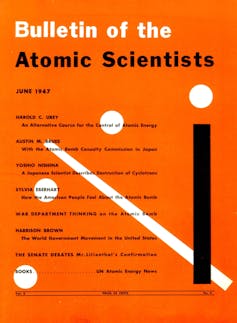
Two years on, the Bulletin, as it came to be known, published its first magazine. And on the cover: a clock, with the minute hand suspended eerily only seven minutes from midnight.
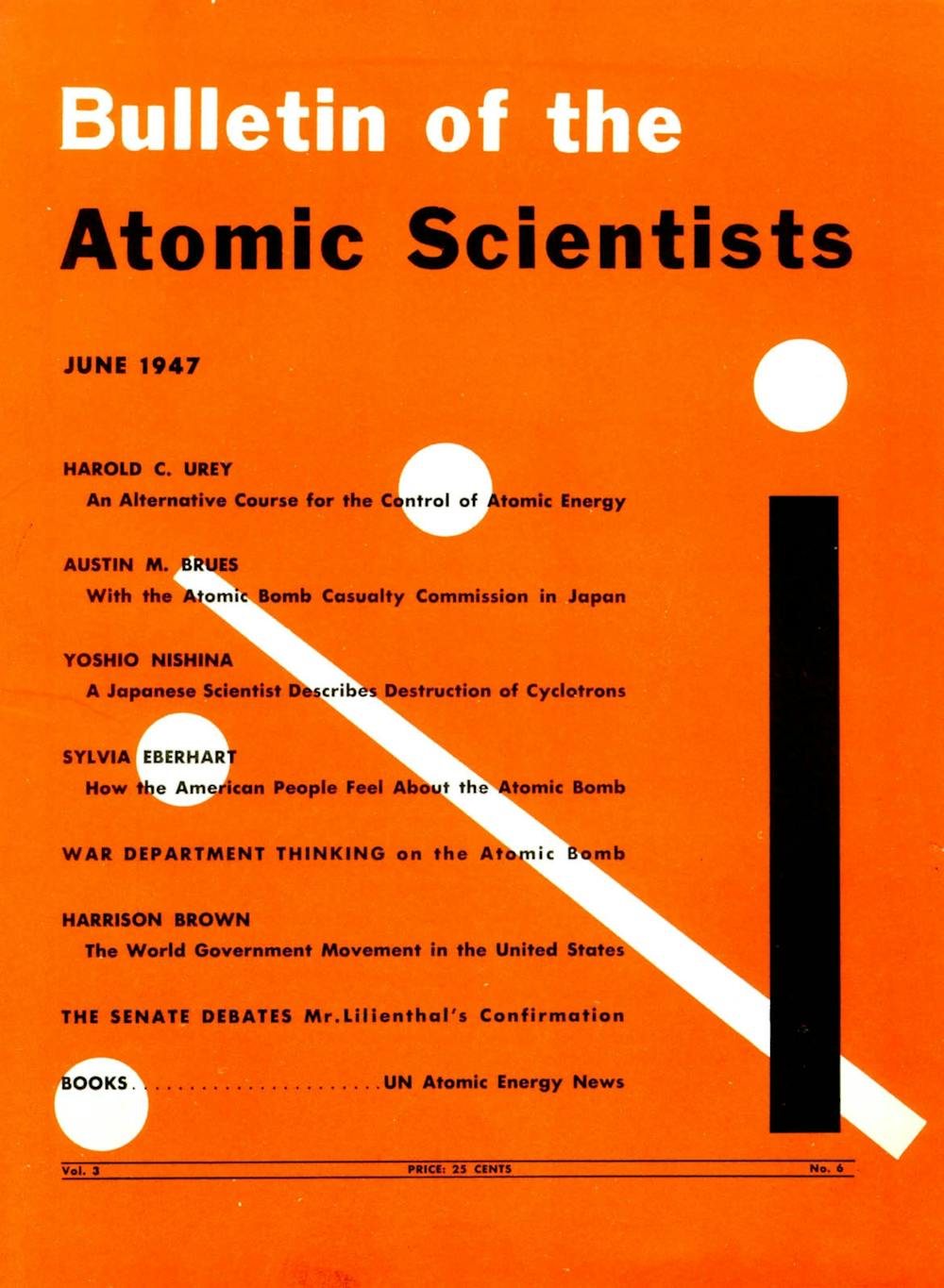
The artist Martyl Langsdorf sought to communicate the sense of urgency she had felt from scientists who had worked on the bomb, including her physicist husband, Alexander. The placement was, to her, an aesthetic choice: “It seemed the right time on the page … it suited my eye.”
Thereafter, Bulletin editor Eugene Rabinowitch was the gears behind the clock’s hands until his passing in 1973, when the board of experts took over.
The clock has been moved 25 times since, particularly in response to the ebb and flow of military buildups, technological advancement and geopolitical dynamics during the Cold War.
Nuclear risk did not abate after the collapse of the Soviet Union, even as the total number of nuclear weapons shrank. And new threats have emerged that pose catastrophic risk to humanity. The latest setting of the clock attempts to gauge this level of risk.
A precarious world
In the words of Bulletin president and chief executive Rachel Bronson:
Make no mistake: resetting the Clock at 90 seconds to midnight is not an indication that the world is stable. Quite the opposite.
The Bulletin cited four key sources of risk: nuclear weapons, climate change, biological threats, and advances in artificial intelligence (AI).
Two ongoing conflicts – Russia and Ukraine, and Israel and Palestine – involve nuclear-weapon states. Longstanding bulwarks of nuclear stability, such as the New Strategic Arms Reduction Treaty between the United States and Russia, are barely functional. North Korea and Iran retain their nuclear ambitions. And China is quickly growing and modernising its nuclear arsenal.
The impacts of climate change are worsening, as the world suffers through its hottest years on record. Six of nine planetary boundaries are beyond their safe levels. And we are likely to fall short of the goal set by the Paris climate agreement – keeping temperature increase to no more than 1.5°C above pre-industrial levels. Dramatic climatic disruptions are a real possibility.
The COVID pandemic revealed the global impacts of a biological threat. Engineered pandemics, created using synthetic bioengineering (and perhaps soon aided by AI tools), could be more viral and lethal than any natural disease. Add to the challenge the continued presence of biological weapons programs around the world, and the shifting disease risk due to the effects of climate change, and biothreats will be a regular battlefront for many countries.
Finally, the Bulletin recognised the risk that comes with advances in AI. While some AI experts have raised the prospect of AI itself being an existential threat, AI is also a threat multiplier for nuclear or biological weapons. And AI could be a vulnerability multiplier. Through AI-enabled disinformation, democracies might struggle to function, especially when dealing with other catastrophic threats.
 Bulletin of the Atomic Scientists members Asha George, Herb Lin, science educator Bill Nye, Bulletin of the Atomic Scientists President and chief executive Rachel Bronson, and Bulletin members Alexander Glaser and Daniel Holz, pose for a photograph with the Doomsday Clock on January 23 2024.
AP Photo/Jacquelyn Martin
Bulletin of the Atomic Scientists members Asha George, Herb Lin, science educator Bill Nye, Bulletin of the Atomic Scientists President and chief executive Rachel Bronson, and Bulletin members Alexander Glaser and Daniel Holz, pose for a photograph with the Doomsday Clock on January 23 2024.
AP Photo/Jacquelyn Martin
Subjective and imprecise, but does that matter?
The Doomsday Clock has its detractors. Critics argue that the setting of the clock is based on subjective judgements, not a quantitative or transparent methodology. What’s more, it is not a precise measurement. What does “90 seconds to midnight” actually mean?
With the clock now set at its highest ever level, it naturally brings into question why we face greater risk than, say, during the Cuban Missile Crisis. What would it take to get closer than 90 seconds to midnight?
Read more: Doomsday Clock moves closer to midnight, but can we really predict the end of the world?[3]
Fundamentally, these criticisms are accurate. And there are plenty of ways the clock could be technically improved. The Bulletin should consider them. But the critics also miss the point.
The Doomsday Clock is not a risk assessment. It’s a metaphor. It’s a symbol. It is, for lack of a better term, a vibe.
A powerful image of nebulous threats
From the very beginning, when seven minutes to midnight “suited the eye”, the Doomsday Clock was an emotional and visceral response to the nuclear moment. Which is why it has become a powerful image, drawing the eyes of the world every year.
Global catastrophic threats are nebulous and complex and overwhelming. With just four dots and two hands, the Doomsday Clock captures the sense of urgency like few images can.
There are better and more actionable ways to assess risk. A handful of countries, for example, conduct national risk assessments. These are formal and regular processes by which governments assess a range of threats to the country, prioritising them on a quantitative scale and building response plans for the highest risk vectors. More countries should conduct these assessments, and be sure to catalogue global catastrophic threats.
Or take the World Economic Forum’s annual Global Risk Report. Based on a survey of around 1,500 experts from across academia, business, government and civil society, it captures the greatest perceived threats over the following two and ten years. Following a similar method, the United Nations is currently conducting its own survey of global risk.
The Doomsday Clock does not replace efforts to understand and assess the greatest threats we face. If anything, it should inspire them.
References
- ^ the Doomsday Clock was unveiled again (thebulletin.org)
- ^ Public domain/Wikimedia (en.wikipedia.org)
- ^ Doomsday Clock moves closer to midnight, but can we really predict the end of the world? (theconversation.com)