Sediment runoff from the land is killing NZ’s seas – it’s time to take action
- Written by: Abigail M Smith, Professor of Marine Science, University of Otago
The fishers at Separation Point, between Golden Bay and Tasman Bay in New Zealand’s northwest South Island, used to be cautious. Something they called “hard coral” would tear their nets. If you dived down about 30 metres, you could see why: extensive reefs.
These reefs were constructed by bryozoans[1], tiny polyp-like creatures that cooperate to build large, branching colonies. They are similar to corals but live in deeper and cooler water.
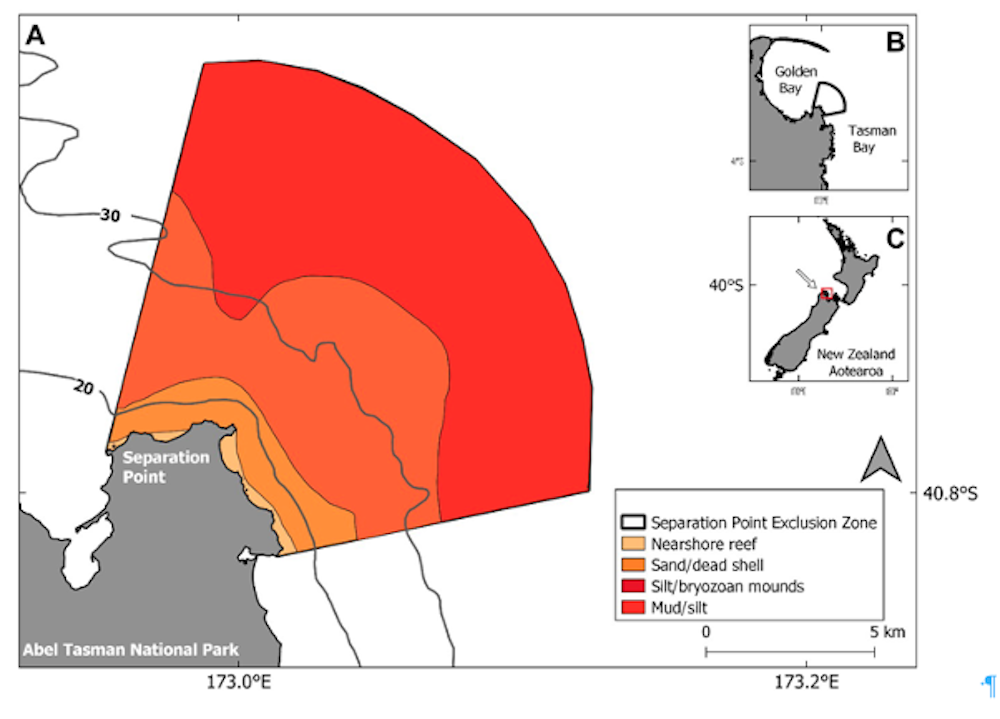
The reefs at Separation Point were gorgeous and biodiverse. They provided shelter for small animals such as oysters and young fish. In 1980, the world’s first bryozoan-based fishing exclusion area was created to protect them: 146 square kilometres of seafloor was closed to most fishing, from the coastline to a depth of about 50 metres.
It went well at first. A 1983 study from the National Institute of Water and Atmospheric Research (NIWA[2]) of just one reef found 37 species of bryozoans and another 39 invertebrate species, plus numerous fish. In 2008, a study comparing fished and unfished areas[3] off Separation Point found more biodiversity where fishing had been limited.
Alas, subsequent developments have not been so kind. Land clearance for agriculture and forestry since human occupation has resulted in a ten-fold increase in sediment runoff in the area.
Thick beds of mud and silt have built up, destroying and burying the reefs. A survey of the same area[4] in 2021 found flat mud deposits, with the occasional small, dead bryozoan sticking up. No fish remained in this marine ghost town.
Part of a bigger picture
These days it’s hard to escape news that the ocean is in trouble. Warming waters cause heatwaves that bleach corals. Fish and sharks appear where they never used to. Plastic is everywhere, including the stomachs of dolphins and penguins. Overfishing is causing populations to crash.
Meanwhile, sea levels are rising, dredging and mining are destroying ecosystems, while underwater engine noise and artificial light are changing how animals behave. Even the fundamental chemistry of seawater is changing as CO₂ dissolves in it. UNESCO’s Ocean Literacy Portal[5] reads like an obituary.
Read more: Plastic pollution in some NZ lakes is comparable to northern hemisphere lakes in highly populated areas, global study finds[6]
But there’s another problem often left off that grim list: sediment runoff. When people remove trees, build roads and overstock paddocks, sand, mud and silt flow into the sea.
The resulting damage to coastal ecosystems gets little press, despite being described by the US National Oceanic and Atmospheric Administration as the greatest single source of pollution[7] in the world’s waterways and coasts.
The first objective of the New Zealand Coastal Policy Statement[8] in 2010 was to maintain and restore marine water quality. But that’s far from what we have today.
Dark waters, turbid with silt, affect marine life. We are increasingly aware of the changes in seaweed cover around New Zealand, from damage to kelp canopies to changes in phytoplankton. Seaweeds need light and clear waters.
Bryozoans, barnacles, oysters, cockles and scallops are suffering too. They literally starve to death by collecting dirt particles rather than food. Their delicate feeding tentacles are damaged or clogged, while their neighbours (such as pāua) are smothered or buried.
Read more: NZ’s vital kelp forests are in peril from ocean warming – threatening the important species that rely on them[9]
New Zealand’s disproportionate problem
Sediment runoff is most likely in wet places with high and regular rainfall, prone to being disturbed by storms and earthquakes, and with steep slopes, young rocks and soils. Agricultural land is a particularly strong source of sediment to waterways. Sound like somewhere you know?
Aotearoa New Zealand is eroding into the sea right under our feet. Over 200 million tonnes of sediment are transported by rivers to the sea[10] each year, making fine sediment the most important and widespread water contaminant in this country.
Despite covering only 0.2% of global land area, the Ministry for the Environment reported in 2018[11] that New Zealand contributes 1.7% of the sediment to the world’s oceans.
Removal of forest and well-rooted plants, overgrazing and construction all result in sediment washing into the sea. Excavating old soils containing now-outlawed pollutants such as DDT, tin or lead exacerbates the problem.
Under the Resource Management Act, regional councils have the authority to prevent discharge of contaminants into water, and the responsibility to manage catchments to minimise sediment getting to the sea. Murky coastal waters suggest they’re not coping with this task.
Action and policy needed
We can make a difference. Planting and avoiding runoff are the most obvious solutions. Roots hold soil better than anything humans have invented. Usefully, they also direct water deep into the ground and remove carbon from the atmosphere.
The usual advice is to plant forests near the tops of catchments, where the ground is steepest and most vulnerable. Projects such as the government’s One Billion Trees Programme[12] are promising, but the key is to leave those trees alone, or find ways to harvest them that minimise runoff.
Read more: New Zealand's maritime territory is 15 times its landmass – here's why we need a ministry for the ocean[13]
The Building Research Association of New Zealand recommends managing construction projects to avoid runoff[14], including using settling ponds and channels to retain dirty water, or chemical “flocculants[15]” to make fine sediments bind together into a glob and sink. Every project should include the post-completion planting needed to retain soil.
Individuals and households can plant gardens and trees to avoid bare spots. They can limit the use of concrete and other impervious surfaces or choose permeable concrete. They can capture rain from their roof in a rain barrel instead of using storm water drains.
The Māori concept of “ki uta ki tai[16]” recognises the connection between the land and sea, and should inform more robust and holistic environmental management policy, from the mountaintops to the deep ocean.
Regional councils use these words, but we need to see real action. Working together, we can keep soil on land where it belongs, and the ocean clean and clear.
References
- ^ bryozoans (www.sciencelearn.org.nz)
- ^ NIWA (niwa.co.nz)
- ^ study comparing fished and unfished areas (niwa.co.nz)
- ^ survey of the same area (www.stuff.co.nz)
- ^ Ocean Literacy Portal (oceanliteracy.unesco.org)
- ^ Plastic pollution in some NZ lakes is comparable to northern hemisphere lakes in highly populated areas, global study finds (theconversation.com)
- ^ greatest single source of pollution (oceanservice.noaa.gov)
- ^ New Zealand Coastal Policy Statement (www.doc.govt.nz)
- ^ NZ’s vital kelp forests are in peril from ocean warming – threatening the important species that rely on them (theconversation.com)
- ^ transported by rivers to the sea (niwa.co.nz)
- ^ reported in 2018 (environment.govt.nz)
- ^ One Billion Trees Programme (www.mpi.govt.nz)
- ^ New Zealand's maritime territory is 15 times its landmass – here's why we need a ministry for the ocean (theconversation.com)
- ^ managing construction projects to avoid runoff (www.level.org.nz)
- ^ flocculants (enva.com)
- ^ ki uta ki tai (niwa.co.nz)