Godzilla Minus One offers an insight into the complexity of Japan’s war memories
- Written by: Jason Jones, Lecturer in Japanese Studies, Monash University
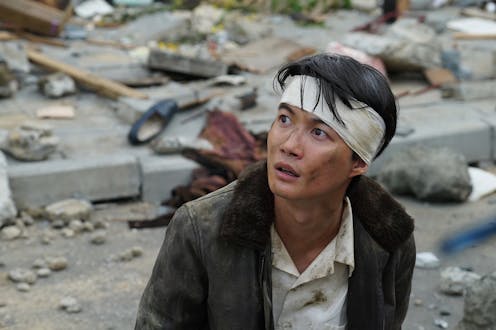
The new hit Japanese film Godzilla Minus One – an homage to Honda Ishirō’s original 1954 film Gojira[1] (more commonly known to English speakers as Godzilla) – centres on the human costs of war.
Released in Japan in November and internationally in December, Takashi Yamazaki’s film is still breaking records, surpassing US$100 million[2] at the global box office.
Much like the iconic Gojira transformed the war into an allegorical nuclear monster bent on destroying Tokyo, Godzilla Minus One offers insights into early post-war Japan and the complexity of the nation’s war memories.
Japan has never forgotten its wartime past, and its population has had to deal with its own trauma. For those interested in Japanese history, Godzilla Minus One provides a new way to read the complexity of Japan’s war memories.
Living despite despair
During the second world war, Navy Tokko (Kamikaze) pilot Koichi Shikishima (Ryunosuke Kamiki) fails to follow through on a suicide mission and lands on Odo Island.
Godzilla appears, and Shikishima freezes in fear instead of shooting. All but he and the head mechanic are killed. Upon his return to Japan, Shikishima experiences post-traumatic stress disorder, torturous guilt and the contempt of his neighbours.
Shikishima’s return references a common experience[3] of veterans of Pacific battlefields in Japan. Guilt and an ambivalent reception at home prevented many veterans from being able to make a life in post-war Japan.
In Godzilla Minus One, it is only when the monster of war – Godzilla – is defeated that the central hero can overcome his trauma and get the girl.
The film critiques the inhumanity visited upon soldiers who served within a wartime imperial army and navy paradigm in which honour was predicated on their willingness to die[4] in service to the emperor, and thus the nation.
In Godzilla Minus One, survival, life and love become the basis of post-war nation-building. The film emphasises this when Shikishima visits the Ministry of Demobilisation[5] to find another Odo Island survivor, only to learn it is nigh impossible to trace anyone’s whereabouts when so many have been sent to their deaths.
If Godzilla (or war) is to be defeated, the movie says, the government can be of no hope. This can be read as a commentary on the ongoing debates in Japan on how the second world war should be taught and interpreted.
Textbooks often acknowledge the country’s role in the war, but avoid[6] “uncomfortable evaluation”. The role of the government in these debates is also a key area of contention. Article 9 of the Japanese constitution promotes pacifism[7] even while the country increases its defence budget, and the removal of the article is debated[8] in current Japanese politics.
In the film, those who collaborate to fight Godzilla must do so through their own ingenuity and volition – unlike the wartime sailors and Tokko pilots who had no choice in their deployment.
While the heroes of both Gojira and Godzilla Minus One exercise choice, their choices take them in drastically different directions: death in the former and life in the latter. This perhaps illustrates a shift in values among today’s younger Japanese generations that privileges surviving the war rather than dying in it.
Read more: Discrimination, internment camps, then deportation: the end of the second world war did not mean peace for Japanese-Australians[9]
Post-war transformation
Godzilla Minus One idealises the disappearance of a troublesome rift in post-war Japan, which, since 1945, has pitted the wartime generation’s view of the war against those of younger Japanese. This rift became especially stark[10] around the death of Emperor Showa (Hirohito), who ruled from 1926 until his death in 1989.
The film also references an important shift in post-war Japan: the war destroyed previously unbreachable class divides. The country’s defeat flattened social differences, impoverishing everyone equally. Here, Godzilla is defeated by an exalted scientist and his best friend, a sea captain of humble origins.
In the film, the endeavour to fight Godzilla is a masculine one. The film depicts women as the monster’s victims, not participants in its destruction. The men in the movie are motivated by the protection of those at home, symbolised by the central character’s adopted female child: a reflection of the gendering of pacifism[11] as female in post-war Japan, which renders the creation of – and the fight against – war as masculine.
Godzilla Minus One demonstrates how Japan’s relationship to its wartime past is constantly being reframed. The film iterates that this allegorical monster of war and destruction is one created by humans – not just the result of some natural disaster divorced from the politics and active decision-making of war.
The only way to kill the monster, or subdue it temporarily, is by a coalition of people who pursue pacifism, ever vigilant against systems and ideologies that seek old glories in new wars, reawakening monsters that should have remained at the bottom of the sea.
Read more: 'Godzilla Minus One': Finding paradise of shared co-operation through environmental disaster[12]
References
- ^ original 1954 film Gojira (www.theatlantic.com)
- ^ surpassing US$100 million (www.forbes.com)
- ^ common experience (research.monash.edu)
- ^ their willingness to die (muse.jhu.edu)
- ^ Ministry of Demobilisation (history.army.mil)
- ^ avoid (www.wilsoncenter.org)
- ^ promotes pacifism (www.lowyinstitute.org)
- ^ is debated (apjjf.org)
- ^ Discrimination, internment camps, then deportation: the end of the second world war did not mean peace for Japanese-Australians (theconversation.com)
- ^ especially stark (www.tandfonline.com)
- ^ gendering of pacifism (www.jstor.org)
- ^ 'Godzilla Minus One': Finding paradise of shared co-operation through environmental disaster (theconversation.com)