A new Netflix doco shows Alexander the Great as queer, and some viewers aren’t happy. An expert weighs in
- Written by: Charlotte Dunn, Lecturer in Classics, University of Tasmania
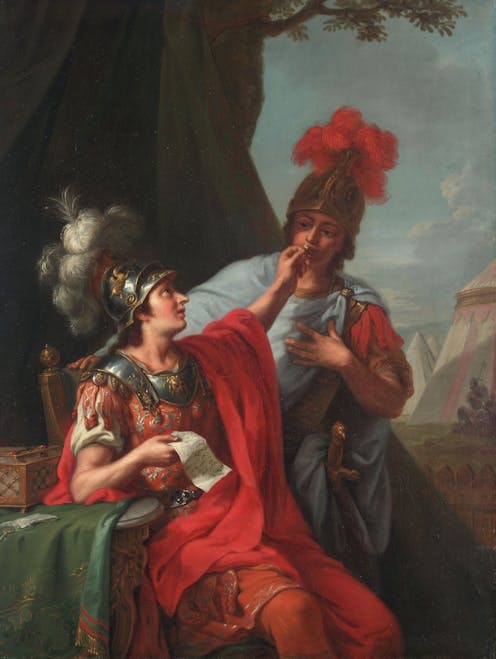
You might be surprised to learn the sex life of a long-dead conqueror is making headlines in 2024. Netflix documentary Alexander the Great: The Making of a God[1] has provoked outrage for its portrayal of Alexander in a romantic relationship with his male companion Hephaestion[2].
Alexander the Great (356–323BC) spent his short life undertaking an enormous military campaign. He defeated the Persian king Darius III[3] and created an empire that stretched from Europe into Egypt, Western and Central Asia, and all the way to India.
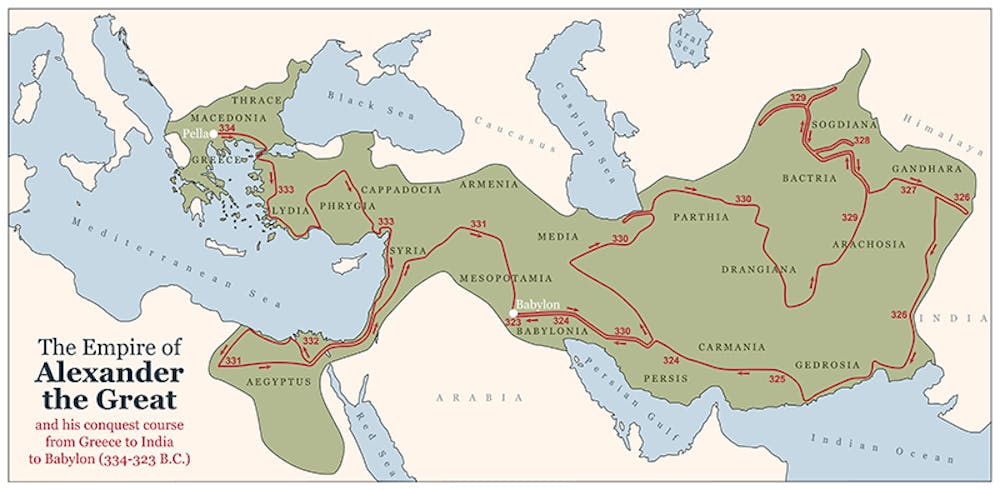
After dying at the young age of 32, he has remained the subject of intense fascination and speculation.
The six-episode series is the latest to tackle some interesting questions about the conqueror’s life through dramatised scenes and commentary from a range of experts. Although the show doesn’t try to cover everything – and there are several gaps – its portrayal of Alexander’s sexuality is what has caused the greatest stir.
Read more: Romosexuality – embracing queer sex and love in Ancient times[4]
Alexander, the great enigma
One of the first scenes depicts Alexander sparring with Hephaestion before the pair share several kisses. Hephaestion promises he will be by Alexander’s side “til the bitter end”. The experts then note the pair were likely more than just close friends.
Some viewers, however, have accused the show of pushing a supposed agenda. Others found it “too woke[5]”.
Even Greece’s Minister for Culture, Lina Mendoni, has spoken on the topic, insisting that historical sources offer no evidence for the relationship going “beyond the limits of friendship[6]”.
Mendoni’s comment was made in response to questions from Dimitris Natsiou, the president of a far-right Christian Orthodox political party. Natsiou has spoken out against the series for perceived inaccuracies. Along with other critics, he suggests the show’s portrayal of Alexander’s sexual identity is a historical distortion.
It’s true there is nothing written by Alexander himself that confirms how he viewed his own sexuality. But is it fair to call the show inaccurate for its interpretation of his relationship with Hephaestion?
The ancient evidence
While the ancient evidence suggests the pair were particularly close, reconstructing the past is not a straightforward matter. Most surviving ancient authors actually wrote centuries after Alexander’s death and often had their own interpretations of events. This makes it very challenging to uncover the truth.
Some sources do assume the pair were lovers, such as the Roman author Claudius Aelianus, or Aelian, because of the way they presented themselves in public[7].
This public presentation is probably the strongest evidence for how important Hephaestion was to Alexander. Alexander was an absolute master of propaganda. He took care to restrict how he appeared in art and sculpture[8], and controlled his campaign narrative through the use of his own historian, Callisthenes of Olynthus[9]. Callisthenes was responsible for glorifying Alexander’s victories and presenting the version of events Alexander wanted.
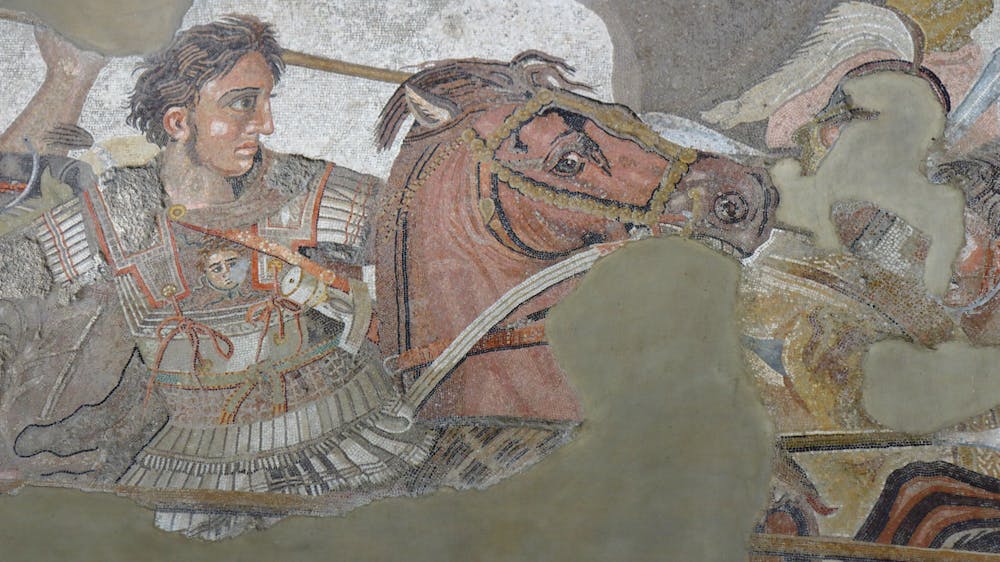 Alexander claimed the mythological hero Achilles was his ancestor.
Shutterstock
Alexander claimed the mythological hero Achilles was his ancestor.
Shutterstock
Alexander also stage-managed a number of events at the start of his military campaign to make it seem like the beginning of another Trojan War[10]. The tale of this war was incredibly important to the ancient Greeks, and especially Alexander, who claimed the mythological hero Achilles was his ancestor.
During the important opening act, Alexander laid a wreath on the tomb of Achilles. Some ancient accounts say Hephaestion did the same for the tomb of Patroclus, who many in the ancient world assumed was Achilles’ lover[11].
Hephaestion is the only companion of Alexander who is mentioned by name doing something important like this. Alexander was no doubt astute enough to understand the implication in his own day; he was therefore probably comfortable with his followers assuming he and Hephaestion were lovers, just as Achilles and Patroclus were thought to be.
Ancient author Diodorus Siculus reports that Alexander preferred Hephaestion above everyone else[12], even claiming that Hephaestion loved him as Alexander, while his other close friend Craterus loved him as the king. These are just some of the numerous anecdotes that demonstrate Hephaestion had a significant role in Alexander’s life – and one that was different to that of a friend.
After Hephaestion’s death in 324 BC, Alexander mourned him extravagantly[13], just as Achilles did for Patroclus[14].
These very public displays might be as close as we can get to understanding how Alexander wanted the pair to be perceived. And they suggest a romantic relationship is a strong possibility.
What does the scholarship say?
Perhaps a more important question is why a documentary exploring this angle might provoke such a strong reaction today.
It’s true that scholarship on Alexander’s sex life has not always been accessible. It wasn’t until 1978 that K. J. Dover’s work Greek Homosexuality[15] paved the way for new insights into a more diverse interpretation of sexualities in the ancient world.
Before this, important scholars on Alexander, such as W. W. Tarn (1869–1957), had outright denied Alexander’s interest in men, asserting any such evidence was a result of “hostile” sources. Tarn even erased[16] certain figures from history, including another possible male lover of Alexander’s, Bagoas[17]. He was unable to accept Alexander as someone who didn’t fit with his own image of the conqueror.
The reality is that same-sex relationships were generally pretty common during the time[18] of Alexander the Great, although there were also societal pressures on men, as they were expected to marry and have children with their legitimate wives.
Read more: Friday essay: the myth of the ancient Greek 'gay utopia'[19]
Queer erasure has been all too common in scholarship[20], which has traditionally favoured hetero-normative interpretations, even when the evidence could clearly be interpreted in another way.
Media representations that explore these interpretations offer us a chance to understand ancient relationships in their own context. In doing so, they pave the way for a richer understanding of the possibilities of the past.
References
- ^ Alexander the Great: The Making of a God (www.imdb.com)
- ^ Hephaestion (www.livius.org)
- ^ Darius III (www.britannica.com)
- ^ Romosexuality – embracing queer sex and love in Ancient times (theconversation.com)
- ^ too woke (www.unilad.com)
- ^ beyond the limits of friendship (www.theguardian.com)
- ^ presented themselves in public (erenow.org)
- ^ in art and sculpture (www.getty.edu)
- ^ Callisthenes of Olynthus (oxfordre.com)
- ^ Trojan War (www.britishmuseum.org)
- ^ assumed was Achilles’ lover (www.britannica.com)
- ^ above everyone else (penelope.uchicago.edu)
- ^ mourned him extravagantly (digitalcommons.unomaha.edu)
- ^ Achilles did for Patroclus (chs.harvard.edu)
- ^ Greek Homosexuality (www.hup.harvard.edu)
- ^ Tarn even erased (erenow.org)
- ^ Bagoas (www.jstor.org)
- ^ during the time (www.livius.org)
- ^ Friday essay: the myth of the ancient Greek 'gay utopia' (theconversation.com)
- ^ in scholarship (www.getty.edu)