Australian music festivals are increasingly affected by climate change. But is the industry doing enough to mitigate its impact?
- Written by: Milad Haghani, Senior Lecturer of Urban Mobility, Public Safety & Disaster Risk, UNSW Sydney
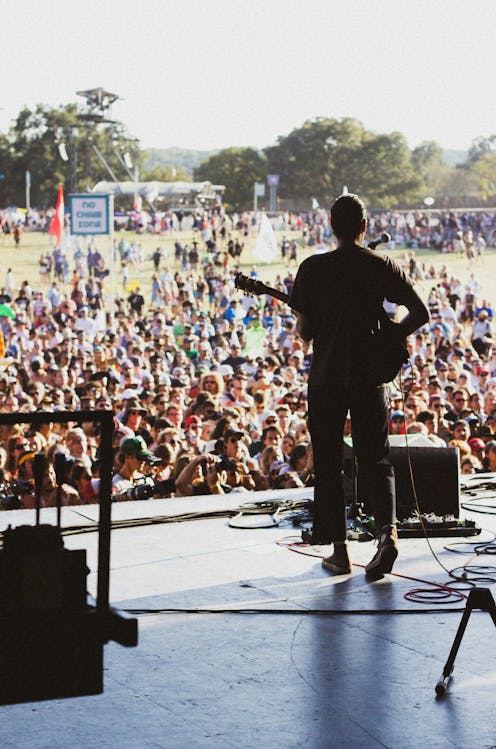
The Pitch Music and Arts Festival in Moyston, Victoria, was cancelled[1] while festival-goers were already on site this weekend, after an extreme fire danger warning was issued.
Cancellations like these have become all too familiar.
The live music and festival industry is currently struggling with significant challenges[2], including expensive insurance premiums and the cost of living crisis impacting ticket sales.
In particular are the challenges associated with climate change, as extreme weather events becoming more frequent, severe and unpredictable.
I looked at news reports over 2022 and 2023 and found at least 22 music festivals in Australia cancelled or disrupted due to extreme weather conditions.
This trend of weather-related interruptions appears to be on the rise: over the seven years between 2013 and 2019, only ten music festivals[3] in Australia were affected by extreme weather.
Severe weather impacts on music festivals and concerts have ranged from delays and cancellations, to the evacuation of venues and areas mid-festival or mid-performance. This will be a growing challenge for the industry.
Read more: Climate change is transforming Australia’s cultural life – so why isn’t it mentioned in the new national cultural policy?[4]
Death, injury and cancellations
This is not limited to Australia, and not all extreme weather-related events result in a cancellation. In my research, I also looked at where and why events were being cancelled in the United States, finding at least 21 cancellations in 2022–23.
I also found similar cases in New Zealand[5], Canada[6], the United Kingdom[7], Spain[8] and the Netherlands[9].
In November, we saw the tragic death of a fan due to extreme heat at Taylor Swift’s Eras Tour in Brazil[10].
Read more: Taylor Swift's Brazil concert was hammered by extreme heat. How to protect crowds at the next sweltering gig[11]
There were more than 100 hospitalisations following a hailstorm at a Louis Tomlinson concert[12] in Colorado last June.
At a Taylor Swift performance in Sydney, fans were temporarily evacuated[13] and the show was delayed due to lightning strikes.
In Australia, severe weather has recently led to the postponement of major events such as the abrupt ending to Sydney’s Good Things festival due to a storm[14] in December, and cancellation the of Strawberry Fields festival, scheduled for October 2022, due to flooding in southern NSW[15].
Extreme weather events are closely linked[16] to climate change. This trend is likely going to get worse. Australia has witnessed a marked increase[17] in the intensity, frequency and duration of heatwaves over the past 67 years, with a significant uptick observed in recent decades.
The environmental impact of festivals
There has not yet been a comprehensive carbon footprint audit[18] of the Australian music industry, but we do know how much music can contribute to carbon emissions through research in the UK.
The UK’s live music industry[19] produces 405,000 tonnes of greenhouse gas emissions annually.
The primary sources of these emissions are audience travel, accounting for 43%, and the operations of live music venues, contributing another 23%. This means nearly three-quarters of industry’s emissions are linked[20] to live music performances.
The average touring DJ is responsible[21] for 35 tonnes of CO₂ a year – more than 15 times the personal carbon budget recommended for individuals[22] and nearly eight times the average.
In 2019 alone, 1,000 touring DJs[23] took more than 51,000 flights around the world, generating as much CO₂ as over 20,000 households.
Music festivals can make a change
There are signs of a growing consciousness[24] within the live music industry towards mitigating environmental impacts.
The UK’s live music sector has committed to reaching net-zero emissions[25] by 2030.
In Australia Woodford Folk Festival[26] and WOMADelaide[27] have banned single-use plastics and promote recycling to minimise waste.
The live music industry can reduce its environmental impact by adopting more renewable energy, and using sustainable transport options for artists and audiences[28].
Engaging audiences in sustainability efforts, such as incentivising carbon offset[29] contributions, can also amplify impact.
Other environmental concerns at festivals are less obvious but also important. Attendees often enjoy wearing glitter, not realising it is made of microplastics[30]. Switching to biodegradable glitter is a practical solution.
Festivals also see waste from abandoned low-quality camping gear[31]. These one-time-use tents and accessories contribute to environmental degradation and create waste management challenges. There needs to be more efforts in educating attendees on the importance of sustainable camping practices and encouraging the use of high-quality, reusable camping gear.
Read more: The environmental cost of abandoning your tent at a music festival[32]
Tree planting has emerged as a popular strategy for music festivals[33] and bands[34] to offset their carbon footprint and contribute positively to the environment[35].
Incorporating carbon offsets into ticket pricing or offering them as voluntary options presents strategy for festivals and artists to mitigate their environmental impact[36].
Challenges such as rising supply chain costs and the cost of living[37] are testing the viability of festivals. Amid these challenges, severe weather can introduce additional uncertainties.
It is important the event industry and festival-goers acknowledge their contributions to these escalating challenges, and take proactive steps towards greening music festivals.
References
- ^ was cancelled (www.noise11.com)
- ^ significant challenges (theconversation.com)
- ^ only ten music festivals (journals.sagepub.com)
- ^ Climate change is transforming Australia’s cultural life – so why isn’t it mentioned in the new national cultural policy? (theconversation.com)
- ^ New Zealand (www.nzherald.co.nz)
- ^ Canada (www.dancemusicnw.com)
- ^ the United Kingdom (news.sky.com)
- ^ Spain (accessaa.co.uk)
- ^ the Netherlands (edmmaniac.com)
- ^ in Brazil (theconversation.com)
- ^ Taylor Swift's Brazil concert was hammered by extreme heat. How to protect crowds at the next sweltering gig (theconversation.com)
- ^ Louis Tomlinson concert (uk.movies.yahoo.com)
- ^ temporarily evacuated (x.com)
- ^ due to a storm (www.smh.com.au)
- ^ flooding in southern NSW (www.abc.net.au)
- ^ closely linked (www.ipcc.ch)
- ^ marked increase (www.sciencedirect.com)
- ^ carbon footprint audit (noco2.com.au)
- ^ UK’s live music industry (theface.com)
- ^ are linked (iopscience.iop.org)
- ^ responsible (theface.com)
- ^ carbon budget recommended for individuals (www.flightnook.com)
- ^ 1,000 touring DJs (cleanscene.club)
- ^ growing consciousness (onimpact.com.au)
- ^ net-zero emissions (theface.com)
- ^ Woodford Folk Festival (woodfordfolkfestival.com)
- ^ WOMADelaide (www.womadelaide.com.au)
- ^ and audiences (www.sunshinecoast.qld.gov.au)
- ^ incentivising carbon offset (link.springer.com)
- ^ microplastics (edition.cnn.com)
- ^ low-quality camping gear (theconversation.com)
- ^ The environmental cost of abandoning your tent at a music festival (theconversation.com)
- ^ music festivals (woodfordia.org)
- ^ bands (onetreeplanted.org)
- ^ contribute positively to the environment (www.taylorfrancis.com)
- ^ mitigate their environmental impact (www.emerald.com)
- ^ rising supply chain costs and the cost of living (theconversation.com)