Belvoir’s compelling and skilful staging of Holding the Man
- Written by: Huw Griffiths, Associate Professor of English Literature, University of Sydney

Walking through Chippendale on my way to Sydney’s Belvoir Street Theatre, where this production of Holding the Man is playing, I pass by the York Theatre. This was the theatre where, in 1985, Timothy Conigrave, author of the original memoir upon which the play is based, was rehearsing a touring show of Neil Simon’s Brighton Beach Memoirs. He had to excuse himself from one rehearsal for an appointment where he learned his HIV-positive diagnosis.
Then, walking up the hill to Surry Hills, I get to the Belvoir Street Theatre itself. Five years after that initial diagnosis, Conigrave’s play, Thieving Boy, was getting its first rehearsed reading at the Belvoir. He wasn’t able to attend because he’d been kept in hospital with Pneumocystis pneumonia, PCP[1], an AIDS-defining illness.
To watch this revival of Tommy Murphy’s beautifully crafted adaptation of Conigrave’s memoir at the Belvoir is to inhabit spaces that are filled with the book’s memories.
One of the things that memoir can do is to hold a space open for memories to live on in the world, personal memories that would otherwise be lost. Conigrave’s 1995 book, Holding the Man, is a rare gift, perfectly capturing what it was like to grow up gay in the decades just before the arrival of HIV.
Read more: Holding the Man, and bringing HIV/AIDS in Australia to a mainstream audience[2]
Noticing the small things
At the book’s heart is a joyous love story between Tim and his high school sweetheart, John Caleo. There is, of course, the overarching trajectory of John’s death and the impact of HIV on their friends and families. But the book works its remarkable magic on a reader by disarming you with the tiny details of somebody’s life.
It is the small things that are often the most affecting in Conigrave’s writing: what people were wearing, what they were listening to, how they looked in certain turns of the light, the awkwardness and fun of sex, what made them smile or laugh.
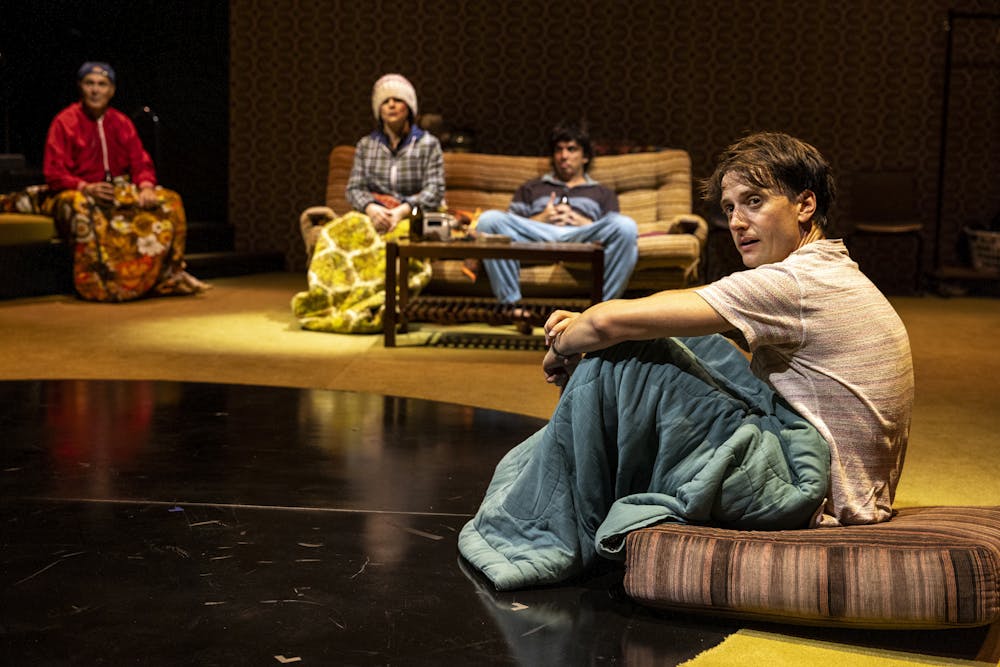
Eamon Flack’s production captures well – and with a lovely, light touch – this sense of fleeting memories that are, nevertheless, still available to us. Tom Conroy is superb in the central role. He takes us from nine-year-old Tim to grieving lover with all of the empathy and playfulness that the part requires. Neither Conigrave’s book nor Murphy’s script shy away from Tim’s flaws; he is, at times, petulant and selfish, but always charming, recognisable and human.
Conroy is joined by a wonderful cast: Danny Ball as John, his lover, but also an ensemble of four performers (Russell Dykstra, Rebecca Massey, Guy Simon and Shannen Alyce Quan) who cycle through all the other people in Tim’s life. They are all great, but special mentions for Massey who wears more wigs than Cher and revels in every part. Guy Simon’s two appearances as a schoolfriend’s mum are also an absolute joy.
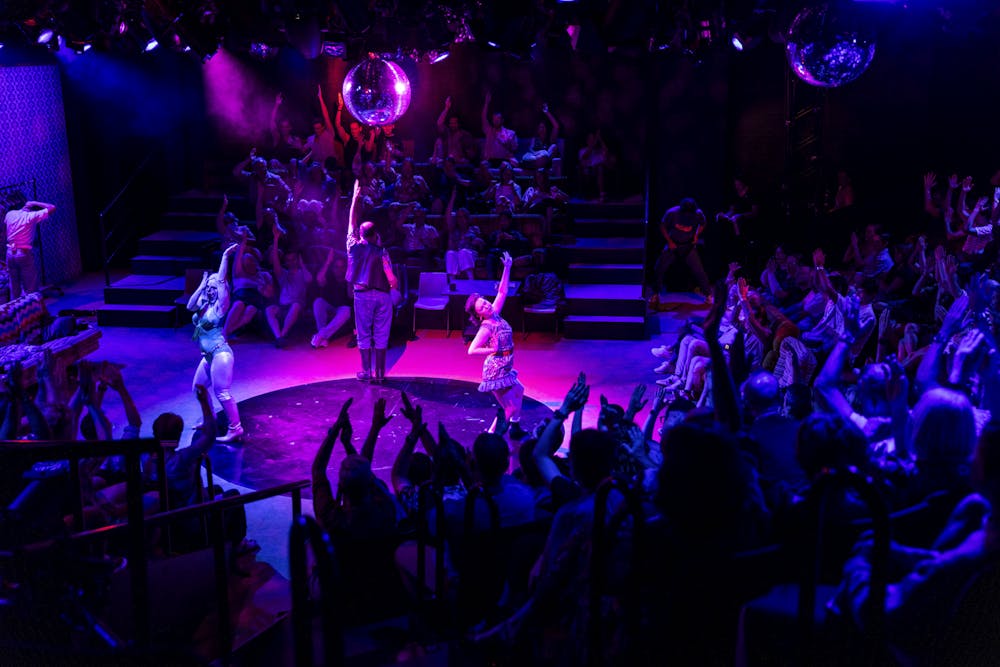 Eamon Flack’s production balances tears and laughter.
Brett Boardman/Belvoir
Eamon Flack’s production balances tears and laughter.
Brett Boardman/Belvoir
The wit, charm and love of the opening act (schoolboy crushes, dancing, music and a lot of laughter) are balanced well with the pathos of the second half (the endurance of love, loss and tears, but also more laughter). Flack’s direction knits together the constant shifts in focus – an essential part of memoir and of memory plays – with an ease that only seems effortless; this is a compelling and skilful use of stage and script.
Read more: Class, queerness and illness in the ‘post-crisis’ era: rewriting the narrative of HIV[3]
A timely reminder
This is also a production that knows it is addressing an audience in 2024, not in 1995, when Conigrave’s book was first published, nor in 2006 when Murphy’s adaptation was first staged. We’ve lived through a lot since, not only the bruising marriage equality vote in Australia, but also a global sense that the lives of queer people might be newly under threat.
 This production captures the sense of fleeting memories.
Brett Boardman/Belvoir
This production captures the sense of fleeting memories.
Brett Boardman/Belvoir
The lives and loves of gay men, our friends and families, are unavoidably threaded through (pulled apart and drawn together) by what happened in the 1980s and 1990s. This production is an important and timely reminder of what was lost, what was gained, and of the precious memories that we need to keep alive.
On the day of the opening night, the NSW parliament was hearing the first reading of a bill that would outlaw gay conversion practices[4], the victims of which testify to its corrosive and violent impact on their lives.
Here’s hoping the ban on such practices is one more step in restoring joy to the lives of queer kids in our city and state.
Holding the Man is at Belvoir, Sydney, until April 14.
Read more: 'Treatments' as torture: gay conversion therapy's deep roots in Australia[5]
References
- ^ PCP (www.ncbi.nlm.nih.gov)
- ^ Holding the Man, and bringing HIV/AIDS in Australia to a mainstream audience (theconversation.com)
- ^ Class, queerness and illness in the ‘post-crisis’ era: rewriting the narrative of HIV (theconversation.com)
- ^ outlaw gay conversion practices (www.abc.net.au)
- ^ 'Treatments' as torture: gay conversion therapy's deep roots in Australia (theconversation.com)