Judge finds Bruce Lehrmann raped Brittany Higgins and dismisses Network 10 defamation case. How did it play out?
- Written by: Brendan Clift, Lecturer of law, The University of Melbourne
Bruce Lehrmann has lost his defamation suit against Channel Ten and journalist Lisa Wilkinson after the media defendants proved, on the balance of probabilities, that Lehrmann raped his colleague Brittany Higgins in Parliament House in 2019.
After a trial lasting around a month, Federal Court Justice Michael Lee – an experienced defamation judge – concluded that both Lehrmann and Higgins had credibility issues, but ultimately he was persuaded[1] that Lehrmann raped Higgins, as she’d alleged and he’d denied.
Read more: Why was Bruce Lehrmann given the all-clear to sue media for defamation? A media law expert explains[2]
Criminal trials by proxy
Ordinarily, charges like rape would be resolved through the criminal courts, but Lehrmann’s criminal trial was aborted[3] in October 2022 after juror misconduct. The charges against him were soon dropped[4], nominally over concerns for Higgins’ mental health.
Higgins, however, foresaw civil proceedings and offered to testify[5] should they arise. That they did, as Lehrmann, free from the burden of any proven crime, sued several media outlets for defamation over their reporting into the allegations (the ABC[6] and News Corp[7] both settled out of court).
Like Ben Roberts-Smith’s recent defamation suit[8] against the former Fairfax papers, this became another case of civil proceedings testing grave allegations in the absence of a criminal law outcome.
The form of proceedings made for some key differences with the aborted criminal trial. In criminal cases, prosecutors are ethically bound to act with moderation in pursuing a conviction, which requires proof beyond a reasonable doubt, while defendants have the right to silence. By contrast, this trial featured detailed accounts from both sides as each sought to convince, in essence, that their contentions were likely to be correct.
Also like the Roberts-Smith case, live streaming of the trial generated very high levels of public engagement. Today’s stream reached audiences of more than 45,000 people. It gave us the chance to assess who and what we believe, and to scrutinise the parties’ claims and the media’s reporting. The Federal Court doesn’t have juries, but we, the public, acted as a de facto panel of peers.
Read more: Why defamation suits in Australia are so ubiquitous — and difficult to defend for media organisations[9]
We saw accusations and denials, revealing cross-examination[10] of the protagonists, witness testimony from colleagues, CCTV footage from nightclubs to Parliament House complete with lip-reading, expert testimony on alcohol consumption and consent, and lawyers constructing timelines which supported or poked holes in competing versions of events.
The complexity of high-stakes legal proceedings was on display, with Justice Lee issuing many interim decisions on questions of procedure and evidence. Whenever transparency was at stake, it won.
The preference for full disclosure led to the case being re-opened[11] at the eleventh hour to call former Channel 7 producer Taylor Auerbach as a witness, providing a denouement that the judge called “sordid”, but which had little relevance to the final result.
An argument over the truth
Lehrmann had the burden of proving that the defendants published matter harmful to his reputation. That matter was Wilkinson’s interview with Higgins on Channel Ten’s The Project in which the allegations were made.
A statement is only defamatory if it’s untrue, but in Australian law, the publisher bears the burden of proving truth, should they opt for that defence. And more serious allegations usually require more compelling proof, as the law views them as inherently more unlikely.
This can be onerous for a defamation defendant, but it also involves risk for the plaintiff, should the defendant embark on an odyssey of truth-telling yet more damaging to the plaintiff’s image. That happened to Ben Roberts-Smith[12] and it happened to Lehrmann here.
On the other hand, if the media hasn’t done their homework, as in Heston Russell’s case[13] against the ABC (also presided over by Justice Lee), the complainant can be vindicated.
This case was a manifestation of Lehrmann’s professed desire to “light some fires[14]”. Few players in this extended saga have emerged without scars, and here he burned his own fingers, badly.
As Justice Lee put it, Lehrmann, “having escaped the lion’s den [of criminal prosecution], made the mistake of coming back to get his hat”.
How was the case decided?
Lehrmann denied having sex with Higgins, whereas Higgins alleged there had been non-consensual sex. The defamatory nature of the publication centred on the claim of rape, so that was what the media defendants sought to prove.
This left open the curious possibility that consensual sex might have taken place: if so, Lehrmann would have brought his case on a false premise (there had been no sex), but the media would have failed to defend it (by not proving a lack of consent), resulting in a Lehrmann win.
That awkward scenario did not arise. The court found sex did in fact take place, Higgins in her heavily-inebriated and barely-conscious state did not give consent, and Lehrmann was so intent on his gratification that he ignored the requirement of consent.
Justice Lee found Lehrmann to be a persistent, self-interested liar, whereas Higgin’s credibility issues were of lesser degree, some symptomatic of a person piecing together a part-remembered trauma. The judge drew strongly on the evidence of certain neutral parties who could testify to incidents or words spoken in close proximity to the events.
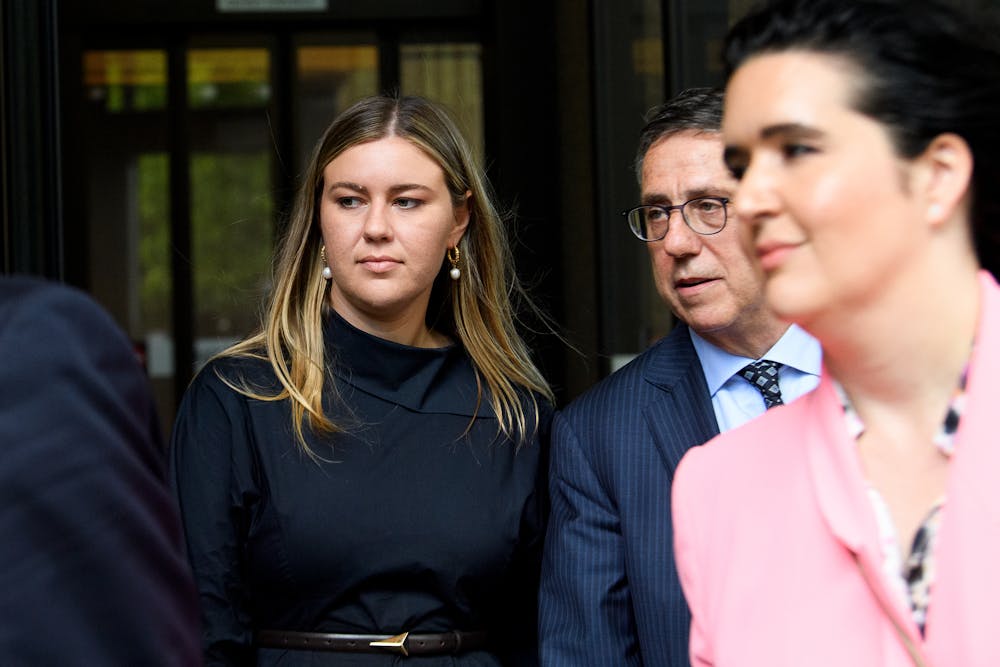 Justice Lee found Brittany Higgins to be unsatisfactory witness, but made worse findings about Lehrmann.
Bianca De Marchi/AAP
Justice Lee found Brittany Higgins to be unsatisfactory witness, but made worse findings about Lehrmann.
Bianca De Marchi/AAP
Defamation laws favour the aggrieved
Australian defamation law has historically favoured plaintiffs and, despite recent rebalancing attempts[15], it remains a favoured legal weapon for those with the resources to use it.
This includes our political class, who sue their critics for defamation with unhealthy frequency for a democracy. In the United States, public figures don’t have it so easy: to win they must prove their critics were lying.
Read more: A win for the press, a big loss for Ben Roberts-Smith: what does this judgment tell us about defamation law?[16]
In Australia, the media sometimes succeeds in proving truth, but contesting defamation proceedings comes at great financial cost and takes an emotional toll on the journalists involved.
Nor can a true claim always be proven to a court’s satisfaction, given the rules of evidence and the fact that sources may be reluctant to testify or protected by a reporter’s guarantee of confidentiality.
But this case demonstrates that publishers with an appetite for the legal fight can come out on top.
References
- ^ he was persuaded (www.judgments.fedcourt.gov.au)
- ^ Why was Bruce Lehrmann given the all-clear to sue media for defamation? A media law expert explains (theconversation.com)
- ^ aborted (www.abc.net.au)
- ^ dropped (www.news.com.au)
- ^ offered to testify (www.theguardian.com)
- ^ the ABC (www.fedcourt.gov.au)
- ^ News Corp (www.theguardian.com)
- ^ recent defamation suit (theconversation.com)
- ^ Why defamation suits in Australia are so ubiquitous — and difficult to defend for media organisations (theconversation.com)
- ^ cross-examination (www.abc.net.au)
- ^ case being re-opened (www.theguardian.com)
- ^ Ben Roberts-Smith (www.bbc.com)
- ^ Heston Russell’s case (www.judgments.fedcourt.gov.au)
- ^ light some fires (www.theguardian.com)
- ^ rebalancing attempts (www.ruleoflaw.org.au)
- ^ A win for the press, a big loss for Ben Roberts-Smith: what does this judgment tell us about defamation law? (theconversation.com)