Clearing the elective surgery backlog will take more than one budget. It’ll need major reform
- Written by: Henry Cutler, Professor and Director, Macquarie University Centre for the Health Economy, Macquarie University
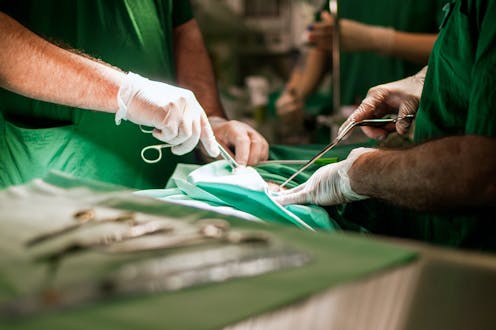
Waiting times for public hospital elective surgery have been in the news[1] ahead of this year’s federal budget. That’s the type of non-emergency surgery that covers everything from removing cysts to hip replacements.
The Australian Medical Association (AMA), a powerful doctors’ lobby group, has called on the federal government to allocate more than A$2 billion[2] over two years to reduce elective surgery waiting times.
While the Albanese government pledged this week to spend more on public hospitals[3], a substantial reduction in elective surgery waiting times won’t happen anytime soon.
Why waiting lists matter
Australians are waiting longer[4] for elective surgery in public hospitals than ever before. Nearly one in ten wait for more than a year[5].
An ageing population and more chronic disease are among factors putting more stress on the health-care system generally. But public hospitals have not kept pace with our increasing health-care needs.
Long waiting times may not concern many Australians with private health insurance; waiting times are much shorter when getting care in a private hospital. For instance, you might wait over a year[6] for cataract surgery in a public hospital. But you’re likely to wait less than a month[7] for it in a private hospital.

For the more than half[9] of Australians without private hospital cover, waiting times for elective surgery in public hospitals matter.
Longer waits mean more suffering for patients and potentially worse surgical outcomes. A UK study[10] found longer waits were associated with worse health outcomes after surgery for hip and knee replacements, but not for varicose vein surgery and hernia surgery.
More worrisome, longer waits reflect a public hospital system under strain[11], a potential forerunner for worse health-care quality[12].
What’s caused the most recent backlog?
COVID is mostly responsible for waiting time increases since 2020. Lockdowns and the suspension of elective surgery created a backlog that public hospitals have struggled to clear. Once restrictions eased, hospitals were not geared for a spike[13] in demand.
It would be wrong to blame COVID for all our waiting time woes. They were unacceptably long before COVID, and had increased[14] in nearly all states and territories five years before the pandemic. Blaming an ageing population and chronic disease would also be wrong. Both are predictable and should not have caught governments off guard.
Public hospital waiting times are long because governments and health-care managers have struggled to reorganise their resources. This is likely due to workforce gaps for nurses, specialists and surgeons, but also due to complexity. Reforming health care is hard, and improvements to care quality have frozen[15] in time.
 We’re short. Can you cover? Managers have struggled to reorganise resources to cope with the demand.
Halfpoint/Shutterstock[16]
We’re short. Can you cover? Managers have struggled to reorganise resources to cope with the demand.
Halfpoint/Shutterstock[16]
The best way to reduce waiting times
A detailed international review paints a bleak picture[17] for ready-made solutions. Changing the way patients are managed on a waiting list showed mixed success. No interventions to reduce the demand for elective surgery or increase supply were found.
In Australia, elective surgery waiting lists are managed by public hospitals using guidelines and three urgency categories (urgent, semi-urgent and non-urgent) defined by the federal government.
Making the care pathway more efficient[18] by redesigning the way patients are allocated to urgency categories and stopping low-value care may reduce waiting times. Allocating waiting patients to public hospitals with shorter waits, rather that to their local hospital, could also help.
One standout approach that may provide lessons for Australia comes from England[19] nearly two decades ago. Maximum waiting times for elective surgery dropped from 18 months to 18 weeks[20] between 2004 and 2008.
Success[21] came from first creating a mandated national target, backed by the prime minister who made shorter waiting times a personal priority.
The UK government invested more in infrastructure, expanded the health-care workforce, changed clinical practice by shifting some surgeries from inpatient to outpatient care, and monitored waiting times closely. Publicly reporting hospital performance and allowing patients to choose their public hospital for elective surgery helped match demand with supply.
 In the UK, people could choose which hospital to attend.
StockImageFactory.com/Shutterstock[22]
In the UK, people could choose which hospital to attend.
StockImageFactory.com/Shutterstock[22]
Importantly, public hospital managers were held accountable[23] for achieving their waiting time targets. Public hospitals received more autonomy if targets were achieved, and chief executives faced being fired if targets were missed.
Unfortunately, waiting times for elective surgery in England have since ballooned. The 18 week standard was last achieved in 2015[24]. This reflects historically low growth in health-care funding after the global financial crisis, a stubborn COVID backlog and, more recently, strikes[25] by consultants and junior doctors.
Are we going to cut waiting times anytime soon?
Substantially reducing waiting times in Australia anytime soon is highly unlikely. Reorganising health-care resources, building infrastructure (such as new operating theatres), developing new care processes and filling workforce gaps will take time.
State, territory and federal governments must first make reducing waiting times a national priority within the next National Health Reform Agreement (an agreement between the Australian government and all state and territory governments on health-care roles and responsibilities).
Meanwhile, activities to reduce waiting times should begin. The midterm review[26] of the National Health Reform Agreement recommended upfront funding to reduce elective surgery backlogs after COVID.
More funding to further reduce waiting times will be required. Just throwing money at state and territory governments would be reckless. This is a structural problem, not something one budget can fix.
References
- ^ in the news (www.abc.net.au)
- ^ more than A$2 billion (www.ama.com.au)
- ^ spend more on public hospitals (www.theaustralian.com.au)
- ^ waiting longer (www.aihw.gov.au)
- ^ more than a year (www.aihw.gov.au)
- ^ over a year (www.aihw.gov.au)
- ^ less than a month (www.smh.com.au)
- ^ Berna Namoglu/Shutterstock (www.shutterstock.com)
- ^ more than half (www.apra.gov.au)
- ^ UK study (pubmed.ncbi.nlm.nih.gov)
- ^ under strain (pubmed.ncbi.nlm.nih.gov)
- ^ worse health-care quality (www.ncbi.nlm.nih.gov)
- ^ for a spike (www.mq.edu.au)
- ^ increased (www.aihw.gov.au)
- ^ have frozen (www.bmj.com)
- ^ Halfpoint/Shutterstock (www.shutterstock.com)
- ^ bleak picture (pubmed.ncbi.nlm.nih.gov)
- ^ more efficient (www.mq.edu.au)
- ^ from England (www.kingsfund.org.uk)
- ^ from 18 months to 18 weeks (www.health.org.uk)
- ^ Success (www.kingsfund.org.uk)
- ^ StockImageFactory.com/Shutterstock (www.shutterstock.com)
- ^ held accountable (www.kingsfund.org.uk)
- ^ in 2015 (www.kingsfund.org.uk)
- ^ strikes (www.health.org.uk)
- ^ midterm review (www.health.gov.au)