There should be a place for Australian art – and artists – in China-Australia diplomacy
- Written by: Alison Carroll, Senior Research Fellow, Victorian College of the Arts, The University of Melbourne
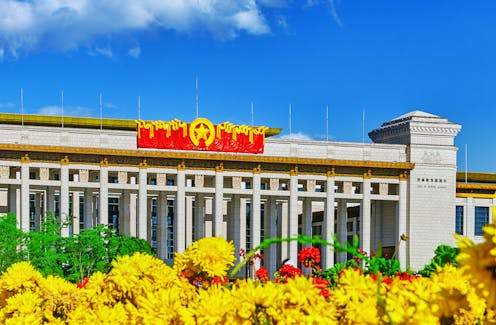
On the wall to the left of the door to the central hall of the National Museum of China, Beijing, is a panel saying it works “under the guidance of Xi Jinping thought on culture”. Across Tiananmen Square in front of the museum is the gateway to the Forbidden City, where Mao Zedong’s image is still pre-eminent.
He too, of course, has often been quoted[1] for his “thought on culture”.
Culture and political life have long been intertwined in China. If it wasn’t clear enough, these words continue, telling us culture’s role is:
to stimulate a vigorous revolutionary spirit and a passion for creativity, gathering a magnificent force to strive for the great rejuvenation of the Chinese nation and the realisation of the Chinese Dream.
The impact of this thinking on the ground across the country is clear. China first – and pretty well only. If you want art debating the direction of China’s leadership, or a debate about the centrality of Chinese culture, forget it.

I have been told that all exhibitions throughout China now have to be vetted by the authorities. That some international artists travelling to China are being asked, as part of their visa application, to sign documents saying they will not make or exhibit work. That artists are leaving, if they can. That galleries cannot display images of Mao or Xi, because, probably with reason, they are open to satire.
This not only has implications for audiences and artists in China, but it is also important to consider what this means for Australian artists – and Australian diplomacy – in China.
China first
I have long been bemused that the foundation painting for the PRC, Dong Xiwen’s Declaration of the Republic first made in 1953 (and variously changed[2] as its personae fell in and out of favour) and in pride of place in the National Museum, is said, in the label, to display “Chinese characteristics” – never mentioning it is in concept, structure and execution a history painting in the grand European tradition.
 Dong Xiwen’s Declaration of the Republic, 1953, on display at the National Museum of China.
Alison Carroll
Dong Xiwen’s Declaration of the Republic, 1953, on display at the National Museum of China.
Alison Carroll
Other works in museums across the country similarly ignore their international history.
The labelling of the collection of woodcuts owned by the China Art Museum in Shanghai says this tradition was “born” in China and “brought” to the world. In fact, China vies with Korea[3] as the place to first make woodcut prints, and the tradition on show in Shanghai comes from Käthe Kollwitz[4] and the Soviet Socialist Realists. This was something the great writer Lu Xun[5] said in the 1920s when he so vigorously supported their importation to China.
This is not to deny Chinese culture, just to say please give fair information for an increasingly cut off audience.
I say “cut off”, and mean cut off from original work from elsewhere and from foreign artists themselves. I am sure young people in China can access imagery online, but to encounter art physically is another thing. I recently wrote a review[6] of the 2024 Yokohama Triennale in Japan, directed by two Chinese curators, where I was at pains to say “being there” was the key reward of the show. The experience can’t just be online.
In a recent two-week tour of China, I was aware of just one major exhibition of foreign art, by the Japanese photographer Hiroshi Sugimoto at the non-government UCCA Centre for Contemporary Art[7] in the 798 art district in Beijing, and smaller individual exhibitions put on by other nations’ cultural agencies, like the Goethe Institut or the Institut Français.
Australia-China relations
In this climate, how might the Australian arts community engage with colleagues and audiences in China? We currently do small things, here and there, that hardly touch the sides.
Artists everywhere want to engage with others, to understand difference, to be challenged and inspired – China offers all that in spades.
Australia has an important relationship with China. If it is to be taken to a more complex level, it needs something that will work as a sustained, serious, professional endeavour.
The only way we can physically have any significant engagement is by setting up our own cultural venue. The 798 art district in Beijing is the perfect site with its mix of museums, commercial galleries and foreign agencies.
 Anthony Albanese and Chinese Premier Li Qiang before an Australia-China CEO Roundtable in Perth, June 18, 2024.
AAP Image/Richard Wainwright
Anthony Albanese and Chinese Premier Li Qiang before an Australia-China CEO Roundtable in Perth, June 18, 2024.
AAP Image/Richard Wainwright
I would not suggest such a site in Japan or Korea: we have long professional relationships there that easily flow into useful and rewarding projects, not needing an onsite presence.
China is different, especially now.
At the end of 2023, the Albanese government committed to continue a A$40 million Coalition-era grant scheme to strengthen Australia-China relations[8].
This money could be used to support an Australian cultural centre as the focus of engagement, for the first time in our history with China.
If there was appetite, that is, for a similar emphasis on the role of culture in our nation’s future as Xi Jinping says it has for China.
References
- ^ often been quoted (www.marxists.org)
- ^ variously changed (en.wikipedia.org)
- ^ with Korea (courier.unesco.org)
- ^ Käthe Kollwitz (jacobin.com)
- ^ Lu Xun (nga.gov.au)
- ^ review (www.artlink.com.au)
- ^ UCCA Centre for Contemporary Art (ucca.org.cn)
- ^ strengthen Australia-China relations (www.afr.com)