Ambulance ramping is getting worse in Australia. Here’s why – and what we can do about it
- Written by: Jonathan Karnon, Professor of Health Economics, Flinders University
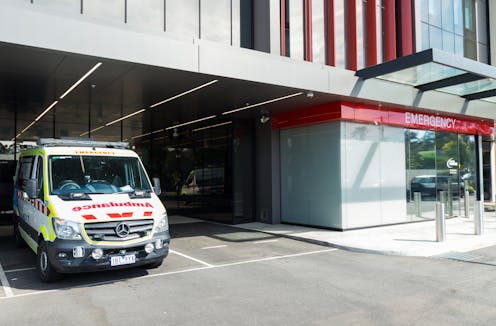
We’ve seen countless media reports[1] in recent days, weeks and months about the ramping of ambulances[2] at hospital emergency departments[3] (EDs) around Australia.
Ambulance ramping occurs when paramedics are made to wait at the hospital’s entrance and are unable to transfer their patient into the emergency department within an appropriate time frame – defined as 30 minutes[4] in South Australia.
Ramping is an indicator of hospital stress. It means patients are waiting longer to receive care in the emergency department, and patients requiring inpatient care are waiting longer to access a hospital bed.
Research suggests ambulance ramping[5] and having to wait longer[6] for a hospital bed are associated with a greater risk of patients dying up to 30 days after their initial presentation.
So why is ambulance ramping still a problem? And what can we do to fix it?
Ramping is getting worse
Available data indicate the problem has become worse over time. In South Australia[7], for example, ramping has been steadily increasing since 2017, from around 500 hours “ramped” per month to around 4,000 hours per month in 2024. This is the sum of the time ambulances spend waiting beyond 30 minutes after arriving at the hospital.
In New South Wales[8], we calculate the numbers of patients being ramped increased from around 44,000 patients per month in early 2022 to more than 50,000 in early 2024.
What’s driving the increase in ramping?
The ambulance ramping bottleneck reflects an imbalance between the number of people presenting at emergency departments and the capacity to treat patients and transfer those requiring inpatient care to a ward.
Potential drivers of this imbalance are increased emergency department presentations and reduced availability of inpatient beds. The latter may reflect increased demand for beds, including longer hospital stays.
Between the financial years 2018–19 and 2022–23 (the latest period for which figures are available), Australian Institute of Health and Welfare data show the numbers of more serious presentations (triage categories 1 to 3) increased by almost 700,000[9] across Australia.
Some 100,000 fewer patients who presented to an emergency department were admitted as inpatients[10] during this period, but the additional presentations will nonetheless have contributed to more ramping.
In the same period, admissions to inpatient beds that did not come through an emergency department increased by almost 400,000[11] across the country. These include admissions for the management of chronic conditions (such as diabetes, heart disease, asthma and so on) and infections and viruses (COVID, flu, RSV and others).
Further, COVID and other viruses are likely to have contributed to increased hospital stress via workforce shortages[12]. This has possibly led to delays in seeing patients in the emergency department and in discharging patients from hospital.
There has not been a significant increase in patients’ time in hospital[14] receiving required care, but there appear to be increasing numbers of patients waiting for placement in an aged care facility or for home care services after their treatment has finished[15].
Many admissions may be preventable
Increased vaccination rates could reduce the impact of viruses. For example, only 21% of Australians[16] aged 65 to 74 received the 2023 COVID booster recommended for their age group.
We know there were significant increases in people delaying or avoiding seeing a GP due to cost[17] in 2022–23, which can put extra pressure on hospitals. The government is trying to address this issue by increasing incentives to GPs[18] to reduce costs to patients.
Meanwhile, government health departments may not have been provided with enough funding to meet increasing demand for health care. Year on year the gap between supply and demand grows. Victorian hospitals[19] are reportedly scrambling to reduce spending in light of proposed budget cuts.
What are the solutions?
The creation of new hospital beds is not the only option for increasing capacity. Governments should design, implement and scale up services that free up hospital capacity by providing appropriate and cost-effective out-of-hospital care.
For example, there is further scope to care for patients admitted to hospital in their own homes with the support of digital technologies. Programs such as My Home Hospital[21] in South Australia aim to provide an alternative to inpatient care.
Across Australia, such “hospital in the home” care was provided 150,000 times in 2022–23, compared to 6.8 million episodes of care[22] in public hospitals.
Virtual ED services are a growing phenomenon across Australia, using virtual consultations[23] to identify patients for whom urgent care can be provided outside hospital. The Victorian virtual ED service is targeting a capacity of 1,000 consults[24] per day.
Longer-term solutions require co-operation between state and territory governments and the federal government to prevent and better manage chronic conditions, such as diabetes and heart disease, outside hospital. This includes boosting access to GPs and improving communication between GPs and hospitals.
Greater investment in well-designed policies and programs to support healthy ageing would also likely help, as well as improving access to required out-of-hospital aged care and disability services for patients waiting to leave hospital.
All these measures could ease the pressure on hospitals and reduce the likelihood of patients waiting in an ambulance, unable to get inside and receive the care they need.
References
- ^ media reports (www.heraldsun.com.au)
- ^ ramping of ambulances (www.couriermail.com.au)
- ^ hospital emergency departments (thewest.com.au)
- ^ 30 minutes (www.sahealth.sa.gov.au)
- ^ ambulance ramping (www.mja.com.au)
- ^ having to wait longer (onlinelibrary.wiley.com)
- ^ South Australia (www.sahealth.sa.gov.au)
- ^ New South Wales (www.bhi.nsw.gov.au)
- ^ almost 700,000 (www.aihw.gov.au)
- ^ admitted as inpatients (www.aihw.gov.au)
- ^ almost 400,000 (www.aihw.gov.au)
- ^ workforce shortages (www.aihw.gov.au)
- ^ Luis Ascui/AAP (photos.aap.com.au)
- ^ patients’ time in hospital (www.aihw.gov.au)
- ^ has finished (www.ama.com.au)
- ^ 21% of Australians (www.aihw.gov.au)
- ^ due to cost (www.abs.gov.au)
- ^ incentives to GPs (www.health.gov.au)
- ^ Victorian hospitals (www.theguardian.com)
- ^ Ground Picture/Shutterstock (www.shutterstock.com)
- ^ My Home Hospital (www.sahealth.sa.gov.au)
- ^ 6.8 million episodes of care (www.aihw.gov.au)
- ^ virtual consultations (theconversation.com)
- ^ 1,000 consults (www.afr.com)