Without a massive grid upgrade, the Coalition’s nuclear plan faces a high-voltage hurdle
- Written by: Asma Aziz, Senior Lecturer in Power Engineering, Edith Cowan University
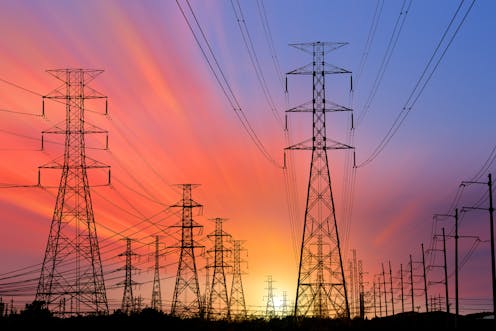
Keeping the lights on in Australia is a complex task. Enough capacity must be ensured everywhere in the country, at every moment. Surplus in one location won’t solve shortages in another, unless we have the transmission infrastructure to transmit electricity between them.
The transmission network largely consists of high-voltage lines and towers, as well as transformers which transfer electrical energy from one circuit to another.
Australia’s transmission network is one of the oldest and longest in the world. As coal stations close and more renewable energy is built, the task of upgrading the system becomes even more pressing. So formidable is the challenge, it’s one of the biggest roadblocks Australia faces in reaching its crucial goal of net-zero emissions by 2050.
The Coalition’s plan for seven nuclear energy plants[1] in Australia further complicates the task. A clear policy direction for Australia’s electricity system is urgently needed.
Lots of work to do
In technical terms, transmission congestion occurs when an element on the network, such as a high-voltage power line or transformer, reaches capacity and cannot carry more electricity.
Think of it as like traffic in a city. During rush hour, bottlenecks occur when there are more vehicles than the roads can handle. During times of peak electricity demand, electricity lines and transformers can also reach their limits. Exceeding the limits of the network can damage equipment and lead to power outages.
Between now and 2050, Australia’s electricity consumption will surge[2]. We’ll need to draw power from increasingly diverse and far-flung sources. Coal power plants, typically located near large population centres, will close. Energy generation from solar and wind farms, usually located in regional and remote areas, will increase.
Importantly, we must make the distinction between electricity capacity and whether that electricity is “dispatchable”, or can be released on demand. That’s one reason why we need new transmission lines – to move electricity around the system as needed. The sooner we can build this capability, the quicker and cheaper our energy transition will be.
So far this decade, 490 kilometres of new transmission lines have reportedly been added[3] to the National Electricity Market, which serves the east coast and South Australia. A further 2,090 km of transmission lines are progressing from the planning phase to the construction phase.
There’s still a lot of work to do: around 10,000 km of new transmission lines is needed by 2050. Western Australia’s main electricity network also needs more than 4,000 km of new high-capacity transmission lines[4].
A looming problem
The network’s ability to carry electricity is influenced by several factors. They include weather conditions, patterns of electricity generation and demand, the capacity of individual elements such as transmission lines and transformers, and their reliability.
Congested transmission can cause fluctuations in power prices. If cheaper electricity cannot be transported to where it’s needed, more expensive generators are dispatched to meet demand. This increases the price[5] of electricity for both energy retailers and consumers. It can also lead to higher prices in some areas than others and poses financial risks for energy providers.
Transmission congestion in Australia is a looming problem. For example, South Australian transmission company ElectraNet forecasts[6] rising congestion on that state’s network due to planned expansions of electricity generators, peaking in the late 2020s and 2030s.
What’s more, planning studies have identified ageing assets in Queensland’s transmission network[7], requiring new routes to manage constraints and ensure reliable supply.
Where does nuclear fit in?
All this has implications for the Coalition’s nuclear plan, if it comes to fruition.
The CSIRO[8] and others[9] say a nuclear power plant of any size would not be operational in Australia until after 2040.
If transmission lines are congested at that future point, nuclear power plants may not be able to send all their electricity to the grid.
Nuclear plants are expensive to build and run. But they typically generate electricity continuously, helping to offset these costs. If the plants can’t feed into the grid, or can’t sell their electricity at competitive prices, they may lose revenue and struggle to cover their costs[10], affecting their long-term viability[11].
The continuous high output[12] of nuclear plants also helps them run efficiently[13]. Frequently adjusting energy output leads to more wear, lower efficiency and reduced energy production over time.
Constraining nuclear output can have broader repercussions, too. In France, for instance, nuclear output is at a 30-year low[14], forcing the country to import electricity and prepare for potential blackouts. The reactors are offline for maintenance, not due to transmission issues. But the example highlights the consequences when nuclear energy is taken out of the mix for any reason.
Clarity is needed
Finally, the increasing share of renewable energy in our electricity grid means there’s no guarantee transmission capacity will be available for nuclear energy.
As South Australia’s energy minister Tom Koutsantonis noted[15] on X, this poses challenges for the Coalition’s plan to build a nuclear plant at the site of an old coal station at Port Augusta and use existing transmission infrastructure:
The myth that a nuclear reactor could just plug into the old Pt Augusta coal power station transmission lines is not true. The transmission lines are already nearly full from new renewables. In truth, a nuclear reactor at Pt Augusta would need new transmission lines, the exact thing the LNP are complaining about.
So what’s the upshot of all this? Transmission infrastructure is a thorny policy problem, and divergent views among policymakers about energy policy only add to the challenges.
A clear direction on the future of Australia’s electricity grid, including transmission infrastructure, is essential. Without it, the energy transition will be slower and more expensive.
References
- ^ seven nuclear energy plants (theconversation.com)
- ^ will surge (aemo.com.au)
- ^ have reportedly been added (www.theguardian.com)
- ^ 4,000 km of new high-capacity transmission lines (www.wa.gov.au)
- ^ increases the price (www.aemc.gov.au)
- ^ forecasts (www.electranet.com.au)
- ^ Queensland’s transmission network (www.powerlink.com.au)
- ^ CSIRO (www.csiro.au)
- ^ others (blueprintinstitute.s3.ap-southeast-2.amazonaws.com)
- ^ struggle to cover their costs (thebulletin.org)
- ^ long-term viability (www.forbes.com)
- ^ continuous high output (www.iaea.org)
- ^ efficiently (www.energy.gov)
- ^ a 30-year low (www.reuters.com)
- ^ noted (x.com)