Trump wants Australian data on migrant crime. This will only scapegoat vulnerable people
- Written by: Leanne Weber, Adjunct Professor of Criminology, University of Canberra

The Trump administration is extending its anti-immigration agenda beyond US borders. This week, US embassies in Australia, New Zealand, Canada, the United Kingdom and several Western European nations were instructed[1] to collect and transmit migrant-related crime data in these countries to Washington.
The administration’s stated purpose is to assist US allies in reforming their immigration systems and curbing what the US labels “mass migration[2]”. In a briefing to explain the action, a US State Department spokesperson[3] called mass migration an “existential threat to Western civilisation and the safety of both the West and the world”.
This request is unprecedented and extremely harmful.
First, it is embedding the Trump administration’s criminalisation and mass deportation[4] of migrants into its diplomatic relations with other countries.
Second, the Trump administration’s directive is perpetuating a false narrative that migrants are to blame for any perceived increase in crime rates.
Escalating US crackdowns
Empirical research over decades in the US[5] shows migrants do not offend at disproportionate rates, despite persistent political claims.
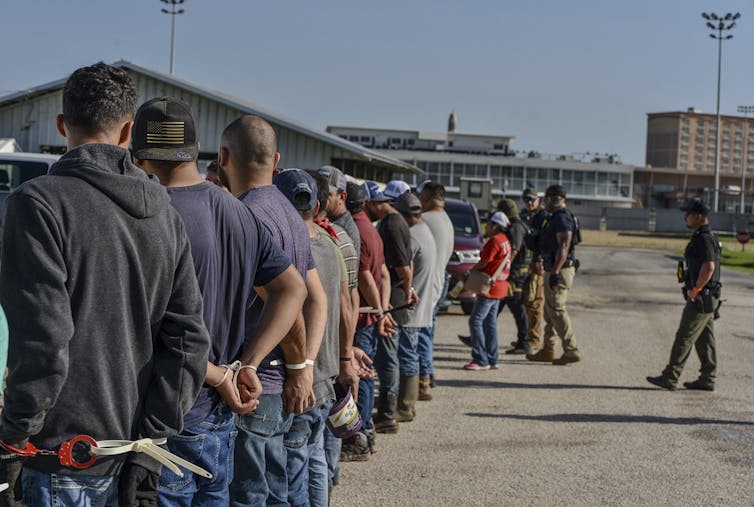
Nonetheless, the Trump administration continues to escalate its harsh crackdown on migrants[6] under the justification that US cities are under siege. This has enabled the government to take actions that critics say violate international law[7] and curtail domestic civil liberties[8], including:
- deporting migrants without due process
- detaining migrants with no criminal history[9] for long periods, and
- separating families.
In addition, the US government has also taken lethal military action[10] against boats in the Caribbean Sea and eastern Pacific Ocean, alleging “narco-terrorists” are flooding the country with drugs.
Australia’s own harsh response
Australia is described in the US State Department briefing as a “great ally”. The spokesperson explained[11] the US government’s intent in collecting migrant crime data:
to warn our friends that if you import a rapid number of individuals of any background, but particularly individuals of a culture that’s radically different than Australia’s without any sort of mechanism for diffusing the impact, that can lead to political unrest, that can lead to economic instability.
In Australia, public inquiries[12] and criminology research[13] have consistently found claims of a link between migrants and crime to be exaggerated and harmful. These studies often call for stricter media regulations[14] on inaccurate crime reporting to avoid scapegoating marginalised communities.
Yet, successive governments have continued[15] to expand their powers[16] to deport migrants under the guise of public safety. This approach is a form of “crimmigration” – when immigration enforcement is incorporated into crime control.
It creates harsher consequences for non-citizens who commit offences, compared to citizens. In addition, many people who have not been convicted of a violent crime[17] – and sometimes no crime at all – have been caught up in these exclusionary processes.
In 2023, the High Court ruled in the NZYQ case[18] that continuing to detain individuals who cannot be removed from Australia is unconstitutional. This resulted in the release[19] of hundreds of non-citizens (some of whom had no convictions, or had convictions and had served their prison sentences) into the community on bridging visas.
The action ignited heated parliamentary debates[20] about a supposed existential threat to Australian society. In many cases, the debates featured divisive language and unsupported claims that are characteristic of the current US administration.
Emergency laws[21] were hastily passed to respond to the situation. These resulted in punitive measures, including:
Migration is not a threat
These developments show the potential for Trumpian-style immigration approaches to take hold in Australia. The recent anti-immigration rallies[22] across Australia – in addition to the adoption of the “mass migration” terminology – suggest there would be fertile ground for this in parts of society.
But it is not clear to us how enhanced visa cancellations and deportation powers improve community safety.
Every day in Australia, people are processed by the criminal justice system and returned to the community. The government is not taking responsibility for effective crime prevention by targeting non-citizens for punishment and exclusion. This will not make Australia safer. It will only trigger safety concerns for multicultural communities.
A more rigorous and evidence-based approach is needed to address the social determinants[23] that increase the risk of marginalised communities coming into contact with the criminal justice system. This includes systemic racism[24].
Migration is a feature of our globalising world and does not represent an existential threat to Western civilisation, as claimed in the US State Department[25].
Retreats into ultra-nationalist rhetoric and the scapegoating of migrants are never the answer.
References
- ^ were instructed (www.abc.net.au)
- ^ mass migration (www.americanimmigrationcouncil.org)
- ^ US State Department spokesperson (www.state.gov)
- ^ mass deportation (link.springer.com)
- ^ Empirical research over decades in the US (aus01.safelinks.protection.outlook.com)
- ^ harsh crackdown on migrants (www.whitehouse.gov)
- ^ international law (www.tandfonline.com)
- ^ curtail domestic civil liberties (www.theguardian.com)
- ^ with no criminal history (www.theguardian.com)
- ^ taken lethal military action (theconversation.com)
- ^ explained (www.state.gov)
- ^ public inquiries (www.tandfonline.com)
- ^ criminology research (www.aic.gov.au)
- ^ stricter media regulations (www.aic.gov.au)
- ^ continued (www.alexhawke.au)
- ^ expand their powers (www.hrlc.org.au)
- ^ violent crime (www.homeaffairs.gov.au)
- ^ ruled in the NZYQ case (www.hcourt.gov.au)
- ^ release (theconversation.com)
- ^ parliamentary debates (parlinfo.aph.gov.au)
- ^ Emergency laws (blogs.law.ox.ac.uk)
- ^ anti-immigration rallies (www.abc.net.au)
- ^ social determinants (theconversation.com)
- ^ systemic racism (www.abc.net.au)
- ^ US State Department (www.state.gov)