A history of blood clots is not usually any reason to avoid the AstraZeneca vaccine
- Written by: Sant-Rayn Pasricha, Division Head, Population Health and Immunity, Walter and Eliza Hall Institute
As haematologists, we look after many patients who have had blood clots in the past or take blood thinners. They often ask: “should I have the AstraZeneca vaccine?”
The answer is usually a definitive “yes”. The blood clots we’ve seen following the AstraZeneca vaccine are completely different to other types of blood clots, such as deep vein thrombosis or a pulmonary embolism, or the clots that cause heart attacks and strokes.
People with a history of these sorts of conditions don’t appear to be at any increased risk[1] from the AstraZeneca vaccine.
In fact, people in this group could be at greater risk[2] from COVID-19, so shouldn’t delay getting vaccinated.
First, how does blood form clots?
Blood flows through our body’s vessels as a liquid, carrying oxygen, nutrients, proteins and immune cells to every organ. But if we get injured or undergo surgery, our body needs to plug the wound to stem bleeding.
Our blood contains components that allow it to quickly transform from a fluid into a semi-solid clot[3] in a few seconds.
At the first sign of damage, the smallest of the blood cells — the platelets — stick to the damaged vessel wall, and together with the damaged wall itself, attract a legion of clotting proteins, which amass on the damaged site and bind the wound.
Read more: How rare are blood clots after the AstraZeneca vaccine? What should you look out for? And how are they treated?[4]
Venous clots
Sometimes theses natural clotting and anti-clotting processes in the blood become unbalanced, putting a person at risk[5] of developing blood clots in their veins. This can occur in people:
with cancer or an infection
who are pregnant
who are taking an oestrogen-containing contraceptive pill
who are immobilised during and after surgery or following major trauma
who have certain inherited conditions.
In all of these cases, an abnormal blood clot can develop in the deep veins of the thigh and groin (deep vein thrombosis), or the lung (pulmonary embolism).
Very rarely, blood clots occur in other places — for example, the veins of the abdomen or the brain.
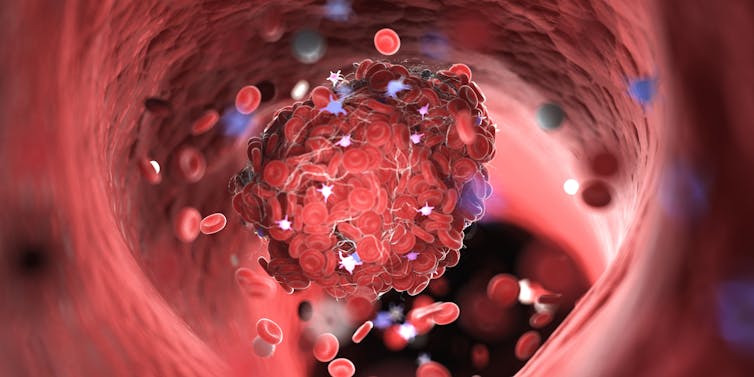 Our blood needs to clot to a degree.
Shutterstock[6]
Our blood needs to clot to a degree.
Shutterstock[6]
Arterial clots
Arteries supplying blood to the heart, brain and lower limbs can become narrowed[7], usually due to risk factors including smoking, diabetes, and high blood pressure and cholesterol.
A clot forming in these sites can obstruct blood flow, causing, for example, a heart attack or stroke.
What is TTS?
The AstraZeneca vaccine is associated with a rare condition called thrombosis with thrombocytopenia syndrome, or TTS[8]. Cases of the condition have also been reported following the Johnson & Johnson COVID vaccine[9], though this one isn’t available in Australia.
We now know a lot more about this condition than we did a few months ago.
TTS is caused by an abnormal immune response[10], resulting in the development of an antibody directed at the platelets[11] (blood cells which prevent bleeding). This causes the platelets to become hyperactive, which triggers blood clots in the body, including in places we don’t normally see clots, like in the brain or the abdomen.
This process also consumes platelets, which results in a low platelet count. In the name “thrombosis” refers to clots, and “thrombocytopenia” to low platelet count.
Read more: What is thrombocytopenia, the rare blood condition possibly linked to the AstraZeneca vaccine?[12]
The Australian Technical Advisory Group on Immunisation (ATAGI) recently estimated the risk of TTS in Australia at around 1.6 in 100,000[13] doses of the AstraZeneca vaccine administered in people 50 and older, although this data may change as more people are vaccinated.
Fortunately, diagnosis and treatment[14] for TTS has progressed rapidly. Doctors now know the symptoms to look out for, and haematologists have identified treatments for the condition[15]. These include intravenous immunoglobulin (a concentrate of antibodies from healthy donors) and blood thinners.
Outcomes for people with TTS have improved significantly worldwide since the condition was first recognised earlier in the year. In Australia, most patients[16] with TTS have recovered or are recovering.
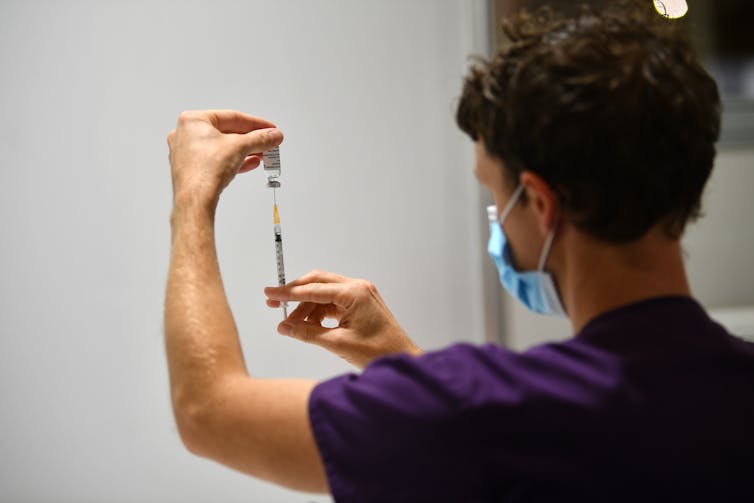 We’re now better at recognising and treating TTS.
James Ross/AAP
We’re now better at recognising and treating TTS.
James Ross/AAP
Don’t delay getting the vaccine
There’s no evidence[17] people who have previously experienced blood clots, have an inherited risk of blood clots, or who take blood thinners or related medications, have any increased risk[18] of TTS.
As an immune-driven disease that causes platelet over-activity, the mechanism for TTS is completely different from other types of blood clots.
In this light, ATAGI recently advised the AstraZeneca vaccine is safe for these people.
As a precaution, Australian guidelines[19] recommend certain people should avoid the AstraZeneca vaccine and have the Pfizer jab instead. These include people:
Read more: People with coronavirus are at risk of blood clots and strokes. Here's what we know so far[20]
It’s crucial to remember that people with risk factors for heart attacks and strokes, including diabetes[21] and high blood pressure, are at increased risk of developing severe COVID-19[22] if they are infected. Further, COVID itself[23] makes the blood more “sticky” and significantly increases the risk of blood clots.
So we advise our patients: even if you’ve had deep vein thrombosis, a pulmonary embolism, a heart attack or a stroke previously, you’re not at increased risk of TTS from vaccination. You should get vaccinated as soon as you’re eligible.
References
- ^ increased risk (www.health.gov.au)
- ^ at greater risk (www.thelancet.com)
- ^ clot (www.ncbi.nlm.nih.gov)
- ^ How rare are blood clots after the AstraZeneca vaccine? What should you look out for? And how are they treated? (theconversation.com)
- ^ at risk (bestpractice.bmj.com)
- ^ Shutterstock (www.shutterstock.com)
- ^ become narrowed (www.nhlbi.nih.gov)
- ^ or TTS (www.health.gov.au)
- ^ Johnson & Johnson COVID vaccine (post.parliament.uk)
- ^ immune response (www.nejm.org)
- ^ antibody directed at the platelets (www.nejm.org)
- ^ What is thrombocytopenia, the rare blood condition possibly linked to the AstraZeneca vaccine? (theconversation.com)
- ^ around 1.6 in 100,000 (www.health.gov.au)
- ^ diagnosis and treatment (www.thanz.org.au)
- ^ treatments for the condition (www.thanz.org.au)
- ^ most patients (www.tga.gov.au)
- ^ no evidence (www.nejm.org)
- ^ have any increased risk (www.health.gov.au)
- ^ guidelines (www.health.gov.au)
- ^ People with coronavirus are at risk of blood clots and strokes. Here's what we know so far (theconversation.com)
- ^ diabetes (www.thelancet.com)
- ^ severe COVID-19 (www.thelancet.com)
- ^ COVID itself (erj.ersjournals.com)