New Zealand has one of the lowest numbers of refugees per capita in the world — there is room for many more
- Written by: Jay Marlowe, Associate Professor, Co-Director Centre for Asia Pacific Refugee Studies, University of Auckland
When COVID-19 forced New Zealand to shut its borders, it left refugees we had committed to resettle in precarious circumstances with shattered hopes.
The latest United Nation figures put people forcibly displaced by conflict at nearly 80 million — a near doubling from ten years ago. Each minute of every day last year 21 people were separated from their friends, family and communities because of who they are or what they believe.
As we approach World Refugee Day[1] this Sunday, we need to reflect on what is fair as we contemplate reopening those borders.
COVID restrictions aside, New Zealand accepts 1,500 refugees per year. While that’s an increase on the previous quota of 1,000, this only keeps track with population growth since the quota began in 1987.
With COVID under control for now, New Zealand accepted 35 refugees in February, with 242 expected to have arrived by the end of our intake year — far short of our total commitment.
All will be required to quarantine for 14 days before starting their five-week orientation program at the Mangere Refugee Resettlement Centre[2] in Auckland.
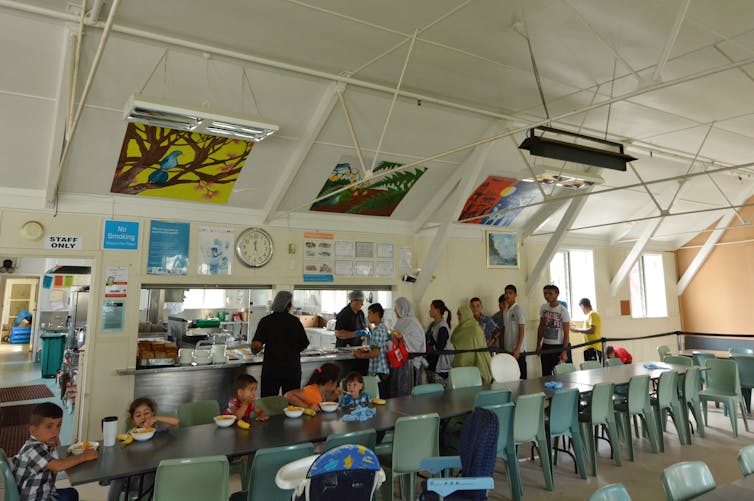 Refugees from Syria, arrivals under an extra quota during the Syrian crisis in 2016, eat lunch at the Mangere Refugee Resettlement Centre.
www.shutterstock.com
Refugees from Syria, arrivals under an extra quota during the Syrian crisis in 2016, eat lunch at the Mangere Refugee Resettlement Centre.
www.shutterstock.com
NZ’s refugee record
While New Zealand does a relatively good job supporting refugees who manage to make it here, we accept small numbers.
According to the latest pre-COVID statistical yearbook[3] from the UN High Commissioner for Refugees (UNHCR), New Zealand has one of the lowest numbers of refugees per capita internationally: 0.3 refugees per 1,000 people, putting us 95th in the world.
By comparison, Sweden ranks sixth by accepting 23.36 refugees per 1,000 people, Canada 49th (2.68), United Kingdom 55th (1.83), Australia 59th (1.74) and the United States 77th (0.84).
Norway and Ireland, with similar populations to New Zealand, are placed 15th (11.29) and 69th (1.22) in the world respectively.
Read more: Resettling refugees in other countries is not reliable, nor is it fair. So, why is Australia doing it?[4]
To put this in context, if we were to fill Eden Park to its capacity of 50,000, about 15 people from refugee backgrounds would be there. We have plenty of space for more.
On the other hand, 2% of students enrolled at the University of Auckland identify as coming from a refugee background. Fill Eden Park with students, then, and there would be 1,000 students from refugee backgrounds. That shows to what extent these people are invested in their futures — and New Zealand’s.
There is no ‘queue’
All of these numbers, however, pale in comparison to countries closest to refugee movements, where the majority of refugees (around 85%) live.
Lebanon, for instance, has about 170 refugees per 1,000 people. Typically, these countries are far less well resourced to support and protect those displaced people.
Over the past ten years, the Refugee Status Unit in New Zealand has approved an average of 106 asylum seekers a year for refugee status (from an average of 375 applicants). These are people who apply for refugee status from within New Zealand due to fears of persecution if they were to return home.
Read more: How British community groups are helping refugees integrate – and the government is making it harder[5]
It’s often said asylum seekers should “join the queue” — but there is no queue. Fewer than 1% of the world’s refugees will have opportunities to resettle in places like New Zealand, Canada, Australia, the UK and US.
This often leaves the one person fortunate enough to receive the opportunity reflecting on the 99 people left behind.
The right to be a refugee
It’s worth noting New Zealand has never had a boatload of asylum seekers arrive on its shores in modern times. Despite this, the fear of asylum seekers remains. This is largely thanks to highly politicised representations of overloaded boats heading for Australia and crossing the Mediterranean into Europe.
Political parties in the UK, North America, Europe and Australia routinely stir up fear and spread misinformation on refugee and migrant issues at election times.
Even in New Zealand people have been unjustly and inaccurately stigmatised, moved from being “at risk” to “a risk”.
But seeking refuge is a human right. New Zealand is a signatory to the 1951 UN Refugee Convention[6] and its 1967 protocol[7], which assert the right to have a claim of refugee status considered and, if successful, to remain in New Zealand.
It is a convention designed to protect us all.
Read more: Comics and graphic novels are examining refugee border-crossing experiences[8]
A fair go for all
On World Refugee Day we should recognise New Zealand can do better in a number of ways:
end the unjust practice of imprisoning some asylum seekers[9] while they wait for their applications to be processed
commit to resettling those who missed the opportunity to come (including from the refugee family support category) during our border closures, as well as the current annual intake
ensure equal support for people seeking asylum or consideration under the family reunification program, regardless of how they arrive in New Zealand
provide adequately resourced services for refugees during the first several years of resettlement, supporting health, education, employment, housing, language acquisition and a sense of belonging
provide opportunities for people from refugee backgrounds to participate equally in employment, education and wider society.
We can all can play a part in helping refugees feel they belong here. A genuine welcome is about ensuring they receive a fair go.
References
- ^ World Refugee Day (www.un.org)
- ^ Refugee Resettlement Centre (www.immigration.govt.nz)
- ^ statistical yearbook (www.unhcr.org)
- ^ Resettling refugees in other countries is not reliable, nor is it fair. So, why is Australia doing it? (theconversation.com)
- ^ How British community groups are helping refugees integrate – and the government is making it harder (theconversation.com)
- ^ UN Refugee Convention (www.unhcr.org)
- ^ 1967 protocol (www.ohchr.org)
- ^ Comics and graphic novels are examining refugee border-crossing experiences (theconversation.com)
- ^ imprisoning some asylum seekers (www.amnesty.org.nz)