Transgender medicine – what care looks like, who seeks it out and what's still unknown: 3 essential reads
- Written by: Daniel Merino, Assistant Editor: Science, Health, Environment; Co-Host: The Conversation Weekly Podcast
Transgender people continue to be the focus of political culture wars in the U.S. In the spring of 2021, lawmakers in many states sought to limit or ban transgender youth from accessing gender-affirming care[1]. The laws proposed – and in some cases passed[2] – were written to have a direct effect on transgender people’s ability to access physical and mental health care.
For many people, the medical options available to transgender people may seem foreign or new – unless you know someone who is transgender, you may not know about this type of care. So to better understand who is getting this care and the evidence that supports it, in recent months, The Conversation reached out to three experts who work with and study transgender youth medicine. Here is a roundup of what these experts had to say.
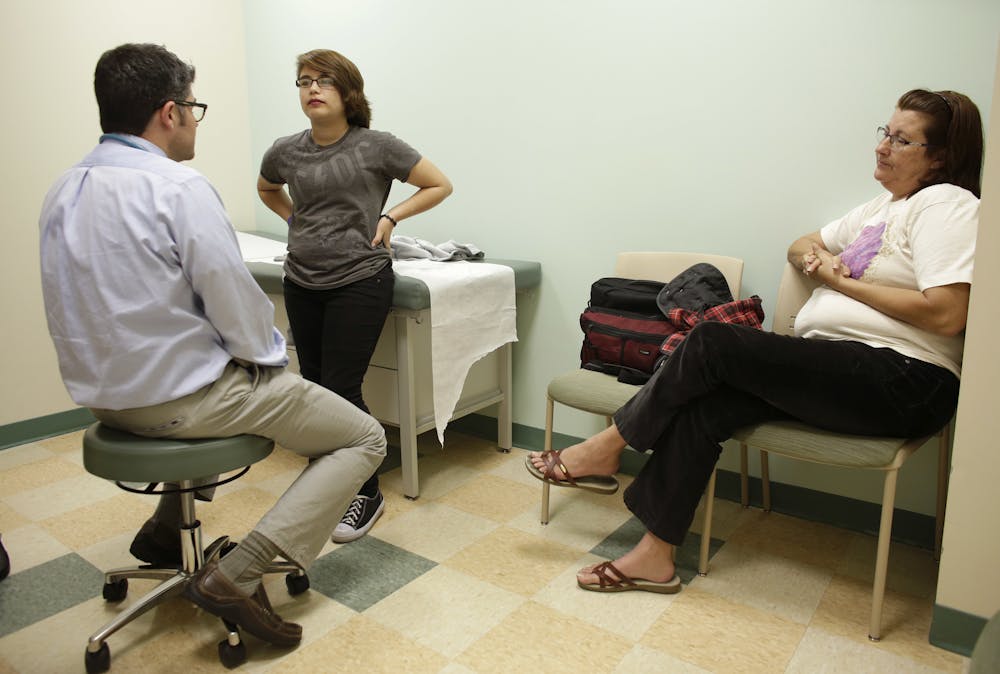 Good transgender medical care is as much about social and emotional interventions as it is drugs or surgery.
AP Photo/Lynne Sladky[3]
Good transgender medical care is as much about social and emotional interventions as it is drugs or surgery.
AP Photo/Lynne Sladky[3]
1. Medical options available to transgender youth
The first question we sought to answer was: What does medical care look like for transgender youth?
To answer this, we contacted Mandy Coles[4], a clinical associate professor of pediatrics and co-director of the Child and Adolescent Trans/Gender Center for Health[5] at Boston University and Boston Medical Center. When young people want to see a doctor and have questions about their gender, they go to someone like Coles.
In her article[6], Coles explains that medical care for transgender youth who suffer from gender dysphoria – when a person’s gender identity does not match the sex assigned at birth – is much more than just hormones or surgery. Social support can have as big an impact on health as physical interventions and “an important first step is to help parents become allies and advocates[7],” says Coles.
But, for many of her patients, physical interventions – including puberty blockers, hormone treatments or surgery – are the best way they can align their physical bodies with their gender identity. For transgender people seeking care who haven’t started puberty or are still in its early stages, puberty blockers are often an initial treatment. As Coles explains, “These medications work like a pause button on the physical changes caused by puberty. They are well studied, safe and completely reversible[8].”
Puberty blockers are only one option available to transgender youth before other, more serious interventions. Taking testosterone, estrogen or other drugs can produce changes in a person’s body that help them look more masculine, feminine or nonbinary – whichever it is the person wants. Every patient is different and “my colleagues and I personalize their treatments to meet their specific need,” says Coles.
Surgery is the most permanent treatment available. It comes with risks and lies at the center of much of the political fighting around transgender care, but as one patient told Coles, gender-affirming care “literally saved my life. I was free from dysphoria[9].”
2. Younger people are seeking care earlier
With an explanation of what kind of medical care exists, the next question is: Who is getting this care and when?
If you have the sense that young people today are more likely to transition than, say, 20 years ago, in a sense you would be correct. But it is a bit more complicated[10] than simply saying more young people are transgender than older people, says Jae A. Puckett[11].
Puckett, an assistant professor of psychology at Michigan State University, recently surveyed nearly 700 trans people and published a paper[12] exploring generational differences in when and how fast people reach milestones of their transgender identity and how this relates to mental health. Milestones include identifying as trans, living in an affirmed gender some or all the time and, for some, accessing trans medical care.
Puckett wrote a story for The Conversation[13] that explains that younger generations are more diverse in gender than older generations. Nearly a quarter of Gen Z participants “identified as nonbinary, whereas only 7.4% of boomers identified this way,” Puckett writes. Another interesting generational difference is the age at which people began to pass through the milestones of coming out. On average, people in every generation realized they “felt different” at around 10 to 13 years old. But “boomers reported reaching the other major milestones later than younger groups,” Puckett explains. “For example, boomers were, on average, around age 50 when they were living in their affirmed gender all the time. In contrast, Gen X was 34, millennials were 22 and Gen Z was 17.”
Better access to medical care and greater social acceptance today, compared with the past, might be one reason for this disparity, they write.
Puckett sees a similar trend in how fast people made transitions. “Gen Z and millennials also reported much shorter gaps between reaching milestones. For instance, the boomers group reported an average 24-year delay between starting to identify as trans and living in their affirmed gender. There was just a two- and three-year gap for Gen Z and millennials, respectively.”
 Research on transgender medicine is limited, and there is still a lot of uncertainty in the field.
blackred/E+ via Getty Images[14]
Research on transgender medicine is limited, and there is still a lot of uncertainty in the field.
blackred/E+ via Getty Images[14]
3. Uncertainty in care
This increase in young people seeking transgender care means more doctors are being asked to provide it. At the bottom of the political and legal fight across the U.S. around transgender medicine, a fundamental – and often avoided – medical question remains: Does this care work?
stef m. shuster[15] is an assistant professor of sociology at Michigan State University. They recently wrote a book exploring the emergence of trans medicine[16] over the last century and how it is practiced today. In an article for The Conversation[17], they explain how the contentious social and political fights over transgender care are drowning out much needed nuance[18] in research as well as the care transgender people receive.
[Get our best science, health and technology stories. Sign up for The Conversation’s science newsletter[19].]
“Blocking people from accessing gender-affirming care creates increased risks[20] for social isolation, suicide ideation and depression,” writes shuster. But they also explain that “little scientific evidence[21] exists to support the use of current trans medical treatments, therapy or decision-making that meets evidence-based standards[22].”
The key phrase there is “evidence-based standards.” One of the reasons for this lack of evidence that care works is pretty simple, according to shuster. “Randomized controlled trials have been implausible, given that only 0.6% of the population identifies as trans or nonbinary[23].” This isn’t to say that doctors are flying blind. As Mandy Coles explains, there is a good and ever-growing amount of evidence gathered in other ways to support many types of interventions[24]. But compared with other medical interventions, guidance is murky, says shuster. As they put it: “How might someone who is trained to manage illness and disease ‘treat’ someone’s gender identity, which is neither an illness nor a disease?”
This lack of clear clinical guidelines is compounded by a lack of training. A study in 2016 found that most medical providers only get one day of training[25] on transgender issues. All this adds up to medical providers feeling a lot of uncertainty in the care they give, shuster found in their research.
So what happens next? shuster acknowledges that some portion of the concerns voiced by lawmakers are legitimate. But bans on transgender medical care or polarizing political fights aren’t going to help people that currently experience very high rates of depression, anxiety, self–harm and suicide[26]. The way forward, shuster argues, is through more funding for studies on transgender care and more training for medical providers that are facing complicated situations.
Editor’s note: This story is a roundup of articles from The Conversation’s archives.
 CC BY[27]
Transgender youth. This article is part of a series[28] exploring the social and medical issues of transgender children and their families. Sign up for a four-email newsletter “course”[29] to learn about the latest research on trans youth.
CC BY[27]
Transgender youth. This article is part of a series[28] exploring the social and medical issues of transgender children and their families. Sign up for a four-email newsletter “course”[29] to learn about the latest research on trans youth.
References
- ^ ban transgender youth from accessing gender-affirming care (www.msn.com)
- ^ in some cases passed (www.cnn.com)
- ^ AP Photo/Lynne Sladky (newsroom.ap.org)
- ^ Mandy Coles (theconversation.com)
- ^ Child and Adolescent Trans/Gender Center for Health (www.bmc.org)
- ^ In her article (theconversation.com)
- ^ parents become allies and advocates (doi.org)
- ^ completely reversible (doi.org)
- ^ from dysphoria (theconversation.com)
- ^ bit more complicated (theconversation.com)
- ^ Jae A. Puckett (www.jaepuckett.com)
- ^ published a paper (doi.org)
- ^ story for The Conversation (theconversation.com)
- ^ blackred/E+ via Getty Images (www.gettyimages.com)
- ^ stef m. shuster (scholar.google.com)
- ^ book exploring the emergence of trans medicine (nyupress.org)
- ^ article for The Conversation (theconversation.com)
- ^ drowning out much needed nuance (theconversation.com)
- ^ Sign up for The Conversation’s science newsletter (theconversation.com)
- ^ increased risks (doi.org)
- ^ “little scientific evidence (nyupress.org)
- ^ meets evidence-based standards (www.wpath.org)
- ^ only 0.6% of the population identifies as trans or nonbinary (ajph.aphapublications.org)
- ^ support many types of interventions (doi.org)
- ^ one day of training (doi.org)
- ^ depression, anxiety, self–harm and suicide (doi.org)
- ^ CC BY (creativecommons.org)
- ^ a series (theconversation.com)
- ^ four-email newsletter “course” (theconversation.com)