To make agriculture more climate-friendly, carbon farming needs clear rules
- Written by: Laura van der Pol, Ph.D Student in Ecology, Colorado State University
As the effects of climate change[1] intensify and paths for limiting global warming narrow[2], politicians, media and environmental advocates have rallied behind “carbon farming” as a mutually beneficial strategy for society, the environment and farmers.
Agriculture covers more than half of Earth’s terrestrial surface[3] and contributes roughly one-third[4] of global greenhouse gas emissions. Paying farmers to restore carbon-depleted[5] soils offers a tantalizing opportunity for a natural climate solution[6] that could help nations to meet their commitments under the international Paris climate agreement[7] to stabilize global warming below 2 degrees Celsius.
An international initiative called “4 per 1000[8],” launched at the 2015 Paris climate conference[9], showed that increasing soil carbon worldwide by just 0.4% yearly could offset that year’s new growth in carbon dioxide emissions from fossil fuel emissions[10].
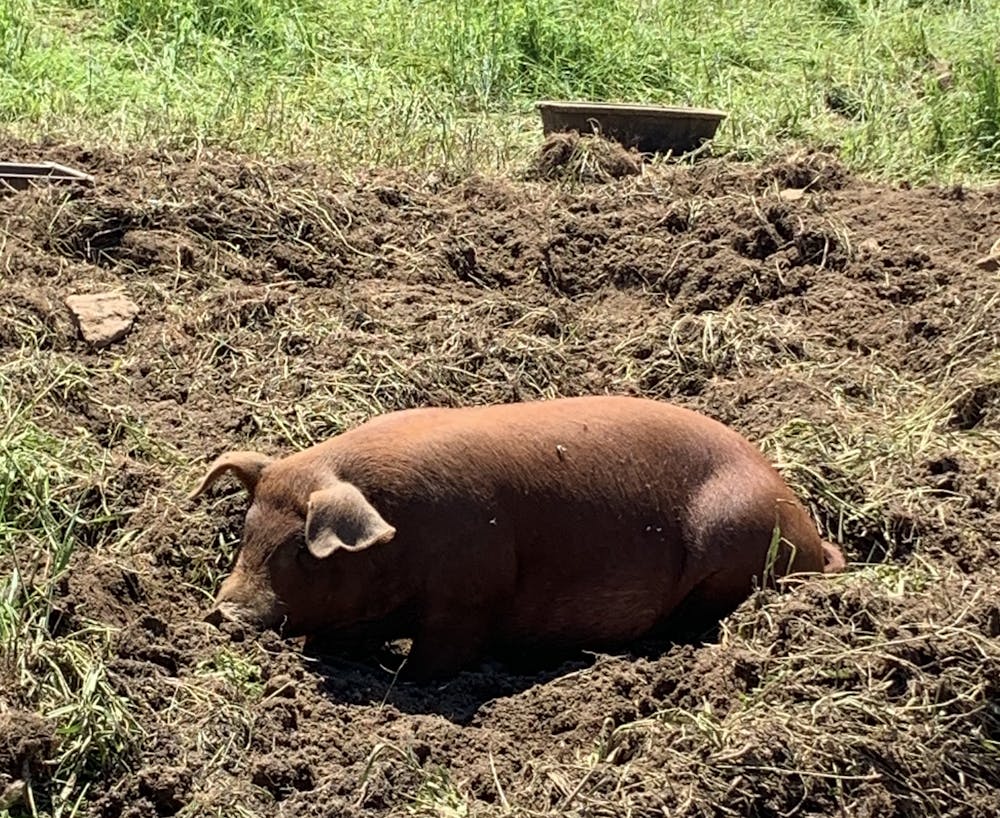 A free-range pig at the Stone Brns Center for Food and Agriculture in New York. Raising livestock and crops together can boost soil carbon through the animals’ grazing patterns and natural manure distribution. Francesca Cotrufo, CC BY-ND[11]
Research shows that farmers and ranchers[12] can also make their operations more resilient[13] to increasingly variable weather[14] by adopting practices that promote soil carbon sequestration. This prospect led us to establish a center[15] at Colorado State University that develops and implements soil-based[16] solutions[17] to climate[18] change[19].
While many policy options exist to reduce emissions from agricuture[20], carbon farming has sparked bipartisan U.S. legislation[21] and attracted investors’ attention[22]. Critics question[23] its true potential, however. Some environment and justice advocacy groups argue that paying farmers won’t do much to increase soil carbon[24], and could allow polluting industries such as manufacturing to avoid necessary emission reductions by buying soil carbon credits from farmers instead.
Given the momentum behind carbon farming as a climate change mitigation strategy number 13411B1020, we believe now is the time to establish clear standards that ensure that only real net changes in carbon receive financial rewards.
Increasing carbon storage in soil can help stabilize the climate and support food production.Carbon farming basics
As plants grow, they pull carbon from the atmosphere, and soil soaks it up and stores it. The amount of carbon stored varies significantly[25] across soil type and climate.
Traditional farming methods that sequester carbon have existed for millennia[26]. For example, minimizing soil disturbance through no-till farming[27] reduces carbon loss to the atmosphere. Diversifying crops[28] and planting legumes[29], perennials[30] and cover crops[31] returns more carbon to the soil, and sustains soil microbes that play key roles in carbon storage[32].
Another climate-friendly strategy is raising livestock and crops together. Rotating cows among pastures allows grasses to recover from grazing, and the animals’ manure and the impacts of their grazing regenerate carbon in soils[33].
Some farmers use these practices, which often are called “regenerative agriculture[34],” particularly in Black[35] and Indigenous communities[36] that have been excluded from access to capital and government subsidies[37].
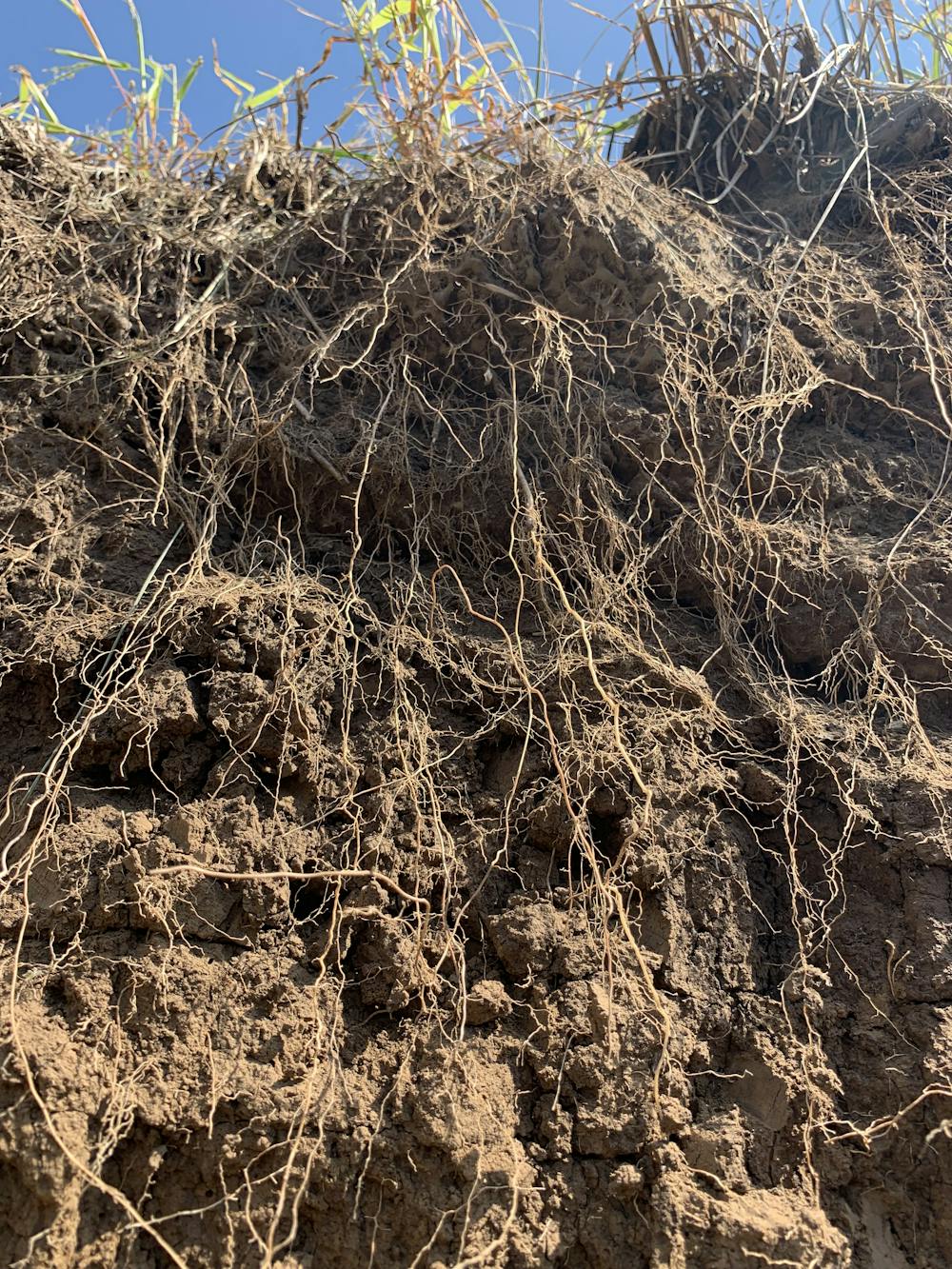 The deep roots of Kernza, a perennial grain, reduce erosion, help the plant tolerate drought and add soil carbon deeper in the ground than shorter-rooted annual grains. Kernza, the first commercially viable perennial grain in the U.S., was developed by The Land Institute, based in Salina, Kansas. Francesca Cotrufo, CC BY-ND[38]
Soil: A low-cost solution
Increasing soil carbon through techniques like no-till is relatively inexpensive. Studies estimate that carbon farming costs US$10-$100 per ton of CO2 removed[39], compared with $100-$1,000 per ton for technologies that mechanically remove carbon from the air[40].
Carbon farming is also a potential revenue stream for farmers and ranchers, who can sell the credits they earn in carbon markets[41]. Large-scale greenhouse gas emitters, such as manufacturers, purchase these credits to offset their own emissions.
Companies such as IndigoAg[42] and Nori[43] are already facilitating payments to farmers for carbon credits. And on June 24, 2021, the U.S. Senate passed the Growing Climate Solutions Act of 2021[44] by a vote of 92-8. The bill would authorize the U.S. Department of Agriculture to help farmers, ranchers and private forest landowners participate in carbon markets.
So far, however, there are no universal standards for measuring, reporting or verifying agricultural carbon credits. Here are the questions we see as top priorities.
Assessing carbon storage
One major challenge is that soils absorb varying amounts of carbon depending on depth, texture and mineral content. While certain practices increase carbon storage[45], quantifying how much is stored and for how long is critical for assigning dollar values to them. The markets and practices[46] that work in different locations also vary widely.
Some scientific models offer estimates of carbon sequestration for various climates and soil types[47] based on averages over large areas. We believe that regulators need rigorous models[48] verified by measurements to avoid crediting carbon that never ends up in soil or doesn’t remain there for long.
But verification isn’t easy. Scientists are still searching for quick, accurate, cost-effective ways[49] to sample and analyze soils.
Possible approaches include infrared spectroscopy[50] – which identifies materials in soil by analyzing how they absorb or reflect infrared light – or machine learning[51], which can find patterns in large data sets quickly. Studies conducted in the U.S. Great Plains[52], the United Kingdom and the European Union[53] suggest these are promising, low-cost methods.
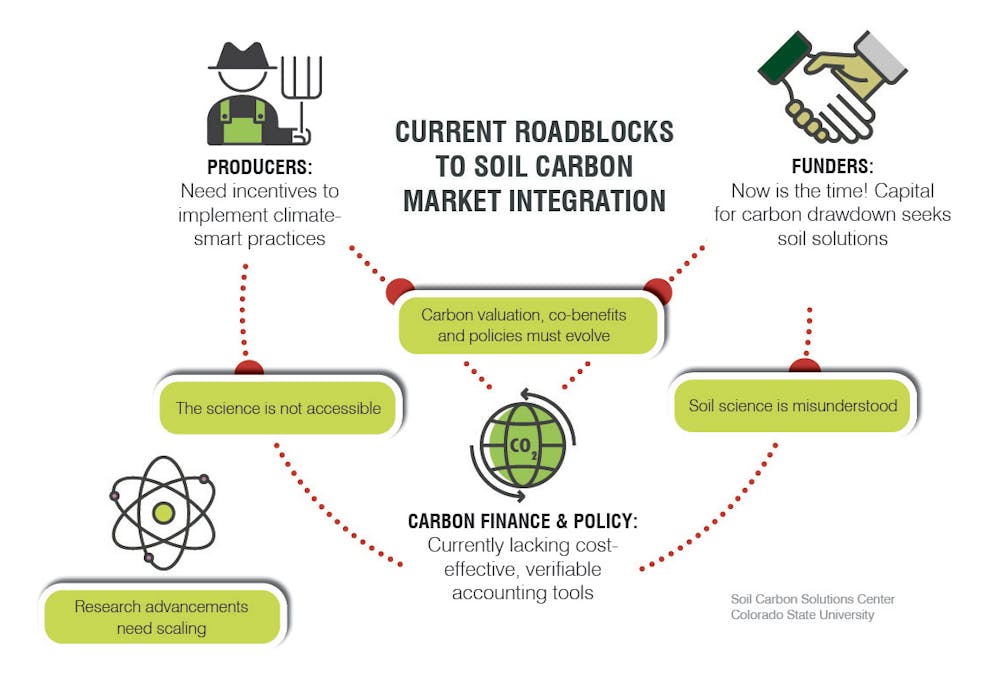 Integrating carbon into markets poses scientific, economic and technical challenges. CSU Soil Carbon Solutions Center, CC BY-ND[54][55]
Another priority is developing national minimum standards to predict and properly value soil carbon capture. Carbon may reside in soil anywhere from days to millennia, so time scale is an important consideration for markets. In our view, credits should reflect the duration carbon resides in soil, with full offsets generated only for longer-lasting storage[56].
We also believe that these programs must consider an operation’s net greenhouse gas emissions. For example, practices may store more carbon in soil but also increase emissions of nitrous oxide, another greenhouse gas[57].
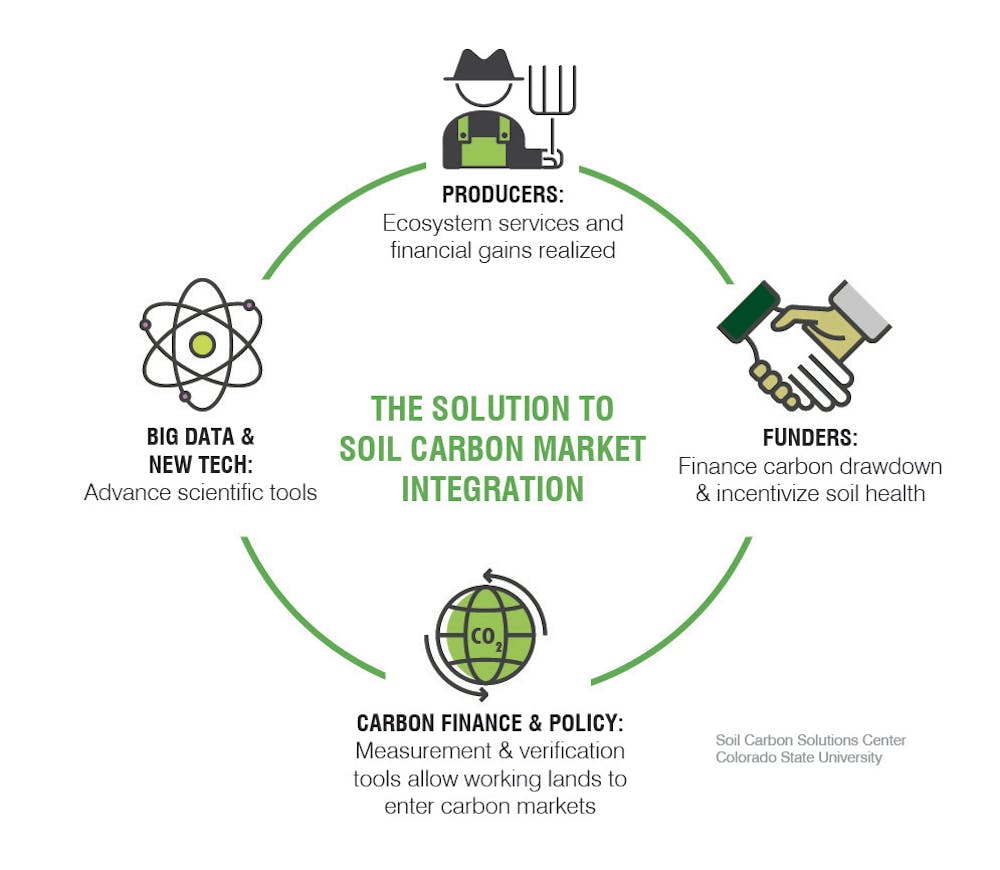 Backed by effective technologies and policies, carbon farming can improve ecosystems and help to slow climate change. CSU Soil Carbon Solutions Center, CC BY-ND[58][59]
Benefits and challenges
Rebuilding carbon-rich soil supports farmers’ bottom lines by improving soil health and increasing crop yields[60]. But federal incentives could preferentially provide resources to big operations[61] that have greater ability to sequester carbon on their vast acreage.
That’s been the case with U.S. farm subsidies: Over the past 25 years, 10% of the largest farms received 78% of subsidies[62].
Since these practices benefit farmers, some may use them even without policy incentives. As we see it, to avoid paying for soil carbon increases that would have occurred anyway[63], carbon banks should avoid crediting farms for adopting practices known to be profitable in their regions.
Ultimately, the goals of climate policy include curbing greenhouse gas emissions and actively removing carbon dioxide from the atmosphere. Before farmers receive soil carbon credits they can sell to offset other sources of emissions, we believe their value must be accurately assessed to ensure that society gets what it pays for.
Editor’s note: This article has been updated to reflect that IndigoAg does not purchase carbon credits.
[Get the best of The Conversation, every weekend. Sign up for our weekly newsletter[64].]
References
- ^ climate change (climate.nasa.gov)
- ^ paths for limiting global warming narrow (doi.org)
- ^ more than half of Earth’s terrestrial surface (ourworldindata.org)
- ^ roughly one-third (www.ipcc.ch)
- ^ carbon-depleted (doi.org)
- ^ a natural climate solution (doi.org)
- ^ Paris climate agreement (unfccc.int)
- ^ 4 per 1000 (www.4p1000.org)
- ^ 2015 Paris climate conference (www.cop21paris.org)
- ^ offset that year’s new growth in carbon dioxide emissions from fossil fuel emissions (doi.org)
- ^ CC BY-ND (creativecommons.org)
- ^ ranchers (doi.org)
- ^ more resilient (doi.org)
- ^ increasingly variable weather (doi.org)
- ^ establish a center (www.research.colostate.edu)
- ^ soil-based (scholar.google.com)
- ^ solutions (scholar.google.com)
- ^ climate (scholar.google.com)
- ^ change (scholar.google.com)
- ^ reduce emissions from agricuture (www.oecd-ilibrary.org)
- ^ bipartisan U.S. legislation (www.politico.com)
- ^ investors’ attention (www.greenbiz.com)
- ^ question (www.wri.org)
- ^ won’t do much to increase soil carbon (modernfarmer.com)
- ^ varies significantly (doi.org)
- ^ have existed for millennia (doi.org)
- ^ no-till farming (doi.org)
- ^ Diversifying crops (doi.org)
- ^ legumes (doi.org)
- ^ perennials (doi.org)
- ^ cover crops (esajournals.onlinelibrary.wiley.com)
- ^ play key roles in carbon storage (theconversation.com)
- ^ regenerate carbon in soils (doi.org)
- ^ regenerative agriculture (theconversation.com)
- ^ Black (www.chelseagreen.com)
- ^ Indigenous communities (www.nativefoodsystems.org)
- ^ excluded from access to capital and government subsidies (flexpub.com)
- ^ CC BY-ND (creativecommons.org)
- ^ US$10-$100 per ton of CO2 removed (doi.org)
- ^ mechanically remove carbon from the air (www.iea.org)
- ^ sell the credits they earn in carbon markets (www.wisfarmer.com)
- ^ IndigoAg (www.indigoag.com)
- ^ Nori (locusag.com)
- ^ Growing Climate Solutions Act of 2021 (www.congress.gov)
- ^ certain practices increase carbon storage (doi.org)
- ^ markets and practices (doi.org)
- ^ estimates of carbon sequestration for various climates and soil types (doi.org)
- ^ rigorous models (doi.org)
- ^ quick, accurate, cost-effective ways (doi.org)
- ^ infrared spectroscopy (doi.org)
- ^ machine learning (doi.org)
- ^ U.S. Great Plains (link.springer.com)
- ^ the United Kingdom and the European Union (doi.org)
- ^ CSU Soil Carbon Solutions Center (www.research.colostate.edu)
- ^ CC BY-ND (creativecommons.org)
- ^ longer-lasting storage (theconversation.com)
- ^ nitrous oxide, another greenhouse gas (doi.org)
- ^ CSU Soil Carbon Solutions Center (www.research.colostate.edu)
- ^ CC BY-ND (creativecommons.org)
- ^ increasing crop yields (doi.org)
- ^ big operations (www.ers.usda.gov)
- ^ 10% of the largest farms received 78% of subsidies (farm.ewg.org)
- ^ to avoid paying for soil carbon increases that would have occurred anyway (www.offsetguide.org)
- ^ Sign up for our weekly newsletter (theconversation.com)