New wave of anti-protest laws may infringe on religious freedoms for Indigenous people
- Written by: Rosalyn R. LaPier, Associate Professor of Environmental Studies, The University of Montana
Over four days in June 2021, thousands of protesters attended the Treaty People Gathering[1] in opposition to Line 3, a crude oil pipeline slated to be built across traditional homelands of the Ojibwe peoples in northern Minnesota.
To begin the gathering, Indigenous elders led a public religious ceremony. They said prayers and sang songs that blessed and sanctified the headwaters of the Mississippi River. They also prayed for the people involved in the protest – over 100 of whom were later arrested for trespassing[2] and other acts of civil disobedience.
As an Indigenous scholar[3] of religion and the environment, I am interested in how Native Americans protect their sacred landscapes and how they are blending protesting with religion[4].
And I see how police crackdowns on protests like the one at Line 3 have the potential to infringe on the religious freedom of Indigenous people.
Anti-protest laws
More than 30 U.S. states – including my home state of Montana – have passed “anti-protesting” laws[5] in recent years to stop the kinds of protest and civil disobedience conducted at Line 3 in Minnesota.
Several anti-protest laws are currently pending[6] in the Minnesota legislature.
These new laws dramatically increase fees and jail time for those convicted. In Montana[7], for example, a person found guilty of damaging “critical infrastructure” can be fined up to US$150,000 and imprisoned for 30 years. Montana added additional charges for those who assist protesters. Even if they do not participate in any civil disobedience, a person or group that “compensates, provides consideration to, or remunerates” protesters can be held “vicariously liable” and receive similar sentences.
The anti-protest laws stand in stark contrast to the longstanding history of the use of civil disobedience within the United States as a tool of social change, such as that practiced by Dr. Martin Luther King, Jr. and others during the fight for civil rights. Civil disobedience[8] is the “public, nonviolent and conscientious breach of law.” In other words, the purpose of civil disobedience is to break the law and get arrested in order to make societal change.
For example, actress and activist Jane Fonda[9] launched “fire drill Fridays” in 2019 to draw attention to the growing climate crisis. Throughout the winter of 2019 and 2020, Fonda and other celebrities and activists were arrested each Friday at the U.S. Capitol.
But this kind of publicity-seeking civil disobedience has drawn the ire of the energy industry and proponents of anti-protesting laws[10].
Protecting religious freedom
Indigenous people in the U.S. have struggled[11] to practice their religions and protect their landscapes since the nation’s founding. Indigenous dancing and rituals used to be illegal in many communities[12]. It was only in 1978 that the American Indian Religious Freedom Act[13] became federal policy and allowed Indigenous people the “inherent right of freedom to believe, express, and exercise [their] traditional religions.”
Despite the change in policy, law professor Kristen Carpenter argues in the Harvard Law Review[14] that, in case after case, the Supreme Court has denied “religious freedom to American Indians.” This is especially true when it comes to the protection of sacred landscapes. The 1988 ruling on Lyng v. Northwest Indian Cemetery Protective Association, known as the “G-O Road” case[15], for example, set the precedent to allow construction on Indigenous sacred sites.
The new anti-protest laws and proposed legislation are alarming to various groups. Hundreds of scientists recently signed an open letter[16] stating they are “gravely concerned” about the increased criminalization of environmental protesting.
Civil liberties organizations[17], meanwhile, worry that the new anti-protesting laws could restrain the First Amendment[18] rights of freedom of speech and freedom to assemble.
But the increased criminalization of protesting also has the potential to infringe on the First Amendment right of religious freedom. That is because Indigenous protests often transform places of protest into places of religious practice and even pilgrimage[19].
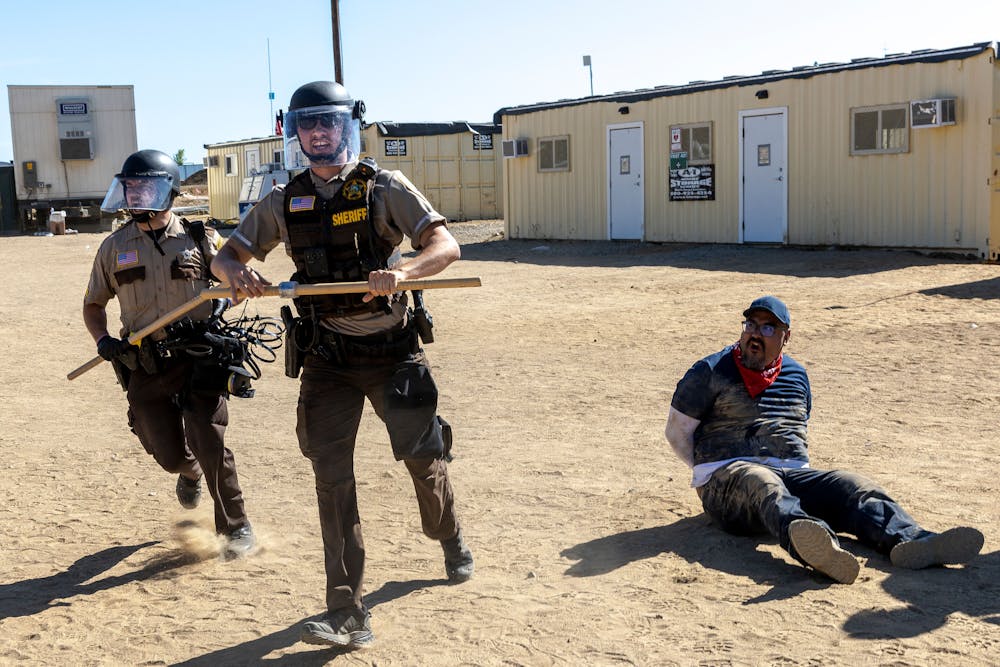 Police arrest environmental activists at the Line 3 pipeline pumping station near Itasca State Park in Minnesota on June 7, 2021.
Kerem Yucel/AFP via Getty Images[20]
Police arrest environmental activists at the Line 3 pipeline pumping station near Itasca State Park in Minnesota on June 7, 2021.
Kerem Yucel/AFP via Getty Images[20]
Shadow of conquest
Indigenous environmental activists in the U.S. have long argued that they are not protesters[21] but “protectors” of sacred landscapes and watersheds. They believe that their role is to keep Indigenous land from further environmental degradation or harm.
In his new book “Religion and Social Protest Movements[22],” historian Tobin Miller Shearer argues that Indigenous people use places of protest as places of religious practice where they deepen their spirituality. He shares how the Dakota Access pipeline protest in North Dakota became a “religiously permeated protest” that “amplified and deepened spiritual practices” of the protesters. Daily prayers were held and sacred fires burned.
Some Indigenous people go to environmental protests just for this reason – to participate in a communal religious ritual.
Louise Erdrich, a Pulitzer Prize-winning Ojibwe author, described her experience[23] at the Line 3 protest camp in an article for The New York Times. “Every morning at 10, people gather to pray,” she wrote. “Every day there are more people in the circle.”
For Erdrich, the camp was not just a place of protest but of spiritual connection.
“We are here on earth, omaa akiing,” she explained, “and the waters are alive with energy.”
[3 media outlets, 1 religion newsletter. Get stories from The Conversation, AP and RNS.[24]]
References
- ^ Treaty People Gathering (www.stopline3.org)
- ^ arrested for trespassing (www.theguardian.com)
- ^ Indigenous scholar (www.rosalynlapier.com)
- ^ blending protesting with religion (theconversation.com)
- ^ anti-protesting” laws (grist.org)
- ^ currently pending (www.icnl.org)
- ^ In Montana (leg.mt.gov)
- ^ Civil disobedience (plato.stanford.edu)
- ^ Jane Fonda (www.nytimes.com)
- ^ anti-protesting laws (www.sierraclub.org)
- ^ have struggled (theconversation.com)
- ^ illegal in many communities (uncpress.org)
- ^ American Indian Religious Freedom Act (www.govinfo.gov)
- ^ argues in the Harvard Law Review (harvardlawreview.org)
- ^ “G-O Road” case (www.oyez.org)
- ^ open letter (www.theguardian.com)
- ^ organizations (www.icnl.org)
- ^ First Amendment (constitution.congress.gov)
- ^ pilgrimage (theconversation.com)
- ^ Kerem Yucel/AFP via Getty Images (www.gettyimages.com)
- ^ not protesters (www.bemidjipioneer.com)
- ^ Religion and Social Protest Movements (www.routledge.com)
- ^ described her experience (www.nytimes.com)
- ^ Get stories from The Conversation, AP and RNS. (theconversation.com)