Biden targets noncompete agreements, which restrict the job opportunities of millions of low-wage workers
- Written by: Raymond Hogler, Professor of Management, Colorado State University
Most American workers are hired “at will”[1]: Employers owe their employees nothing in the relationship except earned wages, and employees are at liberty to quit at their option. As the rule is generally stated, either party may terminate the arrangement at any time for a good or bad reason or none at all.
In keeping with that no-strings-attached spirit, employees may move on as they see fit – unless they happen to be among the tens of millions of workers bound[2] by a contract that explicitly forbids getting hired by a competitor. These “noncompete clauses[3]” may make sense for CEOs and other top executives who possess trade secrets but may seem nonsensical when they are applied to low-wage workers[4] such as draftsmen in the construction industry. A 2019 business survey found that 29% of companies paying an average wage of less than $13 an hour required all their employees to sign noncompete agreements[5].
President Joe Biden seems to agree about the oppressive nature of noncompete contracts. On July 9, 2021, he called on the Federal Trade Commission to ban or limit them[6].
As a scholar of employment law and policy[7], I also have many concerns about noncompete clauses – such as how they tend to aggravate the power imbalances relationship between workers and bosses and suppress wages and discourage labor market mobility[8].
The birth of at-will employment
Courts began to enshrine the at-will doctrine in the 19th century, making exceptions only for employees with fixed-term contracts. In Payne v. Western & Atlantic Railroad Co.[9], the Tennessee Supreme Court ruled that a railway foreman in Chattanooga had the right to forbid his workers from buying whiskey from a merchant named L. Payne.
Payne had sued the railroad, claiming it couldn’t threaten to fire employees to discourage them from buying goods from a third party. The court disagreed, arguing that the railroad had a right to terminate employees for any reason – even one that involved dealing with a independent merchant.
The notion of at-will employment and its associated lack of job protections soon rose to the level of constitutional mandate. The 1894 Pullman strike[10], which disrupted national rail traffic, prompted Congress to pass the Erdman Act[11] four years later. That law guaranteed the right of rail workers to join and form unions and to engage in collective bargaining.
But the Supreme Court struck down that law in 1908. Writing for the majority in Adair v. United States[12], Justice John Marshall Harlan explained that since employers were free to use their property as they wished, they could impose and enforce their own labor rules. Employees, in turn, were free to quit. The court summarized the law with the following statement:
“The right of a person to sell his labor upon such terms as he deems proper is, in its essence, the same as the right of the purchaser of labor to prescribe the conditions upon which he will accept such labor from the person offering to sell it,” Harlan wrote.
That might sound reasonable, but the Adair ruling led to the proliferation of “yellow dog” contracts[13] threatening workers with firing if they joined or organized unions. The term disparaged people who were willing to accept such conditions, but the principle had widespread legal approval[14].
For three decades, the at-will doctrine stymied legislation that would have protected labor rights. Even when a supervisor tried to seduce a longtime employee’s wife and fired the employee in revenge[15], courts refused to protect the man from losing his job.
Labor rights and the law
With the passage of the National Labor Relations Act[16] in 1935, all private-sector workers and unions gained the power to collectively bargain with employers. Subsequent labor agreements, such as the one negotiated by the Steel Workers Organizing Committee[17] with Carnegie-Illinois Steel in 1937, made employers prove “just cause” before firing any person covered by the contract.
The Civil Rights Acts of 1964 and 1991[18] added employment protections prohibiting discrimination based on race, gender, religion and national origin. And the Americans with Disabilities Act[19], which Congress passed in 1990, ensured that persons with disabilities would have access to jobs with or without reasonable accommodation.
Those laws and other measures, including modern exceptions to the at-will rule, offer workers some security.
But they provide no federal protection from noncompete clauses.
Noncompetes and low-wage workers
It’s unclear exactly how many U.S. workers are subject to a noncompete, but the left-leaning Economic Policy Institute estimated in a 2019 report that it’s around 28% to 47% of all private-sector workers[20].
The leeway for employers to impose these provisions varies widely from state to state[21] and is in flux.
California, North Dakota and Oklahoma are the only states to ban them outright[22], while about a dozen forbid them with certain types of low-wage workers. Washington, D.C., also outlaws all noncompete agreements[23].
At the same time, some states, such as Georgia[24] and Idaho[25], have made it even easier for companies to enforce them.
Critics have pointed out the disadvantages of noncompete clauses to unskilled labor.
“By locking low-wage workers into their jobs and prohibiting them from seeking better-paying jobs elsewhere, the companies have no reason to increase their wages or benefits,” Illinois Attorney General Lisa Madigan said when she sued the Jimmy John’s[26] fast-food franchise in 2016 for making its employees sign noncompete clauses.
The chain subsequently agreed to drop its noncompetes[27], which had also come under fire in New York. The clauses had barred the sandwich maker’s workers from working for other companies that earn more than 10% of their revenue from “submarine, hero-type, deli-style, pita, and/or wrapped or rolled sandwiches” for two years after leaving the Jimmy John’s payroll.
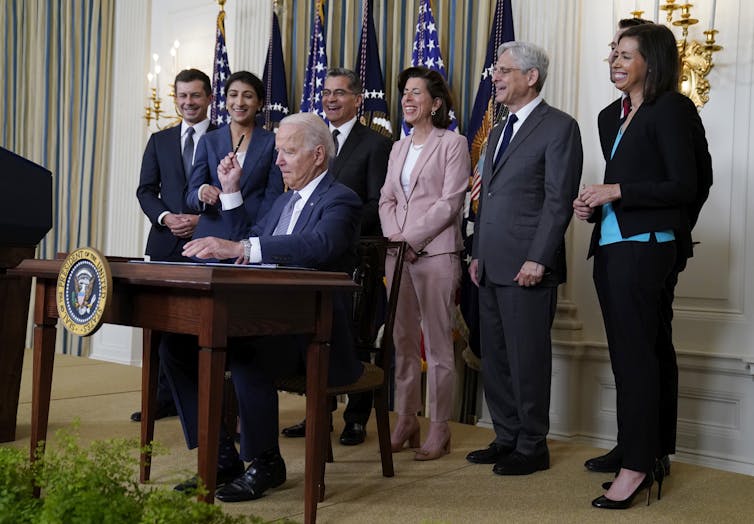 President Biden signed an executive order that would ban or limit noncompete clauses.
AP Photo/Evan Vucci[28]
President Biden signed an executive order that would ban or limit noncompete clauses.
AP Photo/Evan Vucci[28]
Efforts to limit noncompete clauses
Given the patchwork of state laws – and reports that companies are using noncompetes[29] even in places where they are banned – a uniform federal rule could clarify the situation and benefit both employees and employers.
The FTC has a range of options, from banning noncompete clauses entirely to limiting their use to executives and others who may possess trade secrets or other confidential information. The agency could require that the clauses come with certain due-process protections, such as a right to arbitration of contract disputes.
Executives who sign noncompete clauses already get these kinds of protections[30], not to mention lucrative buyout provisions.
If employees with lower pay and less prestige aren’t free to get new jobs, I believe their bosses have a corresponding duty to extend to them the rights enjoyed by people at the top of the corporate ladder, particularly independent third-party dispute resolution.
This is an updated version of an article originally published[31] on Aug. 23, 2017.
References
- ^ Most American workers are hired “at will” (www.ncsl.org)
- ^ tens of millions of workers bound (www.epi.org)
- ^ noncompete clauses (www.milkenreview.org)
- ^ low-wage workers (www.baltimoresun.com)
- ^ required all their employees to sign noncompete agreements (www.epi.org)
- ^ called on the Federal Trade Commission to ban or limit them (www.whitehouse.gov)
- ^ scholar of employment law and policy (scholar.google.com)
- ^ suppress wages and discourage labor market mobility (dx.doi.org)
- ^ Payne v. Western & Atlantic Railroad Co. (casetext.com)
- ^ Pullman strike (www.encyclopedia.chicagohistory.org)
- ^ Erdman Act (recordsofrights.org)
- ^ Adair v. United States (supreme.justia.com)
- ^ “yellow dog” contracts (www.law.cornell.edu)
- ^ widespread legal approval (supreme.justia.com)
- ^ fired the employee in revenge (www.courtlistener.com)
- ^ National Labor Relations Act (www.nlrb.gov)
- ^ Steel Workers Organizing Committee (www.usw.org)
- ^ Civil Rights Acts of 1964 and 1991 (www.eeoc.gov)
- ^ Americans with Disabilities Act (www.ada.gov)
- ^ that it’s around 28% to 47% of all private-sector workers (www.epi.org)
- ^ varies widely from state to state (quirkyemploymentquestions.com)
- ^ are the only states to ban them outright (news.bloomberglaw.com)
- ^ also outlaws all noncompete agreements (www.lw.com)
- ^ Georgia (www.lexology.com)
- ^ Idaho (www.nytimes.com)
- ^ Jimmy John’s (www.illinoisattorneygeneral.gov)
- ^ drop its noncompetes (fortune.com)
- ^ AP Photo/Evan Vucci (newsroom.ap.org)
- ^ reports that companies are using noncompetes (www.npr.org)
- ^ already get these kinds of protections (corpgov.law.harvard.edu)
- ^ article originally published (theconversation.com)