How the presence of humans can disturb wildlife up to half a mile away
- Written by: Jeremy Dertien, PhD Candidate in Forestry and Environmental Conservation, Clemson University
Millions of Americans are traveling this summer as pandemic restrictions wind down. Rental bookings[1] and crowds in national parks[2] show that many people are headed for the great outdoors.
Seeing animals and birds is one of the main draws of spending time in nature. But as researchers who study conservation[3], wildlife[4] and human impacts on wild places[5], we believe it’s important to know that you can have major effects on wildlife just by being nearby.
In a recent review[6] of hundreds of studies covering many species, we found that the presence of humans can alter wild animal and bird behavior patterns at much greater distances than most people may think. Small mammals and birds may change their behavior when hikers or birders come within 300 feet (100 meters) – the length of a football field. Large birds like eagles and hawks can be affected when humans are over 1,300 feet (400 meters) away – roughly a quarter of a mile. And large mammals like elk and moose can be affected by humans up to 3,300 feet (1,000 meters) away – more than half a mile.
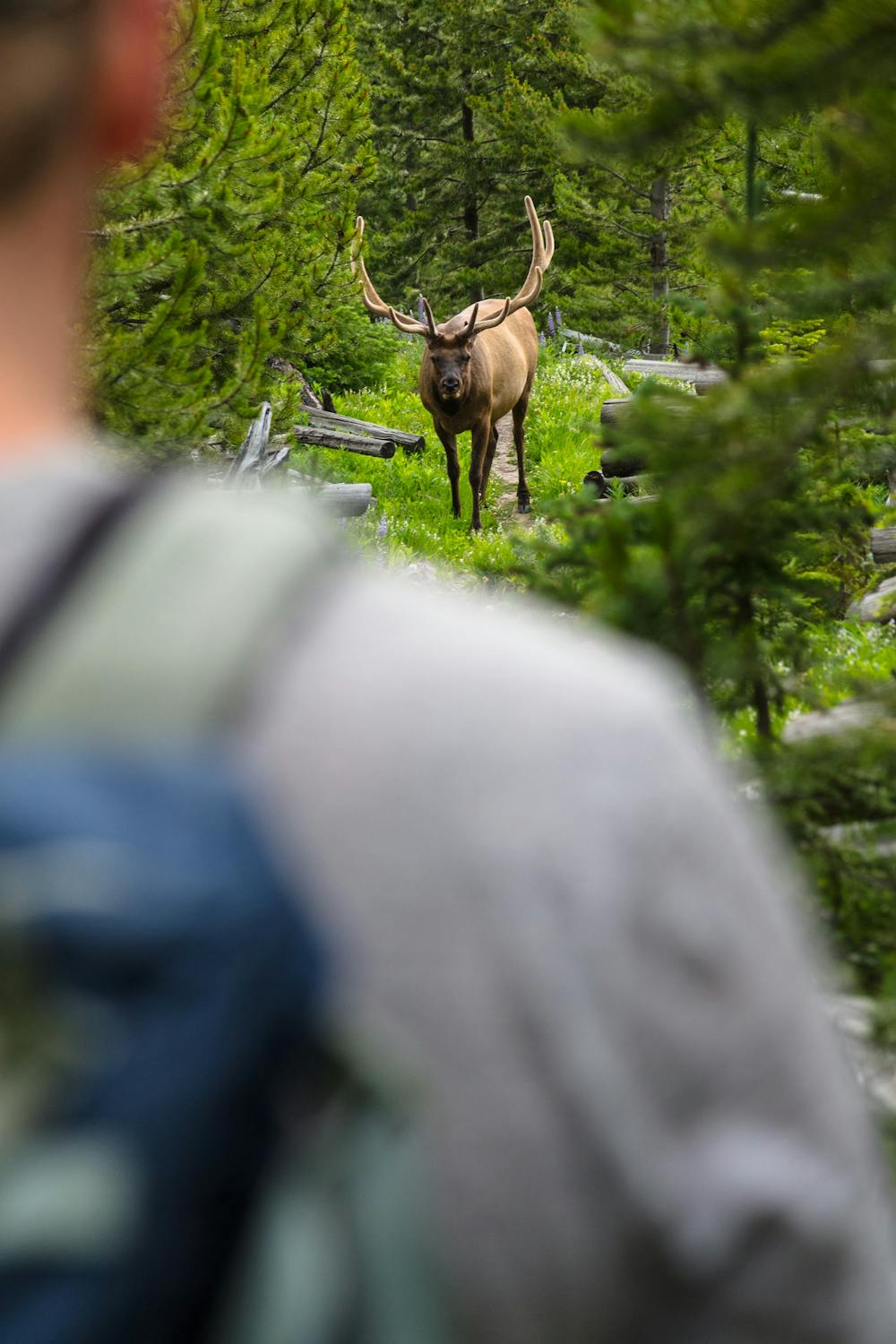 A hiker about 75 feet from a bull elk in Yellowstone National Park.
Jacob W. Frank, NPS/Flickr[7]
A hiker about 75 feet from a bull elk in Yellowstone National Park.
Jacob W. Frank, NPS/Flickr[7]
Many recent studies and reports have shown that the world is facing a biodiversity crisis[8]. Over the past 50 years, Earth has lost so many species that many scientists believe the planet is experiencing its sixth mass extinction[9] – due mainly to human activities.
Protected areas, from local open spaces to national parks, are vital for conserving plants and animals. They also are places where people like to spend time in nature. We believe that everyone who uses the outdoors should understand and respect this balance between outdoor recreation, sustainable use and conservation.
How human presence affects wildlife
Pandemic lockdowns in 2020 confined many people indoors – and wildlife responded. In Istanbul, dolphins ventured much closer to shore than usual[10]. Penguins explored quiet South African Streets[11]. Nubian ibex grazed on Israeli playgrounds[12]. The fact that animals moved so freely without people present shows how wild species change their behavior in response to human activities.
Decades of research have shown that outdoor recreation, whether it’s hiking, cross-country skiing or riding all-terrain vehicles, has negative effects on wildlife[13]. The most obvious signs are behavioral changes: Animals may flee from nearby people, decrease the time they feed and abandon nests or dens.
Other effects are harder to see, but can have serious consequences for animals’ health and survival. Wild animals that detect humans can experience physiological changes, such as increased heart rates and elevated levels of stress hormones.
And humans’ outdoor activities can degrade habitat that wild species depend on for food, shelter and reproduction. Human voices[14], off-leash dogs[15] and campsite overuse[16] all have harmful effects that make habitat unusable for many wild species.
Disturbing shorebirds can cause them to stop eating, stop feeding their young or flee their nests, leaving chicks vulnerable.Effects of human presence vary for different species
For our study we examined 330 peer-reviewed articles spanning 38 years to locate thresholds at which recreation activities negatively affected wild animals and birds. The main thresholds we found were related to distances between wildlife and people or trails. But we also found other important factors, including the number of daily park visitors and the decibel levels of people’s conversations.
The studies that we reviewed covered over a dozen different types of motorized and nonmotorized recreation. While it might seem that motorized activities would have a bigger impact, some studies have found that dispersed “quiet” activities, such as day hiking, biking and wildlife viewing[17], can also affect which wild species will use a protected area.
Put another way, many species may be disturbed by humans nearby, even if those people are not using motorboats or all-terrain vehicles. It’s harder for animals to detect quiet humans, so there’s a better chance that they’ll be surprised by a cross-country skier than a snowmobile, for instance. In addition, some species that have been historically hunted are more likely to recognize – and flee from – a person walking[18] than a person in a motorized vehicle.
Generally, larger animals need more distance, though the relationship is clearer for birds than mammals. We found that for birds, as bird size increased, so did the threshold distance. The smallest birds could tolerate humans within 65 feet (20 meters), while the largest birds had thresholds of roughly 2,000 feet (600 meters). Previous research[19] has found a similar relationship. We did not find that this relationship existed as clearly for mammals.
We found little research on impact thresholds for amphibians and reptiles, such as lizards, frogs, turtles and snakes. A growing body of evidence[20] shows that amphibians and reptiles are disturbed[21] and negatively affected by recreation. So far, however, it’s unclear whether those effects reflect mainly the distance to people, the number of visitors or other factors.
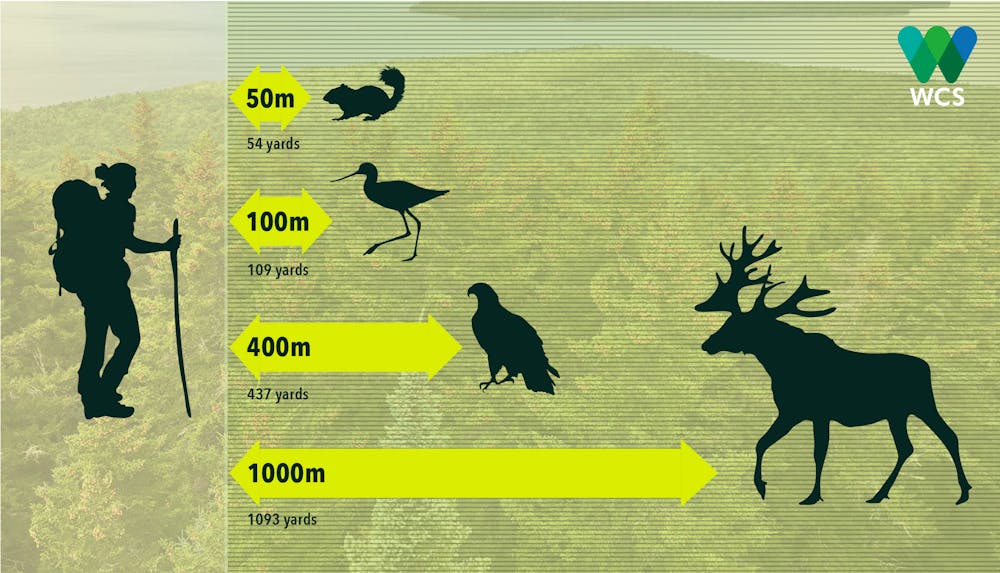 Human recreation starts to affect wild creatures’ behavior and physical state at different distances. Small mammals and birds tolerate closer recreation than do larger birds of prey and large mammals.
Sarah Markes, CC BY-ND[22]
Human recreation starts to affect wild creatures’ behavior and physical state at different distances. Small mammals and birds tolerate closer recreation than do larger birds of prey and large mammals.
Sarah Markes, CC BY-ND[22]
How to reduce your impact on wildlife
While there’s much still to learn, we know enough to identify some simple actions people can take to minimize their impacts on wildlife. First, keep your distance. Although some species or individual animals will become used to human presence at close range, many others won’t. And it can be hard to tell when you are stressing an animal and potentially endangering both it and yourself.
Second, respect closed areas and stay on trails. For example, in Jackson Hole, Wyoming, wildlife managers seasonally close some backcountry ski areas[23] to protect critical habitat for bighorn sheep and reduce stress on other species like moose, elk and mule deer. And rangers in Maine’s Acadia National Park close several trails annually near peregrine falcon nests[24]. This reduces stress to nesting birds and has helped this formerly endangered species recover[25].
Getting involved with educational or volunteer programs is a great way to learn about wildlife and help maintain undisturbed areas. As our research shows, balancing recreation with conservation means opening some areas to human use and keeping others entirely or mostly undisturbed.
As development fragments wild habitat[26] and climate change forces many species to shift their ranges[27], movement corridors between protected areas become even more important. Our research suggests that creating recreation-free wildlife corridors of at least 3,300 feet (1,000 meters) wide can enable most species to move between protected areas without disturbance. Seeing wildlife can be part of a fun outdoor experience – but for the animals’ sake, you may need binoculars or a zoom lens for your camera.
[Get our best science, health and technology stories. Sign up for The Conversation’s science newsletter[28].]
References
- ^ Rental bookings (www.vogue.com)
- ^ crowds in national parks (theconversation.com)
- ^ conservation (scholar.google.com)
- ^ wildlife (scholar.google.com)
- ^ human impacts on wild places (scholar.google.com)
- ^ recent review (doi.org)
- ^ Jacob W. Frank, NPS/Flickr (flic.kr)
- ^ biodiversity crisis (www.un.org)
- ^ sixth mass extinction (theconversation.com)
- ^ dolphins ventured much closer to shore than usual (www.bbc.com)
- ^ Penguins explored quiet South African Streets (www.businessinsider.co.za)
- ^ Nubian ibex grazed on Israeli playgrounds (www.theguardian.com)
- ^ has negative effects on wildlife (doi.org)
- ^ Human voices (www.theatlantic.com)
- ^ off-leash dogs (www.oregonmetro.gov)
- ^ campsite overuse (www.outsideonline.com)
- ^ dispersed “quiet” activities, such as day hiking, biking and wildlife viewing (doi.org)
- ^ and flee from – a person walking (doi.org)
- ^ Previous research (doi.org)
- ^ growing body of evidence (doi.org)
- ^ disturbed (doi.org)
- ^ CC BY-ND (creativecommons.org)
- ^ seasonally close some backcountry ski areas (rootsrated.com)
- ^ close several trails annually near peregrine falcon nests (www.nps.gov)
- ^ helped this formerly endangered species recover (www.nps.gov)
- ^ fragments wild habitat (dx.doi.org)
- ^ shift their ranges (doi.org)
- ^ Sign up for The Conversation’s science newsletter (theconversation.com)