here's what you'll learn if you choose it in years 11 and 12
- Written by: Heather Sharp, Associate Professor, History and Curriculum Studies, University of Newcastle
This article is part of a series[1] providing school students with evidence-based advice for choosing subjects in their senior years.
History is for students curious about the world. It involves discovery, evaluation and imagination.
Around 40% of Australian senior students chose to study[2] year 11 and 12 history in 2016. It was more popular than other humanities subjects such as geography and psychology and more girls chose to enrol (23%) than boys (18%).
Here’s what you need to know if you’re considering taking history in the senior years.
What kinds of history subject are there?
There are a variety of history subjects offered across Australia. For example, Victoria’s history subjects include Australian history[3], 20th century history[4], ancient history[5] and revolutions[6].
Australian history is only available in Victoria. It investigates Aboriginal history and contact with colonialists, through to Federation and 20th century nation building. But the subject is losing popularity. The number of students who completed Australian history almost halved[7] between 2014 and 2019, from 1,245 in 2014 to just 632 in 2019.
Teachers are aiming to make it more interesting and the structure of Australian history will change next year[8]. Instead of learning the entire span of Australian history chronologically, Victorian students will conduct two semester-length investigations of themes including creating a nation, power and resistance, and war and upheaval.
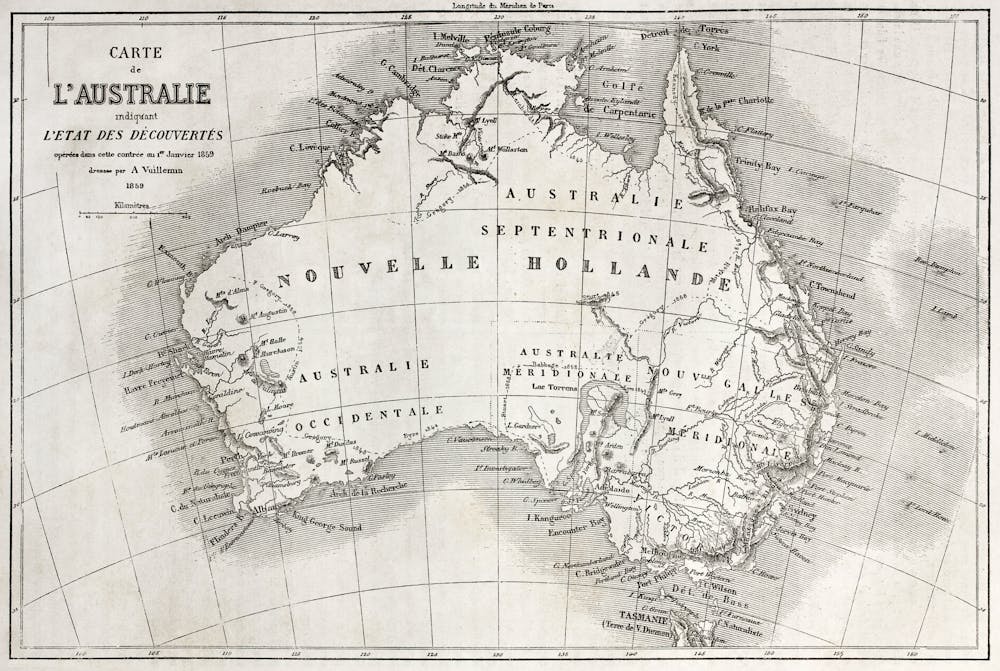 Australian history explores how we got to the present, from Aboriginal history to building the nation of Australia as we know it today. (Map of Australia published in Le Tour du Monde journal, Paris, 1860)
Shutterstock[9]
Australian history explores how we got to the present, from Aboriginal history to building the nation of Australia as we know it today. (Map of Australia published in Le Tour du Monde journal, Paris, 1860)
Shutterstock[9]
Ancient history and revolutions explores societies such as Ancient Egypt, classical Rome and Greece with a focus on politics, military and social history. Revolutions includes an in-depth study of French, American and Russian revolutions.
Year 12 student Taylah told us she took ancient history because:
I always had a fascination with the ancient Egyptian civilisation. I was especially interested in how civilisations have or haven’t learned from the past.
Modern history is available in New South Wales[10] and Queensland[11]. This generally focuses on prominent topics and events from the French Revolution to the present. It covers major conflicts such as the world wars, the Cold War, the Vietnam war, international race relations and peace initiatives such as the beginnings of the United Nations.
Modern history was the most popular course in NSW in 2020, with similar numbers of boys and girls choosing it.
Uniquely, NSW offers an extension history[12] course, which examines historical theory and the uses of history today. This course features a major research project that places students in the role of a historian, extending learning beyond content to communicate conceptual understandings.
What will I be learning?
History is for students interested in understanding the origins of the present and who like to see beyond simple, right-or-wrong answers.
Samantha who is studying teaching at university told us she chose history in years 11 and 12 because:
It always fascinated me how history made the world we live in. I also thought it was interesting how in Australia we are so tied to the Western world, considering geographically we are quite removed.
History isn’t just about learning facts like names and dates. Senior history opens up knowledge to be questioned and explored in depth. For example, students can compare and contrast the revolutions of France and Russia and investigate whether and how the first world war was a precursor to the second.
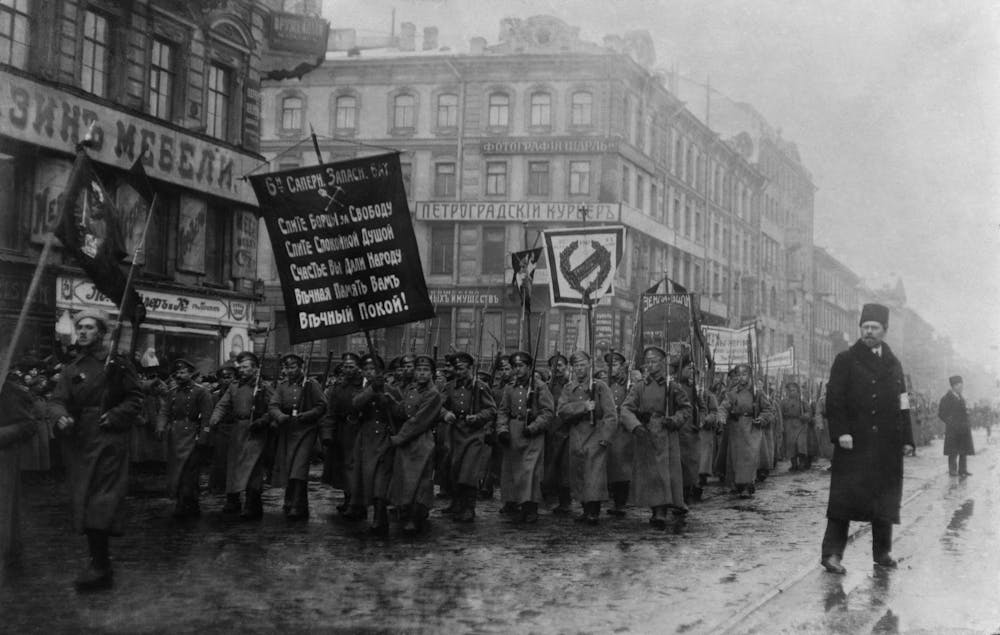 Students can compare the Russian the French revolutions. (Funeral of people killed by Czarist police on Feb 26, 1917 St. Petersburg, Russia)
Shutterstock[13]
Students can compare the Russian the French revolutions. (Funeral of people killed by Czarist police on Feb 26, 1917 St. Petersburg, Russia)
Shutterstock[13]
Jack who has a bachelor in business studies told us he:
enjoyed the combination of skills involved in studying history: writing, critical analysis and assessment of a range of different sources such as books, film and interviews.
A major skill students learn is historical inquiry. This means finding out about the past by researching information from different perspectives, locations and times. Students synthesise information to form a historical evidence-based argument.
Let’s take competing perspectives[14] on Aboriginal civilisation before the British arrived in Australia. For years, our history textbooks told us[15] Aboriginal people were hunter gatherers moving from place to place. But more recent evidence claims many Aboriginal people cultivated the land for farming and aquaculture.
Read more: Secondary school textbooks teach our kids the myth that Aboriginal Australians were nomadic hunter-gatherers[16]
There is still debate[17] about this in the media and in the classroom. Students could research the topic for themselves, read up on the different types of evidence and present their own conclusions.
History is best suited to students who enjoy research as well as reading and writing an argument in response to a question. Students need to be prepared for assigned reading and extended writing tasks.
Where history takes you after school?
Many careers are open to those who study history in senior school and later at university. Some careers that come directly from history study include:
historian, genealogist (family history researcher) or archaeologist
school teacher
museum guide, curator, or education officer (someone who develops education materials and experiences in museums and other public history sites)
research officer for a policy institution, a member of parliament or industry think tank
librarian or archivist (including in conservation and preservation).
Senior curator at a rail museum, Jennifer, told us:
History was the only subject I liked. I chose modern and ancient history for senior because I hoped to have a career in history. I loved learning, analysing and evaluating, finding different sources and opinions, and deep discussions in class. Still choosing history today.
But you don’t just have to take history for a career in it. History also helps develop a range of employment-related skills.
Many employers appreciate skills such as being able to write and communicate effectively and persuasively, to think critically, to consider multiple perspectives and to logically consider consequences based on evidence.
Read more: If the government listened to business leaders, they would encourage humanities education, not pull funds from it[18]
These skills are vital for careers such as in journalism, law, human resources, policy, diplomacy, and other jobs that require critical thinking and clear communication skills.
Rebecca, who studied modern and ancient history in school in Brisbane and then at university told us:
Studying social sciences gives a greater understanding and interest of the wider world […] I work in the UK public service now, and history provides you with excellent analytical, investigation and communication skills. Lots of people in my office have history degrees.
 You can use the research and analytical skills you learn in history in careers like archiving, being a librarian or a researcher in parliament.
Shutterstock[19]
You can use the research and analytical skills you learn in history in careers like archiving, being a librarian or a researcher in parliament.
Shutterstock[19]
When selecting subjects for senior school, there is one important consideration that is often overlooked or set aside. The senior years are hectic. Students should choose at least some of their school subjects for themselves, because they like them and they think the subject is valuable for them.
Read more: Choosing your senior school subjects doesn't have to be scary. Here are 6 things to keep in mind[20]
For many students, history is one of these subjects. By investigating the past, students discover insights about humans and the world they have inherited. These can help them find the paths they will take beyond school.
Read the other articles in our series on choosing senior subjects, here[21].
References
- ^ series (theconversation.com)
- ^ chose to study (growingupinaustralia.gov.au)
- ^ Australian history (www.vcaa.vic.edu.au)
- ^ 20th century history (www.vcaa.vic.edu.au)
- ^ ancient history (www.vcaa.vic.edu.au)
- ^ revolutions (www.vcaa.vic.edu.au)
- ^ almost halved (www.theage.com.au)
- ^ history will change next year (www.theage.com.au)
- ^ Shutterstock (www.shutterstock.com)
- ^ New South Wales (educationstandards.nsw.edu.au)
- ^ Queensland (www.qcaa.qld.edu.au)
- ^ extension history (educationstandards.nsw.edu.au)
- ^ Shutterstock (www.shutterstock.com)
- ^ competing perspectives (theconversation.com)
- ^ history textbooks told us (theconversation.com)
- ^ Secondary school textbooks teach our kids the myth that Aboriginal Australians were nomadic hunter-gatherers (theconversation.com)
- ^ still debate (www.smh.com.au)
- ^ If the government listened to business leaders, they would encourage humanities education, not pull funds from it (theconversation.com)
- ^ Shutterstock (www.shutterstock.com)
- ^ Choosing your senior school subjects doesn't have to be scary. Here are 6 things to keep in mind (theconversation.com)
- ^ here (theconversation.com)