4 ways extreme heat hurts the economy
- Written by: Derek Lemoine, Associate Professor of Economics, University of Arizona
Summer 2021 will likely be one of the hottest on record[1] as dozens of cities in the West experience all-time high temperatures[2]. The extreme heat being felt throughout many parts of the U.S. is causing hundreds of deaths[3], sparking wildfires[4] and worsening drought conditions[5] in over a dozen states.
How does all this broiling heat affect the broader economy?
As an economist who has studied[6] the effects of weather and climate change[7], I have examined a large body of work that links heat to economic outcomes. Here are four ways extreme heat hurts the economy – and a little good news.
1. Growth takes a hit
Research has found that extreme heat can directly hurt economic growth.
For example, a 2018 study found that the economies of U.S. states tend to grow at a slower pace[8] during relatively hot summers. The data shows that annual growth falls 0.15 to 0.25 percentage points for every 1 degree Fahrenheit that a state’s average summer temperature was above normal.
Laborers in weather-exposed industries such as construction work fewer hours[9] when it’s hotter. But higher summer temperatures reduce growth in many industries that tend to involve indoor work, including retail, services and finance. Workers are less productive when it’s hotter out.
2. Crop yields drop
Agriculture is obviously exposed to weather: After all, crops grow outdoors.
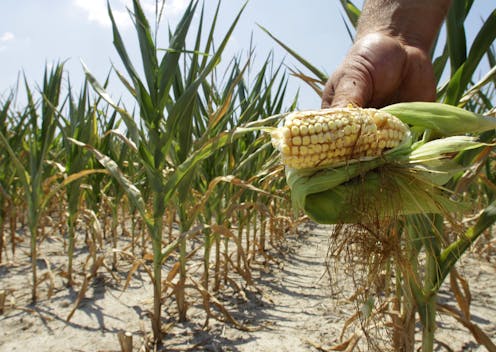
While temperatures up to around 85 F to 90 F (29-32 C) can benefit crop growth, yields fall sharply[10] when thermostats rise further. Some of the crops hit hard by extreme heat include corn, soybeans and cotton. These reductions in yields could be costly for U.S. agriculture.
For example, a recent study I conducted found that an additional 2 degrees Celsius of global warming would eliminate profits[11] from an average acre of farmland in the Eastern U.S.
A prominent example of this was the collapse of the Russian wheat harvest[12] in response to the country’s 2010 heat wave, which raised wheat prices throughout the world.
3. Energy use soars
Of course, when it’s hot, energy use goes up[13] as people and businesses run their air conditioners[14] and other cooling equipment at full blast.
A 2011 study found[15] that just one extra day with temperatures above 90 F increases annual household energy use by 0.4%. More recent research[16] shows that energy use increases the most in places that tend to be hotter, probably because more households have air conditioning.
This increase in electricity use on hot days stresses electric grids right when people depend on them most, as seen in California[17] and Texas[18] during recent heat waves. Blackouts can be quite costly for the economy, as inventories of food and other goods can spoil and many businesses either have to run generators or shut down. For instance, the 2019 California blackouts cost an estimated $10 billion[19].
4. Education and earnings suffer
A long-term impact of increasingly hotter weather involves how it affects children’s ability to learn – and thus their future earnings.
Research has shown that hot weather during the school year reduces test scores. Math scores decrease more and more[20] as the temperature rises beyond 70 F (21 C). Reading scores are more resistant high temperatures, which this research claims is consistent with how different regions of the brain respond to heat.
One study suggested that students in schools that lack air conditioning learn 1% less[21] for every 1 degree Fahrenheit increase in the school year’s average temperature. It also found that minority students are especially affected by hotter school years, as their schools are especially likely to lack air conditioning.
Lost learning results in lower lifetime earnings[22] and hurts future economic growth[23].
The impact of extreme heat on development, in fact, begins before we’re even born. Research has found[24] that adults who were exposed to extreme heat as fetuses earn less during their lifetimes[25]. Each extra day with average temperature above 90 F (32 C) reduces earnings 30 years later by 0.1%[26].
Air conditioning can help – to a point
Air conditioning can offset some of these effects.
For example, studies have found that having a working air conditioner means fewer people die[27], student learning isn’t compromised[28] and extreme heat outside during pregnancy doesn’t hurt fetuses[29].
Not everyone has air conditioning, however, especially in normally cooler areas like Oregon, Washington and Canada that have experienced unusually extreme temperatures this year. And many people can’t afford[30] to own or operate them. Survey data from 2017 found that around half of homes in the Pacific Northwest[31] lacked air conditioning. And about 42% of U.S. classrooms[32] lack an air conditioner.
While heat waves are shown to induce more households[33] to install air conditioning, it’s hardly a panacea. By 2100, higher use of air conditioning could increase residential energy consumption by 83% globally[34]. If that energy comes from fossil fuels, it could end up amplifying the heat waves that caused the higher demand in the first place.
[Over 100,000 readers rely on The Conversation’s newsletter to understand the world. Sign up today[35].]
And in the U.S. South, where air conditioning is omnipresent, hotter-than-usual summers take the greatest toll[36] on states’ economic growth.
In other words, as temperatures rise, economies will continue to suffer.
References
- ^ will likely be one of the hottest on record (weather.com)
- ^ experience all-time high temperatures (www.climate.gov)
- ^ causing hundreds of deaths (www.npr.org)
- ^ sparking wildfires (www.nytimes.com)
- ^ worsening drought conditions (droughtmonitor.unl.edu)
- ^ economist who has studied (www.dereklemoine.com)
- ^ effects of weather and climate change (scholar.google.com)
- ^ tend to grow at a slower pace (doi.org)
- ^ work fewer hours (doi.org)
- ^ yields fall sharply (doi.org)
- ^ would eliminate profits (www.nber.org)
- ^ collapse of the Russian wheat harvest (www.reuters.com)
- ^ energy use goes up (www.washingtonpost.com)
- ^ people and businesses run their air conditioners (www.eia.gov)
- ^ 2011 study found (doi.org)
- ^ More recent research (doi.org)
- ^ California (www.vox.com)
- ^ Texas (www.nytimes.com)
- ^ cost an estimated $10 billion (www.energy.senate.gov)
- ^ Math scores decrease more and more (doi.org)
- ^ learn 1% less (doi.org)
- ^ lower lifetime earnings (doi.org)
- ^ hurts future economic growth (www.aeaweb.org)
- ^ Research has found (doi.org)
- ^ earn less during their lifetimes (doi.org)
- ^ by 0.1% (doi.org)
- ^ fewer people die (doi.org)
- ^ student learning isn’t compromised (doi.org)
- ^ extreme heat outside during pregnancy doesn’t hurt fetuses (doi.org)
- ^ can’t afford (www.wnyc.org)
- ^ around half of homes in the Pacific Northwest (www.eia.gov)
- ^ about 42% of U.S. classrooms (doi.org)
- ^ induce more households (papers.ssrn.com)
- ^ increase residential energy consumption by 83% globally (www.pnas.org)
- ^ Sign up today (theconversation.com)
- ^ take the greatest toll (doi.org)
Read more https://theconversation.com/4-ways-extreme-heat-hurts-the-economy-164382