Younger adults can get very sick and die from COVID too. Here's what the data tell us
- Written by: Peter Wark, Conjoint Professor, School of Medicine and Public Health, University of Newcastle
We learned this week of the tragic death of a 27-year-old man[1] from Sydney who had COVID-19. This follows a 38-year-old woman[2] who died from the virus last month.
Throughout the current Delta outbreak in New South Wales, we’ve heard young people[3] are making up a greater proportion of people in hospital compared with earlier in the pandemic. We’re seeing similar patterns overseas[4].
In NSW between June 13 and July 17[5], the 30-49 age group represented the highest number of COVID-19 hospitalisations, with 45 people in their 30s and 40s admitted (26% of total COVID hospitalisations). Some 13 people aged 49 and under were admitted to ICU, representing 36% of total ICU admissions, with the youngest just a teenager.
What’s behind this worrying trend? Is it the fact more older people are now vaccinated? Or perhaps the Delta variant is causing more severe disease in young people? It may well be a bit of both. Let’s take a look.
Older age is the biggest risk factor
As we learned about COVID-19 last year, it became clear the elderly[6] were the most likely to get very sick. This is true of other infectious diseases[7] too.
A review[8] published late last year shows the steep rise of the infection fatality rate (the chance of dying from COVID-19 if you contract it) with increasing age:
- age 10 — 2 in 100,000
- age 25 — 1 in 10,000
- age 55 — 4 in 1,000
- age 65 — 14 in 1,000
- age 75 — 5 in 100
- age 85 — 15 in 100.
Read more: Does anyone know what your wishes are if you're sick and dying from coronavirus?[9]
But younger people are more likely to be infected
People aged in their 20s have consistently made up a high proportion of COVID-19 cases in Australia and overseas[10]. If we look at all cases of COVID recorded in Australia since the pandemic began, 20 to 29-year-olds[11] account for the highest number (around 22% of total infections).
Reports indicate 67% of new cases[12] recorded in NSW on Thursday were in people under 40.
Some people have proposed greater social contact among those under 40 explains the higher infection rates in this age group. But equally it’s been acknowledged[13] more widespread testing among younger people, greater shielding by older people (staying at home to reduce their risk of infection), and a failure to communicate important public health messages around social distancing to younger people probably contribute.
Whatever the reasons, while the risk of death from COVID-19 is low for younger people, it’s self-evident that if more younger people become infected then more will develop serious illness and die.
 Younger adults have generally been more likely to contract COVID-19 compared to older adults.
Shutterstock[14]
Younger adults have generally been more likely to contract COVID-19 compared to older adults.
Shutterstock[14]
There are other risk factors for young people
Age is not the only factor that influences outcomes with COVID-19.
Having a chronic illness[15] is associated with higher likelihood of more severe disease and death.
Being male and being obese[16] also increase the risk of dying from COVID-19. Obesity may in fact add more significantly to the risk of serious disease in younger people[17].
Of course, none of these risk factors have to be present for a person to develop severe COVID-19.
Read more: COVID-19 cases are highest in young adults. We need to partner with them for the health of the whole community[18]
For younger people who are unwell enough to be hospitalised with COVID-19, the outcomes can be quite serious. A large study from the United Kingdom showed 27% of 19 to 29-year-olds[19] admitted to hospital suffered some form of organ damage to the liver, lungs or kidneys — any of which can lead to permanent disability.
A separate study showed 14% of patients[20] under 40 admitted to ICU died, compared with 31% across all ages.
There is evidence COVID-19 can be associated with sudden deterioration and death[21] in people who seem to be OK, presumably from damage to the heart and sudden cardiac arrest. This phenomenon is very rare at any age.
And younger people are certainly not spared from “long COVID[22]”. A recent Norwegian study[23] looked at people aged 16-30 who had COVID-19 but hadn’t needed hospital treatment. It found after six months, 52% had persistent symptoms including loss of taste or smell, fatigue, breathlessness or impaired concentration.
The Delta variant
While more people are being vaccinated every day, at the same time, the virus is changing. Most recently we’ve seen the rapid global spread of the Delta variant, which is behind Australia’s current outbreaks.
Delta is estimated to be 60% more transmissible[24] compared to the Alpha variant, and may be up to twice as likely to lead to hospitalisation.
The Delta variant also seems more likely to infect younger people. In the UK it’s thought to now be spreading through schools[25] more than any other setting. Last year, school transmission[26] was relatively rare.
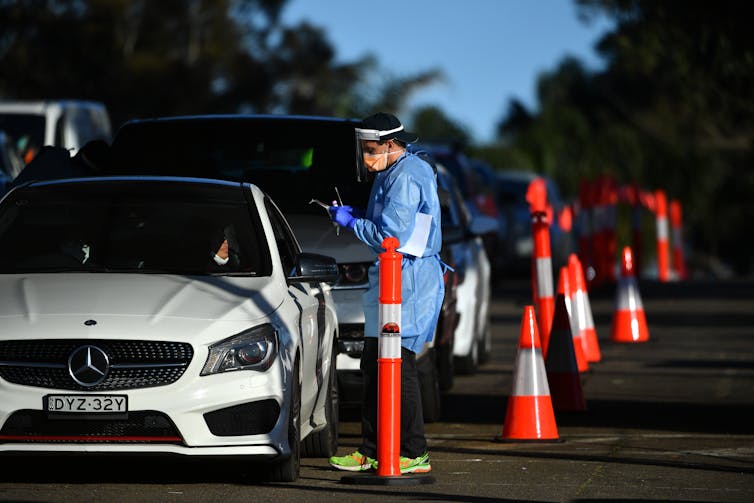 The Delta variant has changed the game.
Joel Carrett/AAP
The Delta variant has changed the game.
Joel Carrett/AAP
There’s been concern in Europe[27] infection with the Delta variant may be leading to a greater proportion of younger people being hospitalised and treated in intensive care compared to earlier in the pandemic. Data from Switzerland[28] show people being admitted to ICU are on average five years younger, have a higher body-mass index, and are presenting with more severe lung failure.
How much of this is due to the change in the virus and how much is because older adults are increasingly vaccinated remains to be determined.
Read more: Why is Delta such a worry? It's more infectious, probably causes more severe disease, and challenges our vaccines[29]
Some reassurance
Despite the increased transmission and what appears to be increased severity of infection with the Delta variant, protection from vaccines is holding up. Certainly both the Pfizer and the AstraZeneca shots continue to be very effective[30] at preventing severe illness and death.
The take home message, though, is that nobody is safe from COVID-19. Serious infection, and even death, can occur at any age; we can’t predict this.
Until we’ve vaccinated enough people in Australia we will need to take care and follow the public health advice, such as social distancing and wearing a mask. This is just as important if you’re 20 as it is if you’re 80.
References
- ^ a 27-year-old man (amp.smh.com.au)
- ^ 38-year-old woman (amp.9news.com.au)
- ^ young people (www.theguardian.com)
- ^ overseas (smw.ch)
- ^ June 13 and July 17 (www.health.nsw.gov.au)
- ^ the elderly (www.bmj.com)
- ^ other infectious diseases (www.thelancet.com)
- ^ review (link.springer.com)
- ^ Does anyone know what your wishes are if you're sick and dying from coronavirus? (theconversation.com)
- ^ and overseas (www.cdc.gov)
- ^ 20 to 29-year-olds (www.health.gov.au)
- ^ 67% of new cases (www.smh.com.au)
- ^ it’s been acknowledged (jamanetwork.com)
- ^ Shutterstock (www.shutterstock.com)
- ^ chronic illness (www.cdc.gov)
- ^ being obese (www.acpjournals.org)
- ^ in younger people (pubmed.ncbi.nlm.nih.gov)
- ^ COVID-19 cases are highest in young adults. We need to partner with them for the health of the whole community (theconversation.com)
- ^ 27% of 19 to 29-year-olds (www.thelancet.com)
- ^ 14% of patients (www.ncbi.nlm.nih.gov)
- ^ sudden deterioration and death (www.heartrhythmjournal.com)
- ^ long COVID (www.nhs.uk)
- ^ Norwegian study (covid19.elsevierpure.com)
- ^ 60% more transmissible (www.bmj.com)
- ^ through schools (www.bmj.com)
- ^ school transmission (www.nature.com)
- ^ Europe (smw.ch)
- ^ Switzerland (smw.ch)
- ^ Why is Delta such a worry? It's more infectious, probably causes more severe disease, and challenges our vaccines (theconversation.com)
- ^ very effective (www.gov.uk)