Beyond the ratings, NBC's Olympics telecast showed video's future
- Written by: Michael J. Socolow, Associate Professor, Communication and Journalism, University of Maine
NBC’s Olympic Games programming from Tokyo has proved a historic success[1].
Perhaps you’ve heard otherwise. Much reporting focused upon the decline[2] in traditional Olympic TV ratings. On Twitter, Washington Post media reporter Paul Farhi went so far as to call the precipitous viewership decline a “catastrophic” development[3] for NBC.
Ratings still matter. But focusing narrowly on ratings mistakenly applies a 20th-century audience metric to a 21st-century event. The classic audience measurement can’t conclusively determine NBC’s success. In evaluating the Tokyo Games by traditional TV measures, critics miss NBC’s insight about how media consumption is changing[4].
No TV programming other than the Olympics assembles almost 17 million viewers[5], every night, for two weeks, as the Tokyo Games did. Even if NBC ends up re-airing ads at no charge to make up for lower-than-expected on-air ratings, network officials remained confident[6] that the Olympics coverage would be profitable. That’s no surprise, as NBC signed up more “premium advertisers” than in 2016 and set a record in advance advertising sales[7], with US$1.25 billion booked before the torch was lit.
Yet broadcast television comprised only one component of NBC’s distribution mix. The Tokyo Games provided enormous amounts of video content divorced from a single channel. Americans watched on phones, on laptops, through cable partners such as NBC owner Comcast and via streaming apps – as well as on traditional broadcast TV. Viewers shared clips across social media, providing free promotion and clicks, and, though the data is not yet available, it’s likely that many purchased subscriptions[8] directly from NBC’s Peacock TV streaming service. Streaming on the Peacock app showed a 24% rise over 2016[9], and at one point, the app reached its largest audience ever[10].
With a few rare exceptions, the Olympics have historically been profitable for U.S. broadcasters while giving viewers a glimpse of the future of media. As my research on Olympic broadcasting[11] has[12] detailed, media innovations that eventually become commonplace are often first introduced at the Games.
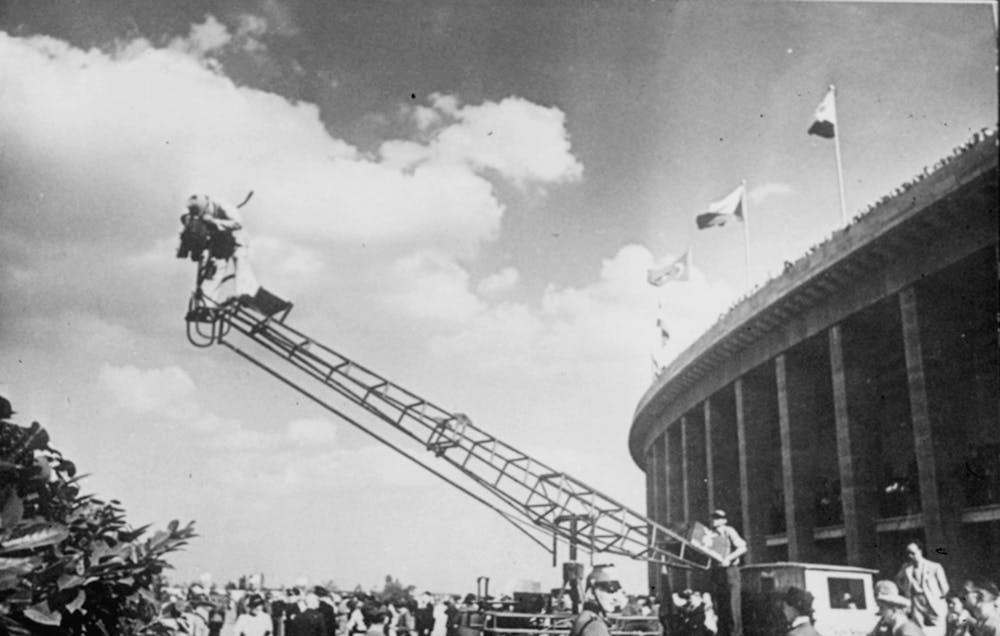 In 1936, cameras transmitted live images of the Olympic Games to viewing rooms elsewhere in the host city of Berlin.
AP Photo[13]
In 1936, cameras transmitted live images of the Olympic Games to viewing rooms elsewhere in the host city of Berlin.
AP Photo[13]
The Olympics and video innovation
Since 1936, the Olympic Games have demonstrated the future of video distribution. The Berlin Games that year were distributed on the world’s first regularly scheduled television service. Although the images beamed into theaters around Berlin turned out to be largely disappointing due to lighting and technical issues, viewers were amazed at being able to observe an event occurring miles away in real time.
Perhaps the most innovative Olympic broadcast occurred in 1968, when ABC employed several new technologies in Mexico City. Color TV cameras had, until then, been bulky and onerous to use outside a studio, but ABC engineers introduced a new, smaller color camera at the Games[14].
Perhaps more important, the experimental stage of live intercontinental satellite video relay that had begun in the early 1960s[15] concluded successfully when the Mexico City Olympics showed it was possible to provide live intercontinental satellite programming over two full weeks of events. The future of watching events, in color[16] and beamed from around the planet as they occurred, had arrived.
The broadcasting of the Barcelona Games in 1992 was the first global TV programming to provide two full signals for every event[17] – one in high definition and one standard. I worked for Radio Televisión Olímpica at the baseball venue that year, and I remember watching Japanese announcers installing specialized HD equipment because NHK, Japan’s Olympic broadcaster, was the only organization making full use of HDTV[18] in 1992. I recall being dazzled by the clarity of the NHK signal.
NBC first tried selling broadcast service directly to viewers from Barcelona. The package was called “Olympics Triplecast[19],” and it offered three channels of 24-hour coverage for $29.95 per day, or $125 for the whole two weeks. Olympics Triplecast was widely considered a failure[20], as U.S. audiences – habituated by decades of free Olympic TV coverage – balked at payment.
With the arrival of subscription streaming, it appears Triplecast wasn’t so much a failure as too early[21]. With the collapse of advertising-supported media and the rise of streaming services training audiences to pay for content, it appears the media market has arrived at the place NBC envisioned in 1992.
NBC’s YouTube channel and Peacock app carried huge amounts of Olympics coverage not measured by traditional television ratings.The audience paradox: Fewer viewers, more profits
Traditional commercial broadcasting was simple: Higher ratings generally created more advertiser demand, resulting in more expensive commercials and increased profitability. Yet even this basic model was slightly wrong – as scholars have shown, ad agencies and networks always measured audiences by demographic characteristics[22]. Not all viewers were equal, as some programs with smaller audiences commanded higher prices because they moved consumer products more effectively. In general, however, the larger the audience, the higher the price.
But when alternatives – first cable TV, then the web and now social media – began siphoning off viewers, the old model transformed. Ratings declined everywhere, as additional options made concentrating the traditional mass audience for even huge events, like the Academy Awards, more difficult.
[_Get The Conversation’s most important politics headlines, in our Politics Weekly newsletter[23].]
An ironic phenomenon then emerged: A few select video spectacles could defy the decline and make more money, even while losing viewers. The Olympics proved the most successful example, as NBC’s ratings from 2012 to 2016 declined about 15%[24], yet the 2016 Rio Games produced the network’s record profit for an Olympics[25], $250 million.
This seems a paradox: How could smaller audiences lead to more ad revenue? The answer lies in the concept of scarcity, and the evolution of media. With so many options to choose from, programs that are able to assemble mass audiences – even if those audiences are smaller and shrinking – became more valuable precisely because there are so few of them.
That’s how NBC keeps selling the Games so effectively. It knows its primary customers are ad agencies, not viewers. And ad agencies understand the scarcity of the Olympic opportunity.
The other way NBC is generating profitability involves selling Olympic programming directly to viewers. The Olympics now consist of video content, not a television show. Success, for NBC, can’t be accurately measured until the number of paid Peacock TV subscriptions is fully tabulated and the quadrennial bump in adjacent NBC non-Olympic programming is known. The Olympics traditionally lifts everything on the network, from The Today Show to NBC Nightly News[26]. NBC monetizes the Games in ways that many critics don’t seem to consider.
If paid Peacock TV subscriptions[27] do well, then we’ll all likely remember the Tokyo Games as the evolutionary moment when many Americans first realized they would need to pay up to watch live sports. “The future is now[28]” was Hall of Fame NFL coach George Allen’s favorite saying, and when it comes to the economics of live sports programming, the Tokyo Olympics show that we’ve arrived.
References
- ^ a historic success (www.hollywoodreporter.com)
- ^ focused upon the decline (www.nytimes.com)
- ^ a “catastrophic” development (twitter.com)
- ^ media consumption is changing (sports.yahoo.com)
- ^ almost 17 million viewers (www.nytimes.com)
- ^ remained confident (www.bloomberg.com)
- ^ set a record in advance advertising sales (www.adweek.com)
- ^ many purchased subscriptions (www.hollywoodreporter.com)
- ^ 24% rise over 2016 (www.bloomberg.com)
- ^ reached its largest audience ever (slate.com)
- ^ my research on Olympic broadcasting (www.press.uillinois.edu)
- ^ has (scholar.google.com)
- ^ AP Photo (newsroom.ap.org)
- ^ ABC engineers introduced a new, smaller color camera at the Games (stillmed.olympic.org)
- ^ begun in the early 1960s (www.bbc.com)
- ^ in color (www.teamusa.org)
- ^ first global TV programming to provide two full signals for every event (tech.ebu.ch)
- ^ the only organization making full use of HDTV (www.nhk.or.jp)
- ^ Olympics Triplecast (www.youtube.com)
- ^ widely considered a failure (www.latimes.com)
- ^ Triplecast wasn’t so much a failure as too early (thestreamable.com)
- ^ measured audiences by demographic characteristics (www.fordhampress.com)
- ^ Get The Conversation’s most important politics headlines, in our Politics Weekly newsletter (theconversation.com)
- ^ declined about 15% (www.wsj.com)
- ^ record profit for an Olympics (money.cnn.com)
- ^ The Today Show to NBC Nightly News (www.yahoo.com)
- ^ paid Peacock TV subscriptions (www.bloomberg.com)
- ^ The future is now (voices.washingtonpost.com)
Read more https://theconversation.com/beyond-the-ratings-nbcs-olympics-telecast-showed-videos-future-165856