Students who are more adaptable do best in remote learning – and it's a skill we can teach
- Written by: Andrew J. Martin, Scientia Professor and Professor of Educational Psychology, UNSW
The speed and scale[1] of the shift to remote online learning during the COVID-19 pandemic has really tested students’ adaptability. Our study[2] of more than 1,500 students at nine Australian high schools during 2020 found strong links between their level of adaptability and how they fared with online learning.
Students with higher adaptability were more confident about online learning in term 2. And they had made greater academic progress by term 4.
The important thing about these findings is that adaptability is a teachable skill. Later in this article we discuss how to teach students to be more adaptable.
What is adaptability and why does it matter?
We have been investigating adaptability[3] for more than a decade. The term refers to adjustments to one’s behaviours, thoughts and feelings in response to disruption.
The pandemic certainly tested every student’s capacity to adjust to disruption. The switch to remote learning involved huge change and uncertainty.
Research has demonstrated positive links between adaptability and students’ engagement and achievement at school[4] and university[5]. As for online learning, the picture is complicated by the many factors identified[6] as affecting its success. These include access to technology, academic ability, instructional quality, socioeconomic status, ethnicity and specific learning support needs.
The pandemic disruptions added to this complexity.
What did the study find?
Our latest study[7] involved a survey of 1,548 students in nine schools in 2020. It covered a period of fully or partially remote online learning in maths (from the start of term 2).
We used the Adaptability Scale[8] to assess how much students were able to respond to disruption in their lives. They were presented with nine statements, such as “To assist me in a new situation, I am able to change the way I do things.” Students were asked to respond on a scale of 1 (strongly disagree) to 7 (strongly agree).
They also answered questions about:
their confidence as online learners
online learning barriers such as unreliable internet, inadequate computing/technology, and lack of a learning area to concentrate
online learning support, such as satisfaction with the online learning platform
home support, such as help from parents and others.
In the term 2 survey, we tested students’ maths achievement. In term 4, they did a second maths test.
We found students with higher adaptability were significantly more confident about online learning in term 2. These students also had higher gains in achievement in term 4. Online learning confidence in term 2 was linked to term 4 achievement gains.
After allowing for the many other factors affecting online learning, we found adaptability had a direct positive impact on student achievements.
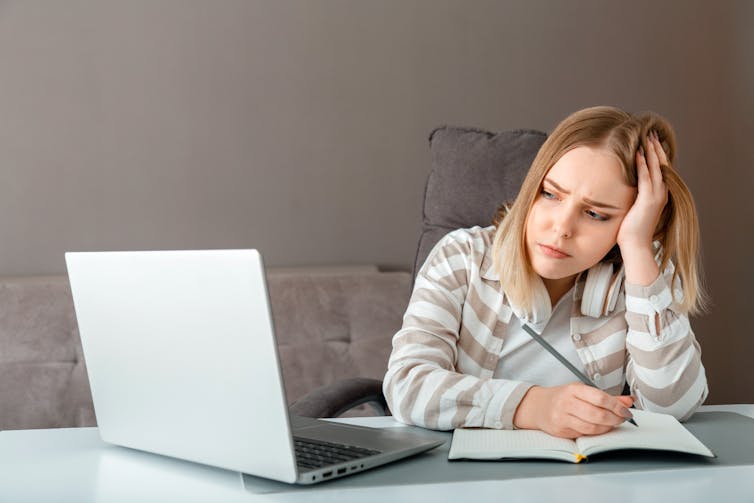 Students who lacked adaptability tended to be less confident about online learning and it showed in their results.
Shutterstock[9]
Students who lacked adaptability tended to be less confident about online learning and it showed in their results.
Shutterstock[9]
Online learning support and online learning barriers also affected students’ online learning confidence. Support was linked to higher confidence, and barriers to lower confidence.
Thus, as well as focusing on increasing students’ adaptability, parents and schools should strive to minimise barriers to online learning and optimise supports.
So how do you teach students to be adaptable?
Boosting adaptability involves teaching students[10] how to adjust their behaviour, thinking and feelings to help them navigate disruption. For example, in the face of new online learning tasks and demands, we could explain to students how to:
adjust their behaviour by seeking out online information and resources, or asking for help — an example would be asking a teacher to help with an unfamiliar online learning management system such as Canvas or Moodle
adjust their attitude by thinking about the new online task in a different way — for instance, they might consider the new opportunities the task offers, such as developing new skills that can be helpful in other parts of their lives
adjust their emotion by minimising negative feelings, or shifting the focus to positive feelings, when engaged in unfamiliar activities — for example, they might try not to focus on their disappointment when the teacher’s approach to online learning doesn’t match the student’s preferences or skill set.
 Students can be taught to adjust their responses so they don’t dwell too long on the negatives but deliberately focus on more positive feelings and actions.
Shutterstock[11]
Students can be taught to adjust their responses so they don’t dwell too long on the negatives but deliberately focus on more positive feelings and actions.
Shutterstock[11]
Adaptability is a skill for life
Of course, these adjustments are helpful for navigating all sorts of disruption. Teaching young people adaptability gives them a skill for life.
It can be helpful to let students know that the three adjustments are part of a broader adaptability process[12] — and they have control over each point in the process. The process involves:
teaching students how to recognise important disruptions to their life so they know when to adjust their behaviour, thinking and feelings
explaining to students the various ways they can make these adjustments to navigate the disruption (using strategies like those described above)
encouraging students to take note of the positive effects of these adjustments so they realise the benefits of adaptability and are motivated to adapt in future
inspiring students to practise their adjustments to behaviour, thinking and feelings so adaptability becomes a routine part of their lives.
It is fair to say adaptability comes more easily to some students than others. However, our longitudinal research among high school students has shown adaptability can and does change[13] over time. It is a modifiable personal attribute. This is great news.
In the face of massive disruptions by COVID-19, we are constantly advised to adjust to a “new normal”. Part of this new normal is the increasing presence of online learning. Our findings show adaptability is an important personal attribute that can help students in their online learning during the pandemic — and likely beyond.
References
- ^ speed and scale (www.science.org.au)
- ^ Our study (www.researchgate.net)
- ^ investigating adaptability (www.researchgate.net)
- ^ at school (www.researchgate.net)
- ^ university (www.researchgate.net)
- ^ many factors identified (www.aitsl.edu.au)
- ^ latest study (www.researchgate.net)
- ^ Adaptability Scale (www.researchgate.net)
- ^ Shutterstock (www.shutterstock.com)
- ^ teaching students (www.researchgate.net)
- ^ Shutterstock (www.shutterstock.com)
- ^ adaptability process (www.researchgate.net)
- ^ adaptability can and does change (www.researchgate.net)