Children need playgrounds now, more than ever. We can reduce COVID risk and keep them open
- Written by: Sharon Goldfeld, Director, Center for Community Child Health Royal Children's Hospital; Professor, Department of Paediatrics, University of Melbourne; Theme Director Population Health, Murdoch Children's Research Institute
It’s been a tough 18 months for Australian families and their children. We can’t underestimate the cumulative impact of parent and carer job losses, mental strain, working from home and remote learning. As developmental paediatricians we are increasingly concerned about how these have affected children’s development.
As a result of pandemic restrictions, children all over the world[1] are doing significantly less physical activity[2], and spending more time[3] sitting[4]. This is one reason playgrounds are so important for children right now.
Play is vital[5] for children. It improves their learning[6], as well as social and physical development. Play also encourages development of coping skills[7], which are critical in times of crisis.
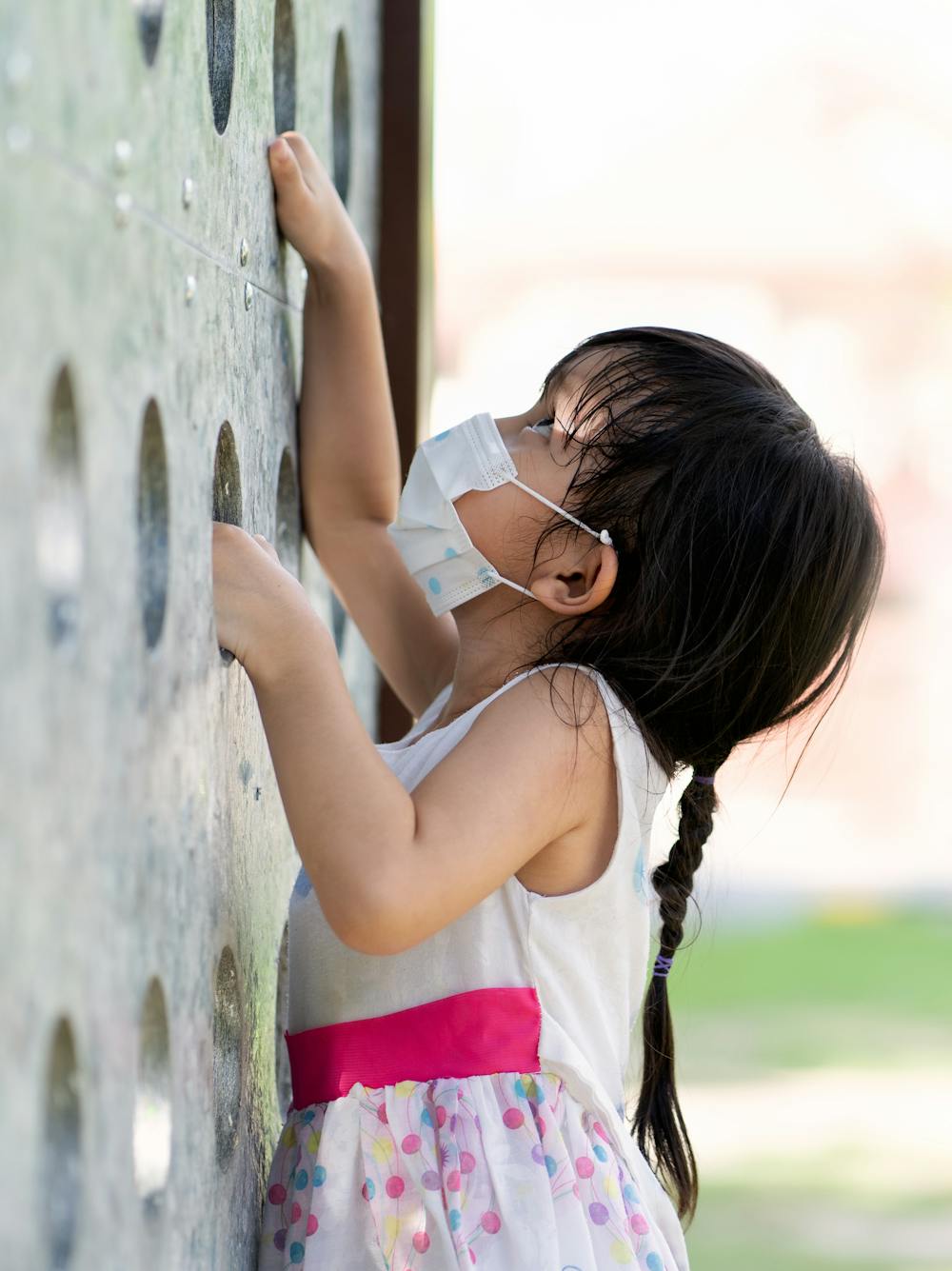 In these uncertain times, play can give kids a sense of normalcy.
Shutterstock[8]
In these uncertain times, play can give kids a sense of normalcy.
Shutterstock[8]
In these uncertain and restrictive times, playing outdoors also gives kids some sense of normalcy[9].
Victoria closed outdoor playgrounds last week[10] due to concerns about potential transmission. Closing playgrounds particularly impacts children living in medium- and high-density housing, with limited access to outdoor play spaces. These children tend to fall into lower-income brackets[11] and are already more vulnerable to the effects of social isolation.
While there may be some risks to keeping playgrounds open, these must be appropriately balanced with the overwhelming benefits playgrounds have for children’s development. There are certain precautions we can take to reduce the risk of COVID-19 transmission in playgrounds.
What’s the research on playgrounds and transmission?
To date, few studies have looked at the specific role of playgrounds in the transmission of SARS-CoV-2, the virus that causes COVID-19. We found none that have been conducted with the Delta (B.1.617.2) variant.
Three studies focused on surface contamination — in Israel[12], Brazil[13] and Indonesia[14]. Some samples of playground surfaces (two out of 25 in the Israeli study) tested positive. The Brazil study (which collected samples in February 2021) identified toilets, ATMs, handrails, playground, and outdoor gym equipment as having the highest rates of viral contamination of all surfaces studied.
Read more: High priority: why we must vaccinate children aged 12 and over now[15]
But while the virus has been found on the surfaces, there was no clear evidence of whether this has led to transmission in playgrounds. The Indonesian study suggested transmission may be more likely if children share food or drinks. However, that study only looked at journals published in 2019 and 2020, so that doesn’t account for Delta.
 There is evidence for surface contamination in playgrounds, but not transmission.
Shutterstock[16]
There is evidence for surface contamination in playgrounds, but not transmission.
Shutterstock[16]
Two studies examined transmission in parks. In the United Kingdom[17] (with data collected June to November 2020) with two main findings. Less movement of people was associated with decreased transmission. This supported lockdowns. But the study also noted outdoor park use was associated with decreased case rates, especially in urban areas with low green space availability (including areas of higher density living). This is because parks offer an alternative to indoor spaces where transmission is higher. If parks close, then people congregate more indoors.
In the United States[18] (with data collected March to May 2020), park use increased with school closures. Interestingly, this was not associated with growth of COVID-19 levels, either at the time or in the following weeks.
So, there is surface contamination, but no published evidence of transmission. And outdoor use of parks is not necessarily associated with more cases. And in high density areas parks are an important space.
With the right strategies, we can minimise the risks in playgrounds while ensuring children don’t miss out on the vital need for play in a time of heightened stress and uncertainty.
We can keep playgrounds safe
Access to outdoor play[19] is essential for healthy child development. Indoor play does not appear[20] to equate with outdoor play in terms of benefits.
Read more: Are the kids alright? Social isolation can take a toll, but play can help[21]
To keep playgrounds safe for children, we must ensure children are central to our thinking. Both the United Kingdom[22] and the US offer guidelines[23] for COVID-safe playgrounds. These include play equipment being cleaned regularly, and children maintaining a distance of six feet (around 2 metres) from each other (clearly where possible).
Similar recommendations have been proposed in Australia[24]:
check current restrictions
stay home if unwell
socially distance
use disinfectant wipes on equipment
sanitise hands
avoid using shared taps or water fountains
remind children to avoid touching their faces
try to prevent physical contact between children as much as possible
avoid sharing toys
use the playground outside peak periods.
Read more: Heading back to the playground? 10 tips to keep your family and others COVID-safe[25]
Some of these are easy to implement than others but point to the need for thinking through what we could do in playgrounds to keep them safe and open.
Anecdotally, early childhood and school teachers, particularly in low income areas, are seeing children with less social, coping and physical skills after 18 months of recurrent lockdowns — a significant proportion of preschool children’s whole lives.
Paediatricians are seeing families where the parents are confused and frightened to take their children to playgrounds, even when lockdown closures end. Recurrent playground closures add to these fears.
Finally we need adults to help. They must also follow the restrictions in their state or territory. These include adhering to gathering limits, wearing face masks and socially distancing. In the COVID-19 world we will need to safeguard our children’s health and their development.
References
- ^ children all over the world (www.frontiersin.org)
- ^ physical activity (pubmed.ncbi.nlm.nih.gov)
- ^ spending more time (www.ncbi.nlm.nih.gov)
- ^ sitting (pubmed.ncbi.nlm.nih.gov)
- ^ vital (theconversation.com)
- ^ improves their learning (theconversation.com)
- ^ development of coping skills (link.springer.com)
- ^ Shutterstock (www.shutterstock.com)
- ^ sense of normalcy (onlinelibrary.wiley.com)
- ^ closed outdoor playgrounds last week (www.theage.com.au)
- ^ fall into lower-income brackets (www.frontiersin.org)
- ^ Israel (www.cambridge.org)
- ^ Brazil (www.medrxiv.org)
- ^ Indonesia (ejournal.lucp.net)
- ^ High priority: why we must vaccinate children aged 12 and over now (theconversation.com)
- ^ Shutterstock (www.shutterstock.com)
- ^ United Kingdom (covid-19.cochrane.org)
- ^ United States (ideas.repec.org)
- ^ outdoor play (www.mdpi.com)
- ^ does not appear (ijbnpa.biomedcentral.com)
- ^ Are the kids alright? Social isolation can take a toll, but play can help (theconversation.com)
- ^ United Kingdom (www.gov.uk)
- ^ US offer guidelines (www.cdc.gov)
- ^ have been proposed in Australia (theconversation.com)
- ^ Heading back to the playground? 10 tips to keep your family and others COVID-safe (theconversation.com)