What is ISIS-K? Two terrorism experts on the group behind the deadly Kabul airport attack and its rivalry with the Taliban
- Written by: Amira Jadoon, Assistant Professor at the Combating Terrorism Center, United States Military Academy West Point
An attack on a crowd[1] gathered outside Kabul’s airport on Aug. 26, 2021, has left at least 100 people dead, including at least 13[2] U.S. troops. ISIS-K claimed responsibility[3] for the coordinated suicide bomb and gun assault, which came just days after President Joe Biden warned[4] that the group – an affiliate of the Islamic State group operating in Afghanistan – was “seeking to target the airport and attack U.S. and allied forces and innocent civilians.”
Amira Jadoon, a terrorism expert at the U.S. Military Academy West Point[5], and Andrew Mines, a research fellow at the George Washington University’s Program on Extremism[6], have been tracking ISIS-K for years and answered our questions about who the terrorist group is, and the threat it poses in a destabilized Afghanistan.
Who is ISIS-K?
The Islamic State Khorasan Province, which is also known by the acronyms ISIS-K, ISKP and ISK, is the official affiliate of the Islamic State movement operating in Afghanistan, as recognized[7] by Islamic State core leadership in Iraq and Syria.
ISIS-K was officially founded in January 2015. Within a short period of time, it managed to consolidate territorial control in several rural districts in north[8] and northeast[9] Afghanistan, and launched a lethal campaign across Afghanistan and Pakistan. Within its first three years, ISIS-K launched attacks[10] against minority groups, public areas and institutions, and government targets in major cities across Afghanistan and Pakistan.
By 2018, it had become one of the top four deadliest terrorist organizations[11] in the world, according to the Institute for Economics and Peace’s Global Terrorism Index.
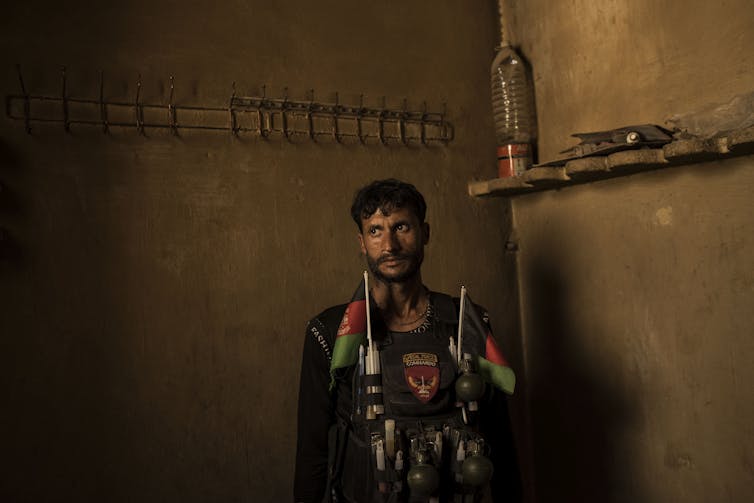 An Afghan soldier surveys a former ISIS-K jail in Nangarhar province, eastern Afghanistan.
Andrew Renneisen/Getty Images
An Afghan soldier surveys a former ISIS-K jail in Nangarhar province, eastern Afghanistan.
Andrew Renneisen/Getty Images
But after suffering major territorial, leadership and rank-and-file losses[12] to the U.S.-led coalition and its Afghan partners – which culminated in the surrender[13] of over 1,400 of its fighters and their families to the Afghan government in late 2019 and early 2020 – the organization was declared, by some, to be defeated[14].
Can you tell us a little more about the group’s background?
ISIS-K was founded[15] by former members of the Pakistani Taliban, Afghan Taliban and the Islamic Movement of Uzbekistan. Over time, though, the group has poached militants from various other groups.
One of the group’s greatest strengths is its ability to leverage the local expertise of these fighters and commanders. ISIS-K first started to consolidate territory in the southern districts of Nangarhar[16] province, which sits on Afghanistan’s northeast border with Pakistan and is the site of al-Qaida’s former stronghold in the Tora Bora area.
ISIS-K used its position on the border to garner supplies and recruits from Pakistan’s tribal areas, as well as the expertise of other local groups with which it forged operational alliances[17].
Substantial evidence shows that the group has received money[18], advice, and training[19] from the Islamic State group’s core organizational body in Iraq and Syria. Some experts[20] have placed those figures in excess of US$100 million.
What are its aims and tactics?
ISIS-K’s general strategy is to establish a beachhead for the Islamic State movement to expand its so-called caliphate to Central and South Asia.
It aims to cement itself as the foremost jihadist organization in the region, in part by seizing the legacy of jihadist groups that came before it. This is evident in the group’s messaging, which appeals to veteran jihadist fighters as well as younger populations in urban areas[21].
Like the group’s namesake in Iraq and Syria, ISIS-K leverages the expertise of its personnel and operational alliances[22] with other groups to carry out devastating attacks. These attacks target minorities like Afghanistan’s Hazara[23] and Sikh[24] populations, as well as journalists[25], aid workers[26], security personnel and government infrastructure.
ISIS-K’s goal is to create chaos and uncertainty in a bid to push disillusioned fighters from other groups into their ranks, and to cast doubt on any ruling government’s ability to provide security for the population.
What relationship does ISIS-K have with the Taliban?
ISIS-K sees the Afghan Taliban as its strategic rivals. It brands the Afghan Taliban as “filthy nationalists[27]” with ambitions only to form a government confined to the boundaries of Afghanistan. This contradicts the Islamic State movement’s goal of establishing a global caliphate.
Since its inception, ISIS-K has tried to recruit Afghan Taliban members while also targeting Taliban positions throughout the country.
ISIS-K’s efforts have met with some success, but the Taliban have managed to stem the group’s challenges by pursuing attacks and operations[28] against ISIS-K personnel and positions.
These clashes have often occurred[29] in tandem with U.S. and Afghan air power and ground operations against ISIS-K, although the full extent to which these operations were coordinated is still unclear.
What is clear is that the majority of ISIS-K’s manpower and leadership losses[30] were the result of U.S. and Afghan-led operations, and American air strikes in particular.
How much of a threat is ISIS-K in Afghanistan and to the international community?
As a relatively weakened organization, ISIS-K’s immediate goals are to replenish its ranks and signal its resolve through high-profile attacks. Doing so can help ensure that the group doesn’t become an irrelevant player in the Afghanistan-Pakistan landscape. It is interested in attacking U.S. and allied partners abroad, but the extent to which the group is able to inspire and direct attacks against the West is an issue that has divided the U.S. military and intelligence community[31].
In Afghanistan, however, ISIS-K has proved itself to be a much greater threat. In addition to its attacks against Afghan minorities and civilian institutions, the group has targeted international aid workers[32], land-mine removal efforts[33] and even tried to assassinate[34] the top U.S. envoy to Kabul in January 2021.
It is still too early to tell how the U.S. withdrawal from Afghanistan will benefit ISIS-K, but the attack on the Kabul airport shows the continued threat posed by the group.
In the short term, ISIS-K will likely continue its efforts to sow panic and chaos, disrupt the withdrawal process and demonstrate that the Afghan Taliban are incapable of providing security to the population.
If the group is able to reconstitute some level of territorial control in the longer term and recruit more fighters, it will most likely be poised to make a comeback and pose threats on the national, regional and international levels.
Editor’s note: This story was updated at 8 a.m. EST on Aug. 27, 2021 to reflect the latest information on casualties at that time.
[This week in religion, a global roundup each Thursday. Sign up.[35]]
References
- ^ attack on a crowd (www.nytimes.com)
- ^ at least 13 (apnews.com)
- ^ claimed responsibility (www.reuters.com)
- ^ President Joe Biden warned (deadline.com)
- ^ terrorism expert at the U.S. Military Academy West Point (www.westpoint.edu)
- ^ research fellow at the George Washington University’s Program on Extremism (extremism.gwu.edu)
- ^ recognized (www.ctc.usma.edu)
- ^ north (www.afghanistan-analysts.org)
- ^ northeast (www.afghanistan-analysts.org)
- ^ attacks (ctc.usma.edu)
- ^ top four deadliest terrorist organizations (www.visionofhumanity.org)
- ^ territorial, leadership and rank-and-file losses (ctc.usma.edu)
- ^ surrender (undocs.org)
- ^ defeated (www.washingtonpost.com)
- ^ ISIS-K was founded (www.ctc.usma.edu)
- ^ southern districts of Nangarhar (www.afghanistan-analysts.org)
- ^ operational alliances (ctc.usma.edu)
- ^ money (www.undocs.org)
- ^ advice, and training (www.hurstpublishers.com)
- ^ experts (www.hurstpublishers.com)
- ^ urban areas (www.usip.org)
- ^ operational alliances (ctc.usma.edu)
- ^ Hazara (www.forbes.com)
- ^ Sikh (www.theguardian.com)
- ^ journalists (www.nytimes.com)
- ^ aid workers (www.theguardian.com)
- ^ filthy nationalists (www.afghanistan-analysts.org)
- ^ attacks and operations (www.afghanistan-analysts.org)
- ^ occurred (www.washingtonpost.com)
- ^ manpower and leadership losses (ctc.usma.edu)
- ^ an issue that has divided the U.S. military and intelligence community (www.nytimes.com)
- ^ international aid workers (www.independent.co.uk)
- ^ land-mine removal efforts (thediplomat.com)
- ^ assassinate (www.cnn.com)
- ^ Sign up. (theconversation.com)