Universities lost 6% of their revenue in 2020 — and the next 2 years are looking worse
- Written by: Peter Hurley, Policy Fellow, Mitchell Institute, Victoria University
With a 6% drop in revenue, 2020 was a year Australian universities would prefer to forget, a report released today by the Mitchell Institute shows.
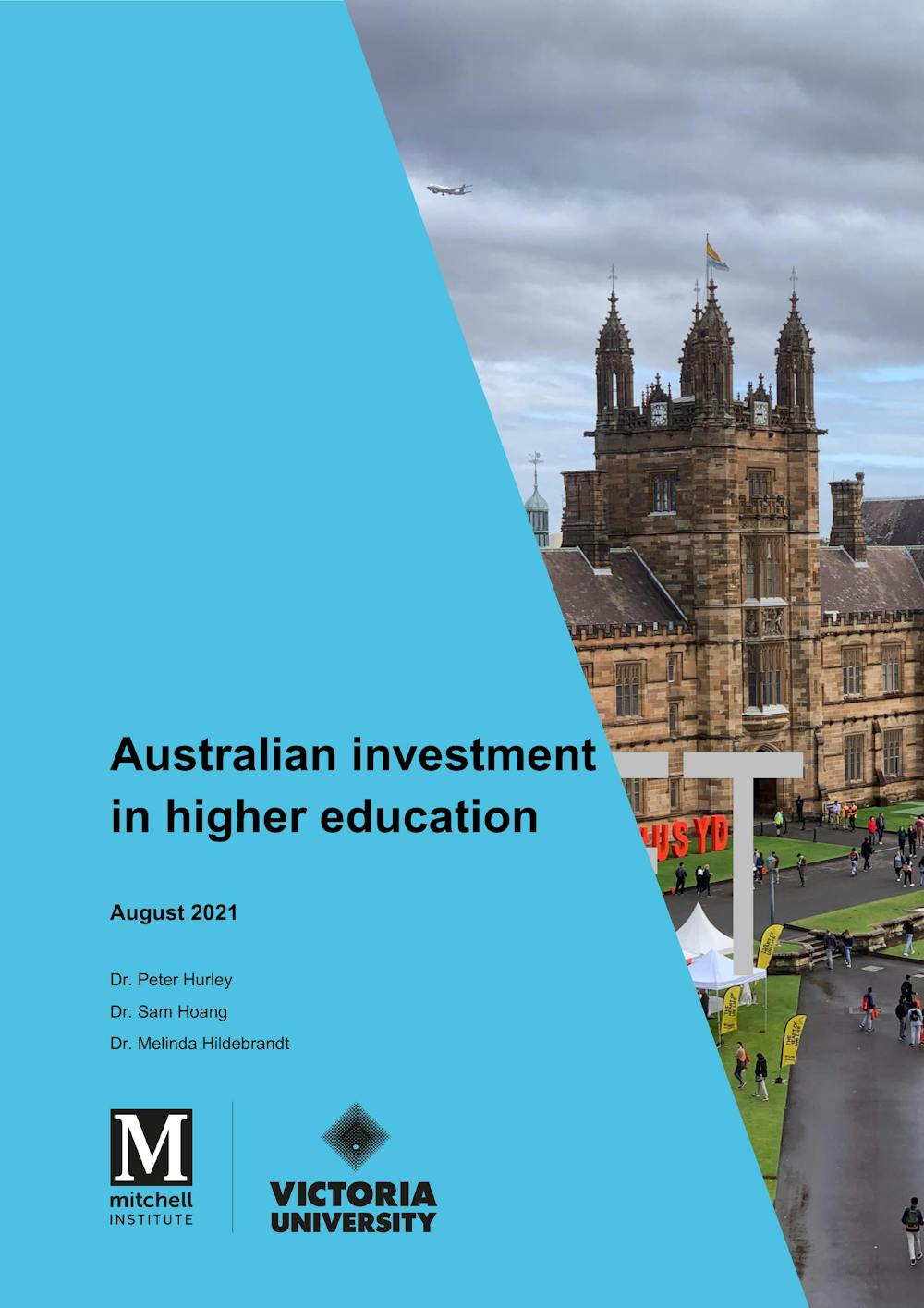 Mitchell Institute report into investment in higher education.
The report, Australian investment in higher education[1], analyses over a decade of data to trace changes in university policy and the impact of the COVID-19 pandemic. It shows university revenue fell by A$2.2 billion, down 6% from 2019. Operating surpluses across the sector fell by A$1.6 billion.
The main cause of the falls was reduced international student revenue and income from investments, such as dividends.
The silver lining to the clouds over 2020 was the losses were not as bad as expected. But our analysis points to some very dark clouds on the horizon for Australia’s universities.
Special government support[2] for the sector ends in 2021[3]. Continuing border closures mean international student revenue is likely to keep falling.
In 2022 and 2023, universities will have to navigate some of the most challenging conditions they have ever faced.
Read more: As hopes of international students' return fade, closed borders could cost $20bn a year in 2022 – half the sector's value[4]
Decades of strong revenue growth ended abruptly
Universities had experienced an almost unbroken run of growth[5] in revenue since 1995. The chart below shows increases in total revenue from 2009 to 2019, before the pandemic caused a fall in 2020.
There are two main reasons for the growth universities experienced.
The first was the introduction of demand-driven funding in 2012. This uncapped the number of government-funded places for domestic students. The result was increases in enrolments.
The second was the growth in international student numbers.
By 2020, both these sources of growth had come to a halt. However, investment income was the biggest contributor to the drop in revenue in 2020, falling by A$1.1 billion compared to 2019.
As the chart below shows, the combined impact of these factors meant university surpluses fell.
In 2020, operating results across the sector were a total surplus of A$680 million, a 1.6% margin. This is well below the 6% margin[6] generally considered to be financially prudent.
Fifteen of the 38 universities included in the analysis reported a deficit in 2020. Operating surpluses were concentrated in the three largest universities – Monash (A$267 million), Melbourne (A$178 million)[7] and Sydney (A$107 million)[8].
The extent of losses and shrinking surpluses in 2020 suggests the pandemic has already made it difficult for universities to cope with further falls in revenue forecast for 2021 and beyond.
Read more: Which universities are best placed financially to weather COVID?[9]
What has happened to international student revenue?
In the short term, the greatest challenge universities face is continuing problems with enrolling international students. Since 2015, revenue from this source had almost doubled. In 2019, it totalled about A$10 billion.
In 2020, international student revenue fell in real terms by A$868 million, or 8.6%, to A$9.2 billion.
This fall was less than expected. We suggest the timing of border closures and students deferring their courses[10] (but remaining enrolled) mean it has taken time for the disruption to international student enrolments to be fully felt.
The chart below shows how international student enrolments at universities began to fall in 2020. By December 2020, trend levels were about 10% below what they were in December 2019.
As the pandemic progresses, the drop in international enrolments is accelerating. In the first six months of 2021, international student enrolments at public higher education institutions fell at an annualised trend rate of between 20% and 24%.
Read more: Australia's international education market share is shrinking fast. Recovery depends on unis offering students a better deal[11]
This suggests every missed six-monthly intake of international students is collectively costing universities about A$1 billion to A$1.2 billion.
What lies ahead?
With border closures set to continue, universities face a difficult future.
Federal government support[12] of an extra A$1 billion in research funding is due to finish in 2021.
The Job-Ready Graduates Package[13] introduced in 2020 means universities are likely to be asked to enrol more domestic students for less money[14] if they wish to maintain government funding levels.
Our report highlights that Australian universities have increasingly been encouraged to collect fee-for-service and commercial revenue. Government support as a proportion of total revenue has fallen.
Read more: Big-spending 'recovery budget' leaves universities out in the cold[15]
This has made universities more vulnerable to economic shocks, like the one caused by the pandemic and international border closures.
Universities play very important roles in Australia’s society and economy. Without further support, parts of the university sector are likely to face very difficult choices that will mean further cuts to staffing[16], courses[17] and research[18].
References
- ^ Australian investment in higher education (www.vu.edu.au)
- ^ government support (www.dese.gov.au)
- ^ ends in 2021 (theconversation.com)
- ^ As hopes of international students' return fade, closed borders could cost $20bn a year in 2022 – half the sector's value (theconversation.com)
- ^ an almost unbroken run of growth (www.uts.edu.au)
- ^ 6% margin (www.uts.edu.au)
- ^ Monash (A$267 million), Melbourne (A$178 million) (www.theaustralian.com.au)
- ^ Sydney (A$107 million) (www.smh.com.au)
- ^ Which universities are best placed financially to weather COVID? (theconversation.com)
- ^ students deferring their courses (internationaleducation.gov.au)
- ^ Australia's international education market share is shrinking fast. Recovery depends on unis offering students a better deal (theconversation.com)
- ^ Federal government support (www.dese.gov.au)
- ^ Job-Ready Graduates Package (www.dese.gov.au)
- ^ more domestic students for less money (theconversation.com)
- ^ Big-spending 'recovery budget' leaves universities out in the cold (theconversation.com)
- ^ staffing (www.universitiesaustralia.edu.au)
- ^ courses (independentaustralia.net)
- ^ research (theconversation.com)