the federal government should learn from these moving, hopeful ads
- Written by: Andrea Fenton, PhD Student Swinburne University of Technology, Teaching Associate Melbourne University, Monash University , Swinburne University of Technology
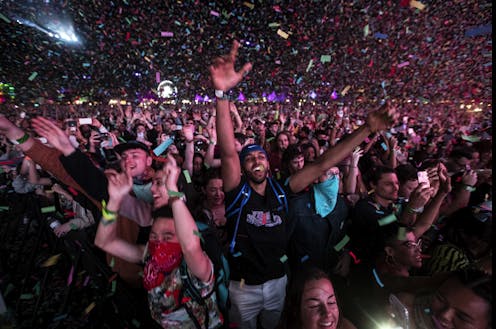
A new ad has been released from the LIVE Alliance (Live Industry Venues + Entertainment) a music industry collective, under the guidance of advertising veteran Russel Howcroft[1].
The campaign, Vax the Nation, is set to Powderfinger’s My Happiness. Here, the lyrics take on new meaning as we watch scenes of live music and connection, which seem like a lifetime ago.
The ad shows massive crowds at music festivals and live shows such as one by Elton John. We are swept up with the joy of connection and music as the lyrics remind us “it seems an age since I’ve seen you”. These engaging scenes are then brought to an abrupt end as newspaper headlines scream “lockdown looming”. The music stops. The tagline reads:
STOP THE INTERRUPTIONS. VAX THE NATION.
The ad, with moving music and engaging visuals is a powerful reminder of better times, however — as with all vaccine messaging — it has not been without controversy.
Guy Sebastian appeared to withdraw his support for the campaign, attracting criticism from many artists, before subsequently clarifying he is “pro-vax[2]”. Ben Lee suggested on Twitter Sebastian was trying to be “all things to all people[3]”, but the strength of Vax the Nation makes clear most of our artists want to stand in front of audiences again, and they believe vaccinations are the way to get there.
Government-driven campaigns, like “Arm Yourself” and the first campaign in January featuring Australia’s deputy chief medical officer Dr Nick Coatsworth, have been criticised[4] as being weak and ineffective. The root of the problem for these ads is a lack of emotion and a clear message.
It seems ads from the industries most hurt by lockdowns are better at capturing our emotions. These are the ads most likely to drive action, because they offer an answer to one crucial question: what might I gain by being vaccinated?
Read more: Australia's new vaccination campaign is another wasted opportunity[5]
The power of emotions
Vax the Nation clearly reminds us what we have lost, and what we have to gain. The call to action is clear: get vaccinated, and get back to the exhilaration of live music.
In a similar way, the recent Qantas ad presented emotive scenes of travel. A mother who wants to take her children to Disneyland; an isolated farmer wanting to see his daughter in London; a couple who want to marry with family and friends in Singapore. It tugs at our heartstrings as it shows us scenarios we identify with: by getting vaccinated, it suggests, we can get back to travel, and back together with those we love.
Another ad, from the Victorian arts industry, featuring the Melbourne Symphony Orchestra and performers such as Tim Minchin and Virginia Gay was also warmly received. It asks viewers to play their part and give “the performance of a lifetime”.
Soaring music and performances fill the screen as he states “we can’t wait to give you a standing ovation”. The ad is emotive, hopeful and successful in terms of people wanting to view the message again. So far, it has received over 182,000 views on YouTube.
A call to action
If the Arm Yourself and Dr Coastworth ads were criticised for their blandness, another government ad was criticised for using fear as a motivation. This recent campaign, directed at Sydney residents, featured a woman in hospital struggling to breathe.
It had a clear call to action — “Stay home. Get tested. Book your vaccination” — but the use of fear can have unintended consequences. Rather than promoting action, these ads are more likely to promote stigmatisation and distress[6].
Read more: Why the federal government's COVID-19 fear appeal to Sydney residents won't work[7]
The Qantas and Vax the Nation commercials have this call to action but focus on sharing important moments with those who are close to us: family and friends. They wouldn’t be as powerful if they showed someone on their way to a business meeting, or playing music alone.
They each tell us what we can gain from getting vaccinated. This is missing from the Arm Yourself campaign. Everyone wants to know what’s in it for me, or — at least, what’s in it for someone that matters to me. Despite spending millions, the government still can’t get the message right.
The job of encouraging increased vaccination rates has fallen to industries struggling the most with lockdowns and border closures.
Perhaps it is not really surprising those from the creative industries know how to move us and craft an engaging story; perhaps these creatives should have been asked to drive the advertising campaigns in the first place. It is wonderful to see these messages coming to the fore. But what a pity the government’s messaging isn’t stepping up to the plate.
Now, the government should take inspiration from the Vax the Nation, Qantas and the Victorian Arts Industry ads. Creativity and positivity are needed to inspire people to get vaccinated.
References
- ^ guidance of advertising veteran Russel Howcroft (mumbrella.com.au)
- ^ pro-vax (www.theguardian.com)
- ^ all things to all people (twitter.com)
- ^ have been criticised (theconversation.com)
- ^ Australia's new vaccination campaign is another wasted opportunity (theconversation.com)
- ^ stigmatisation and distress (theconversation.com)
- ^ Why the federal government's COVID-19 fear appeal to Sydney residents won't work (theconversation.com)